
Durga, Kali and Parvati are connected through narratives of manifestation, Goddess-centered theology and regional devotion. They can be understood as forms of one Devi in a Shakta setting, yet each also has distinctive stories, images and worship. The relationship is clearer when a particular account is named instead of treating the three names as interchangeable labels.
Kali’s emergence in the Devi Mahatmya
Chapter 7 of the Devi Mahatmya describes Kali appearing from Ambika’s brow as anger darkens her face. Kali kills Chanda and Munda and receives the name Chamunda. Chapter 8 continues her action against Raktabija alongside the other Goddess powers.
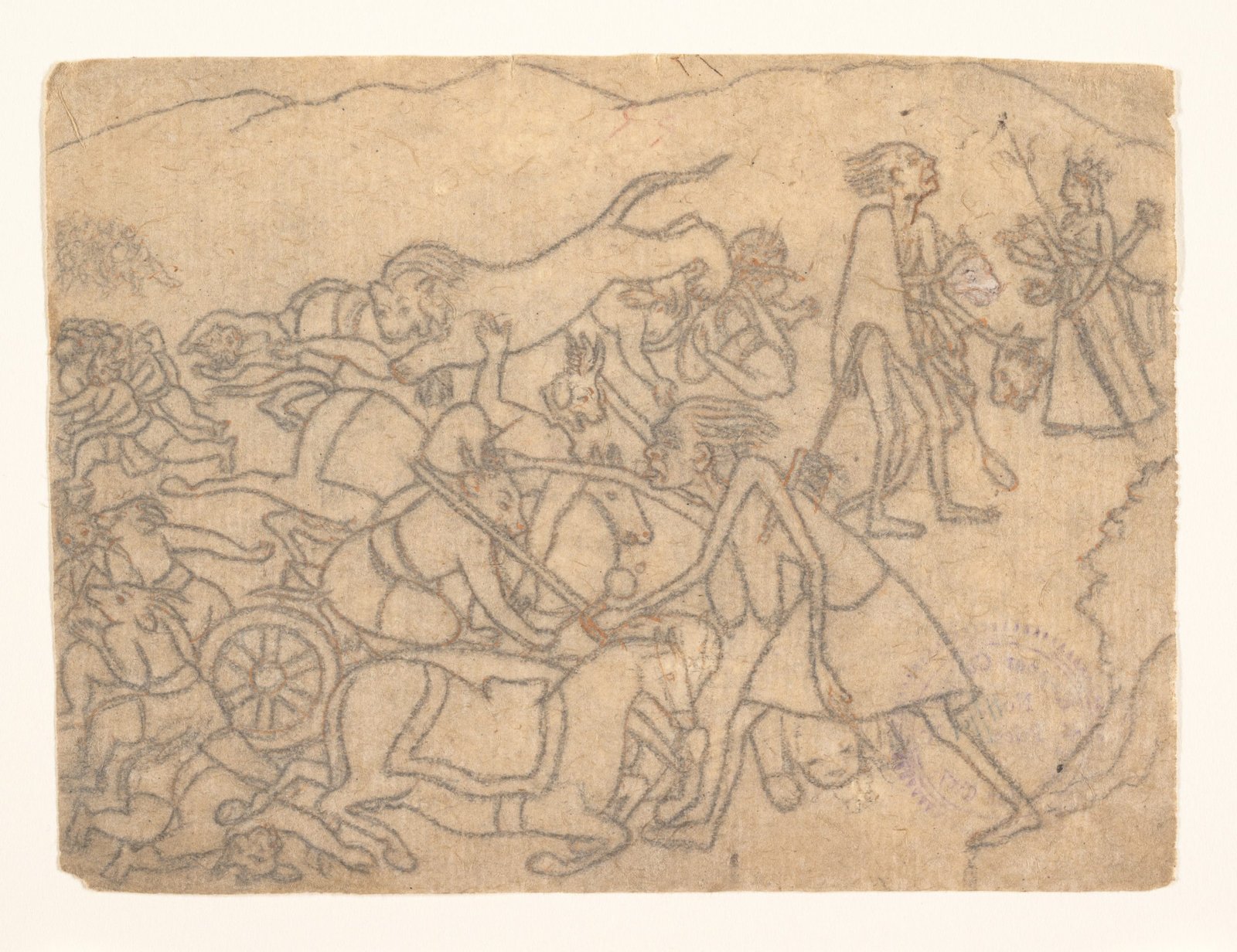
The drawing reproduced here, made in Guler about 1780, shows the encounter and the presentation of the severed heads. A sequence of actions is gathered into one scene. It provides a visual reading of this particular episode, rather than a general portrait of every form called Kali or Chamunda.
Parvati, Ambika and the names in the text
Chapter 5 gives another important transition. Parvati arrives while the gods are praising the Goddess; a form emerges from her bodily sheath and is called Kaushiki, while Parvati’s darkened form receives a further name. The text’s movement among names and manifestations is part of its theology and narrative craft.
When reading this passage beside chapter 7, keep the sequence and the names in view. A compressed modern summary can obscure which form is speaking or acting. Chapters 5, 7 and 10 should be read together before arranging them into a simple diagram of one Goddess producing another.
Many forms and one Goddess
Chapter 10 presents a declaration of the Goddess’s singularity and the withdrawal of other Goddess forms into her. This offers a textual basis for a Shakta understanding of multiplicity within one divine reality. It does not require every local image or named Goddess to lose its distinct ritual identity.
The terms “same” and “different” therefore need a context. They may refer to ultimate theological identity, appearance in a particular story, a temple’s principal deity or a devotee’s chosen form. Those are related questions, but they are not identical. A statement about theological unity cannot replace the documentation of a specific historical image.
Uma’s homecoming in Bengal
Bengali Durga Puja brings the victorious Goddess into the emotional world of a daughter’s return home. Belur Math’s account explains the Agamani songs through Menaka’s longing for Uma. This gives the relationship between Durga and Parvati a recognizable regional devotional form.
Family groupings can include Lakshmi and Saraswati alongside Ganesha and Kartikeya. That arrangement belongs to the festival’s account of the divine household; it should not be imposed as the universal genealogy of those Goddesses. The larger relationships hub distinguishes familial, narrative and theological ways of speaking.
Reading the forms in their own settings
The individual profiles of Durga, Kali and Parvati explain their attributes and worship in greater depth. The Shiva–Shakti guide separates Kali standing on Shiva from the battle emergence described here.
The selected Ya Devi verse praises the Goddess present in all beings as Shakti. Its devotional address helps readers approach a different register from narrative genealogy. Kali Puja and Navratri show why distinct forms and regional practices remain meaningful within broader Goddess devotion.
Sources and further reading
- Devi Mahatmya, chapters 5, 7–8 and 10; Sanskrit Documents text with provenance
- The Metropolitan Museum of Art, Kali Presenting the Heads of Chanda and Munda to Durga, Guler, ca. 1780
- Belur Math, Durga Puja at Belur Math; Agamani and Uma devotion
- Thomas B. Coburn, Encountering the Goddess, SUNY Press, 1991 (scholarly further reading)