
- Alternate names
- Maa Kali; Mahakali; Dakshina Kali; Bhadrakali; Shyama
- Traditions / lineages
- Shakta; Tantric traditions where specifically applicable; Bengali Shakta bhakti; Wider Hindu Goddess worship
- Scriptural associations
- Devi Mahatmya; Later Shakta Puranic and Tantric literature
- Festivals
- Kali Puja
- Temples
- Kalighat Kali Temple; Dakshineswar Kali Temple
On this page
Few Hindu deities are as easily recognized, or as frequently misunderstood, as Kali.
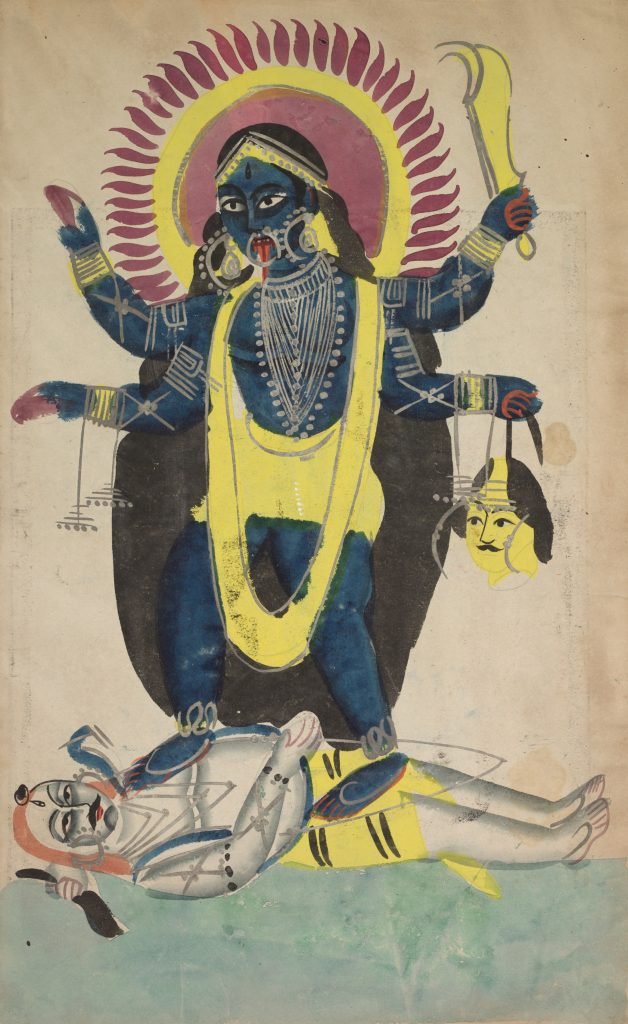
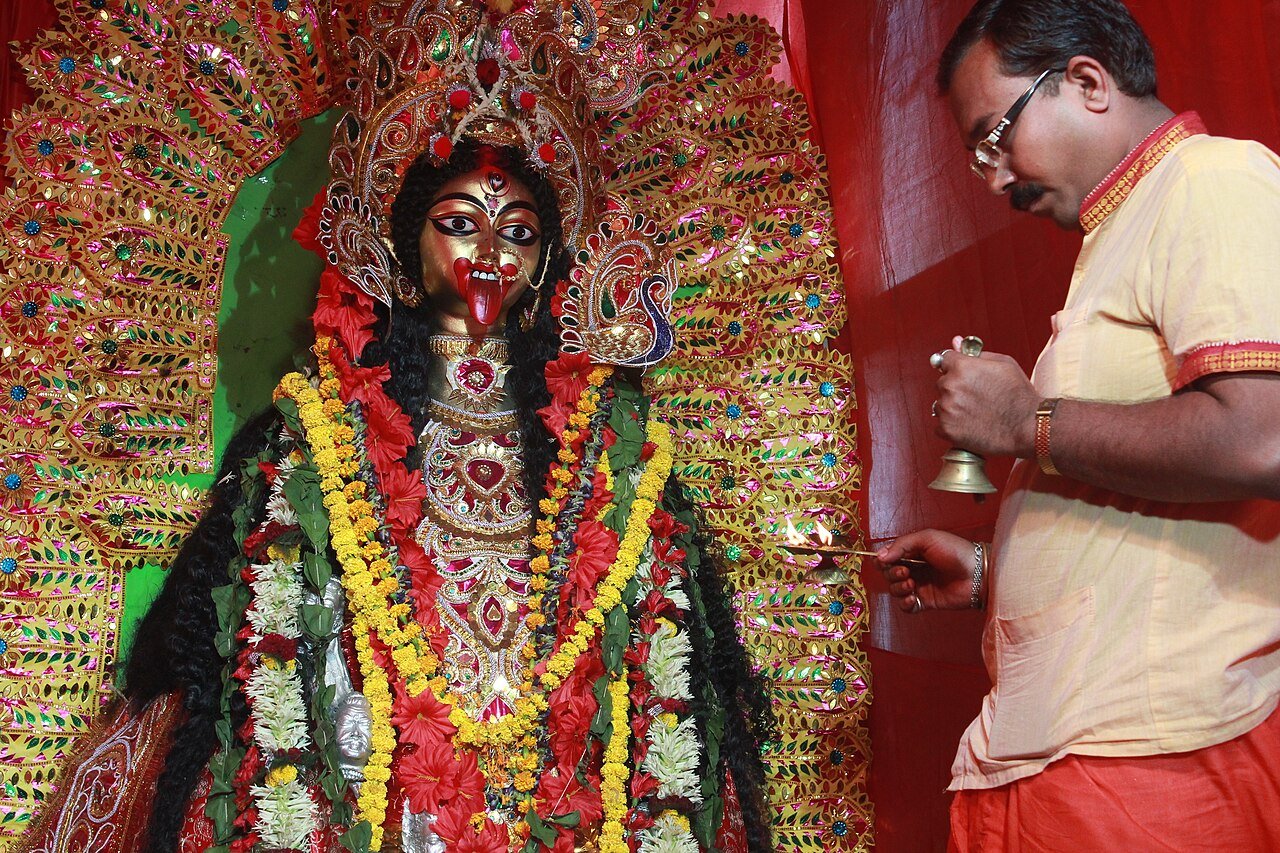
Her dark body, loose hair, protruding tongue, garland of severed heads, weapons and association with cremation grounds can appear terrifying when separated from the religious traditions that give these images meaning. Within Hindu worship, however, Kali is also approached as Mother, protector and supreme Goddess. Her devotees may address her with intimacy and affection even while her iconography confronts death, violence and impermanence.
Kali occupies several religious worlds at once. She appears in Sanskrit texts such as the Devi Mahatmya, became highly important in Tantric traditions, developed a particularly rich devotional culture in Bengal, and today is worshipped in temples and households across India, other parts of South Asia and the Hindu diaspora. Scholarship on Kali repeatedly emphasizes this range. She can appear as demon-slayer, Tantric Goddess, local temple deity and compassionate mother without any one of these roles completely defining her.
Understanding Kali therefore begins with context. Her fierce appearance is part of her identity, but it is only one part.
What Does the Name Kali Mean?
The Sanskrit name Kālī is commonly translated as “the black one” or “the dark one.”
Her name is related to the Sanskrit word kāla, a term whose meanings include black or dark and, in different contexts, time and death. These linguistic associations have contributed to later theological interpretations of Kali as a Goddess who stands in relation to time, mortality and the dissolution of all things.
These meanings should be handled carefully. A theological explanation of Kali as “Time itself” is richer than a simple dictionary translation and belongs within particular interpretive traditions.
Her dark complexion is a persistent feature of Kali’s iconography. Depending on the artistic tradition, she may appear black, deep blue, gray, or another very dark hue.
Formal transliteration:
Kālī
Devanagari:
काली
Kali in the Devi Mahatmya
One of Kali’s most influential early appearances occurs in the Devi Mahatmya, the celebrated Goddess text embedded in the Markandeya Purana.
The text does not introduce Kali through the familiar later image of a Goddess calmly standing on Shiva. Her appearance belongs to a battlefield.
During the conflict with the demons Shumbha and Nishumbha, two commanders named Chanda and Munda approach the Goddess. The Goddess becomes enraged, and a terrifying dark form emerges from her forehead.
This is Kali.
Her appearance intensifies the already fierce character of the battle. She attacks the demon forces and kills Chanda and Munda. After presenting their heads to the Goddess Chandika, she receives the name Chamunda, derived from the names of the two slain demons.
The episode establishes an important relationship between Kali and the larger Goddess tradition. Kali appears as a manifestation of the Goddess’s concentrated martial power rather than as an unrelated deity entering the story from outside it. Oxford’s overview of Kali describes her literary history as emerging through epic, Puranic and Tantric materials while retaining strong associations with raw martial power and liminal spaces.
Read about Durga and the Devi Mahatmya →
Kali and Raktabija
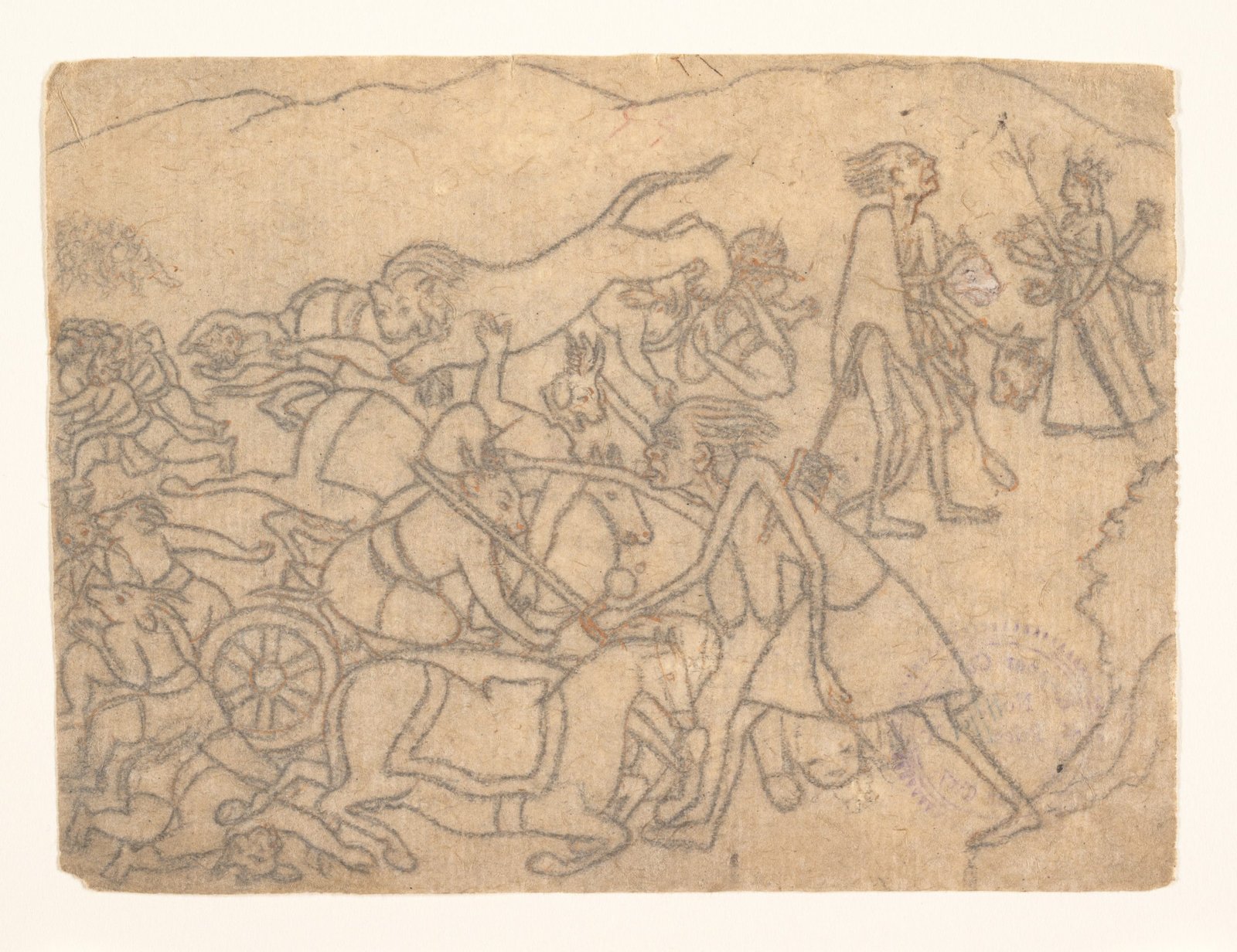
Kali’s role continues in the next phase of the Devi Mahatmya when the Goddess confronts Raktabija.
Raktabija possesses an unusual and dangerous power. When his blood falls to the ground, new versions of him arise from it. Ordinary attacks therefore multiply the threat.
Kali becomes essential to defeating him.
As the other divine powers strike Raktabija, Kali prevents his blood from reaching the ground by consuming it along with the newly produced demons. The multiplication finally stops and Raktabija can be destroyed.
This story is one source for Kali’s association with blood, but the narrative context is specific. Her fearsome action solves a cosmic problem that conventional warfare has made worse.
The episode should also be kept separate from the Mahishasura narrative. Mahishasura’s defeat and Raktabija’s defeat belong to different battles within the Devi Mahatmya.
Is Kali a Form of Durga?
Kali and Durga are closely connected, but a single universal formula does not describe their relationship in every Hindu tradition.
Within the Devi Mahatmya, Kali emerges during the Goddess’s battle and participates in the larger manifestation of Devi’s power. In that textual setting, Kali and the Goddess who confronts Shumbha and Nishumbha belong to a unified theological structure.
Other traditions may understand Kali in relation to Durga, Parvati, Mahadevi or Shakti in different ways.
Kali also has traditions in which her own identity is fully central. She is worshipped directly as supreme Goddess rather than simply as a subsidiary form of another deity.
This is particularly important in Kali-centered Shakta and Tantric traditions and in Bengali devotional religion.
Kali’s Appearance and Iconography
Kali’s iconography varies by period, region and theological tradition, but several features have become widely associated with her.
She may be shown with:
- a black or very dark complexion
- loose, disheveled hair
- a protruding tongue
- several arms
- a sword or curved blade
- a severed head
- a garland of heads or skulls
- a girdle or ornament associated with severed arms
- gestures of protection and blessing
- a standing or dancing posture over Shiva
- imagery connected with cremation grounds
The combination can appear contradictory. Hands that hold a sword and severed head may coexist with hands making abhaya, the gesture of reassurance or fearlessness, and varada, the gesture of giving or blessing.
This combination is part of Kali’s religious complexity.
She confronts death while offering refuge.
She is represented through frightening imagery while being addressed as Mother.
She appears in spaces associated with mortality while also being sought for protection and liberation.
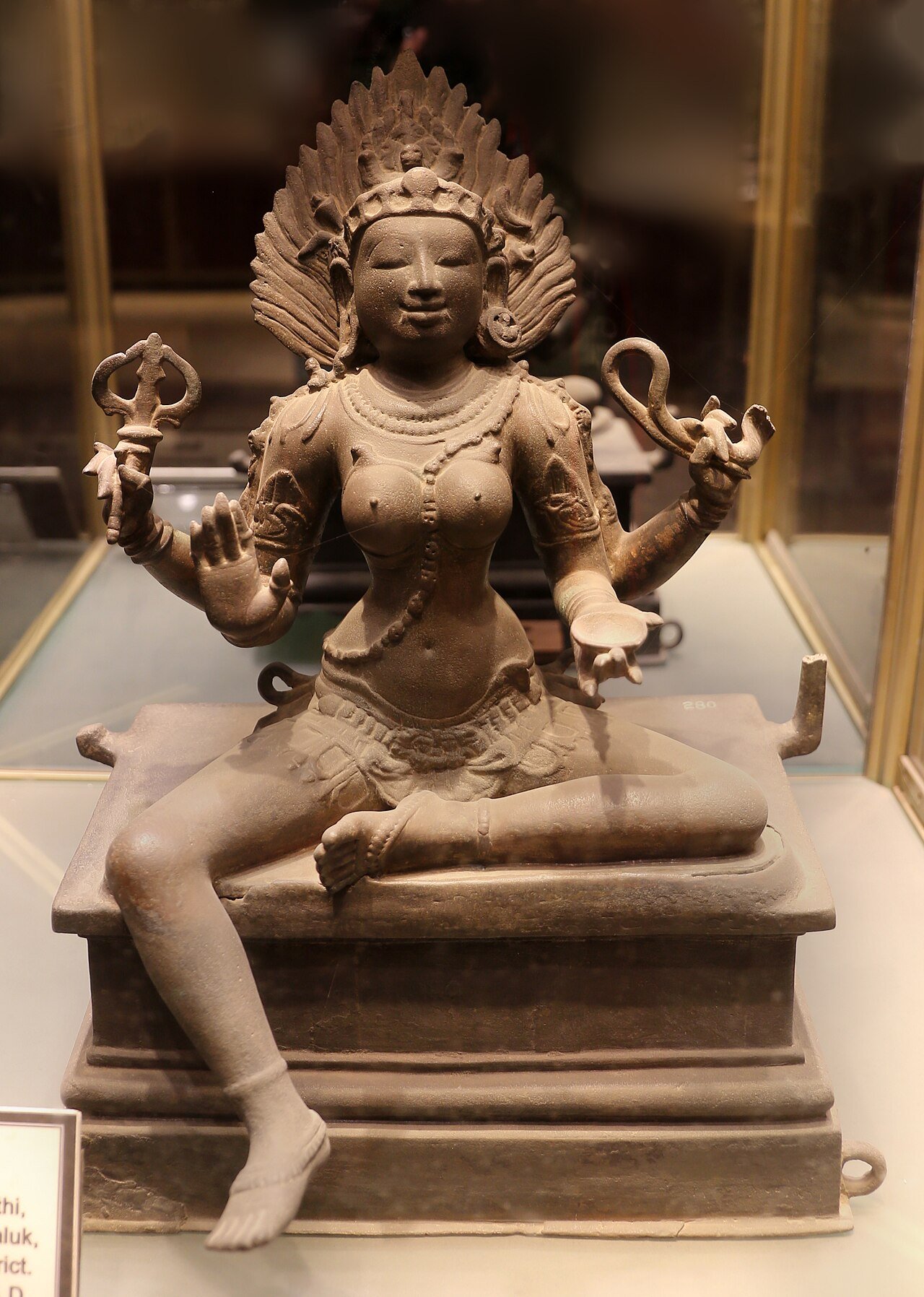
Indian collections preserve striking regional variations. A tenth-century Chola bronze from Tamil Nadu, documented through the Government Museum, Chennai, presents Kali seated with a comparatively serene expression despite fierce attributes such as weapons and a skull-related sacred cord. Such works show why one standardized modern image cannot represent the whole history of Kali iconography.

Why Does Kali Stand on Shiva?
One of the most familiar modern images of Kali shows her standing on the prone body of Shiva.
Several narratives and theological interpretations explain this image, and they should not be collapsed into a single origin story.
A widely circulated devotional account describes Kali becoming uncontrollable after battle. Shiva lies down in her path, and when she steps upon him she becomes aware of what has happened. Her extended tongue is then interpreted as a gesture of shock, embarrassment or sudden self-awareness.
This explanation is popular, but it should not be presented as though it were the account given in the Devi Mahatmya. The familiar Kali-on-Shiva icon developed through later textual, Tantric, artistic and devotional traditions.
Other interpretations emphasize theology rather than narrative. Kali represents active divine power, Shakti, while Shiva beneath her can represent consciousness or the still principle upon which that power acts.
Later Shakta texts also developed narratives explaining specific forms such as Dakshina Kali. Scholarship on the Mahabhagavata Purana, for example, identifies a later medieval Shakta narrative explaining the origin of an image in which Kali stands on Shiva’s chest.
The image should therefore be read within the tradition and period in which it appears.
Kali as Divine Mother
Kali’s fierce visual form can obscure an equally important aspect of her worship: Kali as Mother.
This is especially prominent in Bengal.
From the eighteenth century onward, Bengali Shakta devotional poetry developed an intensely personal relationship with the Goddess. Poets could complain to Kali, plead with her, tease her, accuse her of neglect and surrender completely to her care.
Ramprasad Sen, an eighteenth-century Bengali Shakta poet, became one of the most influential voices in this devotional tradition. Scholarship on Bengali Shakta poetry traces how Kali’s Tantric and fierce dimensions were increasingly brought into intimate forms of bhakti in which she could be approached as a loving, unpredictable and deeply personal Mother.
The title Maa Kali, Mother Kali, is therefore not merely a modern attempt to soften a frightening deity. Maternal devotion has a substantial history within Kali worship.
This devotional perspective also helps explain why interpretations based only on horror, violence or destruction fail to capture how many devotees actually experience her.
Kali and Tantra
Kali is strongly associated with Tantric traditions, particularly with streams of Shakta Tantra that engage themes of death, liminality, the body, ritual power and the transcendence of conventional boundaries.
Her cremation-ground imagery became especially significant in some of these contexts.
Tantric traditions sometimes deliberately work with symbols that conventional social life treats as dangerous, impure or frightening. The religious purpose cannot be reduced to shock. Such practices may be concerned with confronting fear, breaking habitual distinctions, realizing non-duality, or transforming the practitioner’s understanding of reality.
Kali became especially prominent in certain left-hand Tantric traditions, but not every Kali devotee is a Tantric practitioner. Oxford’s survey of Kali scholarship makes this distinction clear by treating her Tantric, regional, temple and maternal devotional traditions separately.
It is therefore inaccurate to describe Kali worship generally as “Tantric worship.”
Tantra is one major part of Kali’s history, not the whole of it.
Kali and the Mahavidyas
Kali is also one of the Mahavidyas, a group of ten Goddesses prominent in Shakta Tantric traditions.
The commonly listed ten are:
- Kali
- Tara
- Tripurasundari
- Bhuvaneshwari
- Bhairavi
- Chinnamasta
- Dhumavati
- Bagalamukhi
- Matangi
- Kamala
Kali is commonly placed first in the sequence, although individual traditions may interpret the group and its internal relationships differently.
The Mahavidyas include Goddesses whose appearances range from beautiful and regal to unsettling and deliberately transgressive. Taken together, they express a broad range of approaches to divine feminine power.
Kali’s place among them reinforces her importance within Shakta Tantra, but her religious identity extends well beyond the Mahavidya system.
Kali in Bengal
Bengal has played an especially important role in the development of Kali worship.
The region’s Shakta traditions brought together Tantra, temple worship, household devotion, poetry, festivals and local forms of the Goddess.
Two important Kali temples in and around Kolkata illustrate this living devotional world.
Kalighat
Kalighat Kali Temple is one of Kolkata’s best-known sacred sites. West Bengal Tourism describes it as an important Shakti Peetha and identifies its distinctive image of Kali with the temple’s long devotional history. The temple remains especially active during Kali Puja and other major sacred days.
Kalighat also gave its name to the celebrated nineteenth-century Kalighat painting tradition. Artists working around the pilgrimage market produced watercolor paintings for visitors, including images of popular Hindu deities and scenes of contemporary Bengali life.
The Indian Museum in Kolkata preserves a Kalighat painting from 1889 showing Kali dancing on Shiva. It provides an especially useful visual connection between pilgrimage, popular art and Kali worship in colonial-era Calcutta.
Dakshineswar
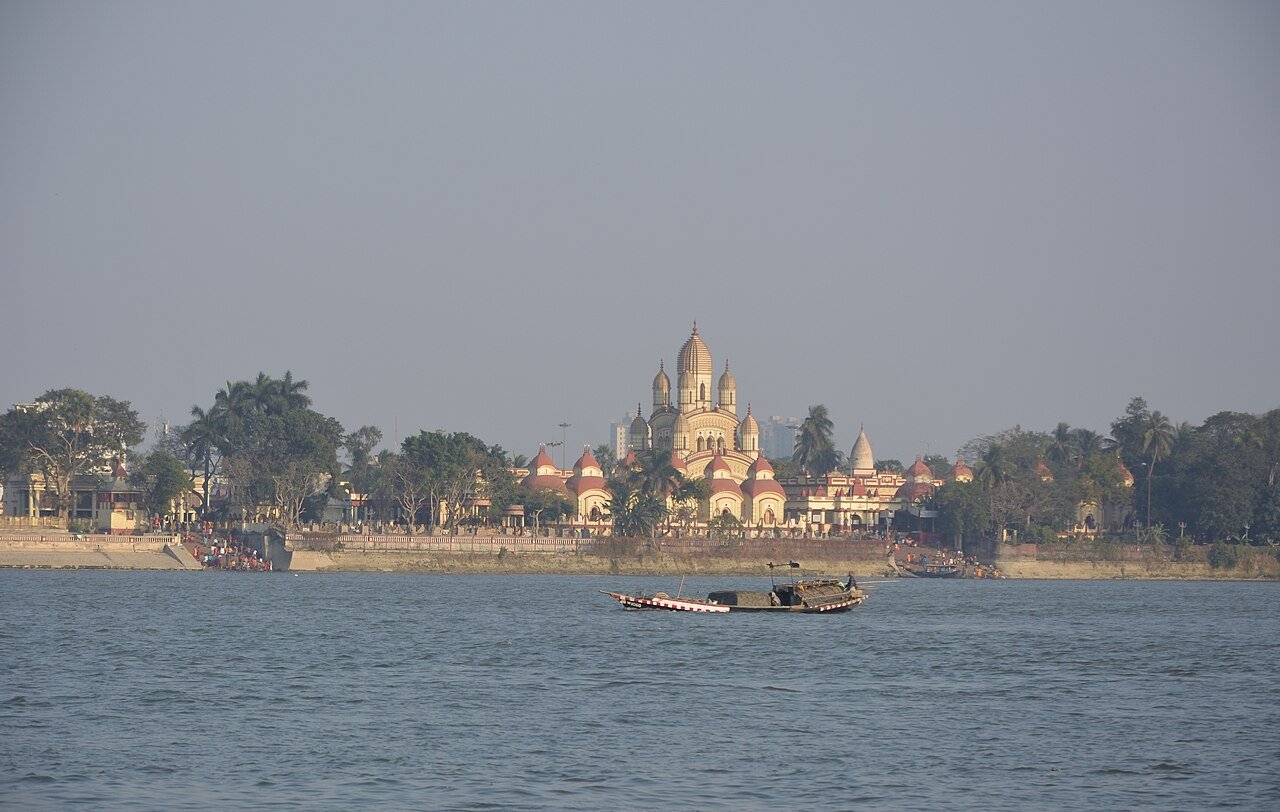
The Dakshineswar Kali Temple, founded by Rani Rashmoni and consecrated in 1855, is dedicated to Bhavatarini, a form of Kali. The temple’s nine-spired architecture represents a recognizable Bengali temple style.
Dakshineswar became closely associated with Sri Ramakrishna, who served as a priest there and developed an intense devotional relationship with Kali as Divine Mother. The Ramakrishna tradition describes his worship of Kali as central to his spiritual life.
Together, Kalighat and Dakshineswar illustrate how Kali exists through particular places and communities, not only through Sanskrit theology or historical iconography.

Kali Puja
Kali Puja is one of the major festivals centered on the Goddess, especially in Bengal and Bengali communities.
It is generally observed during the autumn festival season around the new moon associated with Diwali and Dipavali observances in many parts of India.
Public images of Kali, household worship, temple rituals, offerings and community celebrations become especially visible at this time.
Kali Puja has its own ritual calendar and regional history within the autumn festival season.
Kali Puja is a distinct festival tradition and should not be conflated with Durga Puja or Navratri.

Is Kali the Goddess of Death?
Kali certainly has strong associations with death.
She appears in cremation-ground imagery, wears symbols connected with severed bodies, and confronts the physical realities that ordinary social life often tries to keep at a distance.
Yet the label “Goddess of Death” is too narrow if used as a complete definition.
Death in Kali traditions can be connected with time, change, impermanence, ego, liberation and the limits of embodied existence. Her destructive imagery may be understood within larger theological frameworks in which creation and dissolution belong to the same divine reality.
For devotees who worship her as Mother, Kali’s relationship with death does not make her malevolent. Her power over death may itself become a source of refuge.
Academic work on Kali has emphasized precisely this tension. She inhabits categories that might otherwise seem incompatible: death and motherhood, terror and protection, marginality and central religious devotion.
Is Kali Evil?
No Hindu theological category equivalent to the modern popular idea of an “evil goddess” adequately describes Kali.
Her imagery can be frightening, and several texts place her amid violence, demons, blood and cremation grounds. The religious narratives in which these features appear, however, generally present her power as directed toward forces that threaten cosmic or spiritual order.
Western descriptions of Kali have not always preserved that context. Colonial, missionary and later popular representations sometimes used her violent imagery as evidence of supposedly irrational or barbaric religion. Modern media have continued some of these distortions.
Scholarship on Kali specifically examines how dramatically her image changed when removed from South Asian religious settings and reinterpreted through Western cultural assumptions.
The better question is not whether Kali is “good” or “evil,” but what her imagery means within the Hindu traditions that worship her.
What Does Kali Represent?
There is no single symbolic key that explains Kali.
Different traditions have understood her through ideas including:
- divine power
- protection
- destruction of demonic forces
- time
- mortality
- transformation
- liberation
- the dissolution of ego and limitation
- maternal compassion
- the transcendence of conventional boundaries
These meanings come from different textual, ritual and philosophical settings.
Modern explanations sometimes turn each part of Kali’s body into a fixed psychological symbol. A severed head may be described as ego, a sword as knowledge, and her darkness as infinite consciousness, for example. Such interpretations can be valuable within particular teachings, but they should be identified as interpretations rather than assumed to be universal ancient definitions.
DurgaShakti approaches Kali’s iconography historically first, then explain traditional and philosophical interpretations where reliable sources support them.
Kali Today
Kali continues to be worshipped as a living deity.
Devotees encounter her in famous temples such as Kalighat and Dakshineswar, in regional shrines, household worship, festival images, poetry, sacred music and personal devotional practice.
Her imagery has also traveled far beyond its original religious settings. Kali appears in modern art, feminist interpretation, psychology, popular spirituality, literature and global media.
These reinterpretations can be culturally significant, but they should remain distinguishable from Hindu devotional traditions.
For many worshippers, Kali is neither primarily a symbol nor an intellectual idea.
She is Maa Kali, a deity with whom a devotee can form a personal relationship.
That living devotional identity belongs beside the battlefield stories, Tantric theology and historic iconography when trying to understand who Kali is.
Continue Exploring
Goddess traditions
Texts and traditions
Living practice
Sources & Further Reading
Primary textual foundation
Devi Mahatmya, within the Markandeya Purana
Especially relevant:
- Kali’s emergence during the Chanda and Munda battle
- the origin of the name Chamunda
- the Raktabija episode
- the relationship between Kali and the larger Goddess manifestation
A reputable scholarly translation should be used when verse-level citations are added.
Academic scholarship
Noor van Brussel and Marianne Pasty-Abdul Wahid, “Kālī,” Oxford Bibliographies in Hinduism.
Useful for Kali’s:
- Sanskrit literary history
- Puranic traditions
- Tantric history
- Bengali bhakti
- temple and regional worship
- changing interpretations outside South Asia
Rachel Fell McDermott and Jeffrey J. Kripal, eds., Encountering Kālī: In the Margins, at the Center, in the West.
Useful for:
- South Asian contexts
- iconography
- Tantra
- Bengal
- Western reinterpretations of Kali
Rachel Fell McDermott, Mother of My Heart, Daughter of My Dreams: Kali and Uma in the Devotional Poetry of Bengal.
Useful for:
- Bengali Shakta bhakti
- Ramprasad Sen
- Kali as Mother
- historical development of Bengali Goddess devotion
Rachel Fell McDermott, Singing to the Goddess: Poems to Kali and Uma from Bengal.
Useful for the development and devotional language of Bengali Kali worship.
Indian museum and cultural sources
Museums of India, Indian Museum, Kolkata
Kalighat painting depicting Kali dancing on Shiva, 1889.
Useful for:
- Bengali popular sacred art
- Kalighat painting
- Kali-Shiva iconography
Museums of India, National Museum, New Delhi
Eighteenth-century illustrated folio depicting Kali standing on Shiva with multiple arms and weapons.
Useful for:
- historical painted iconography
- Kali-Shiva imagery
- regional variation
Government Museum, Chennai / Virtual Museum of Images and Sounds
Chola-period Kali images from Tamil Nadu.
Useful for:
- South Indian Kali iconography
- demonstrating that Kali traditions are not exclusively Bengali
- differences between later Bengali and earlier South Indian representations
Victoria Memorial Hall, Kolkata / Museums of India
Historic paintings of Kali from Bengal.
Useful for nineteenth and early twentieth-century Bengali visual culture.
Living tradition sources
Department of Tourism, Government of West Bengal
Useful for Kalighat Temple, its living worship and regional context.
Incredible India / Ministry of Tourism, Government of India
Useful for Dakshineswar Kali Temple, architecture and the Bhavatarini tradition.
Ramakrishna Math and Ramakrishna Mission
Useful specifically for Ramakrishna’s devotional relationship with Kali at Dakshineswar.