

- Alternate names
- Uma; Gauri; Haimavati; Girija; Aparna; Ambika; Shailaja
- Traditions / lineages
- Shaiva; Shakta where contextually appropriate; Broader Hindu Goddess traditions; Regional Himalayan traditions
- Scriptural associations
- Epic and Puranic literature; Shaiva Agamas; Later regional narratives including Nepalese Swasthani tradition
On this page
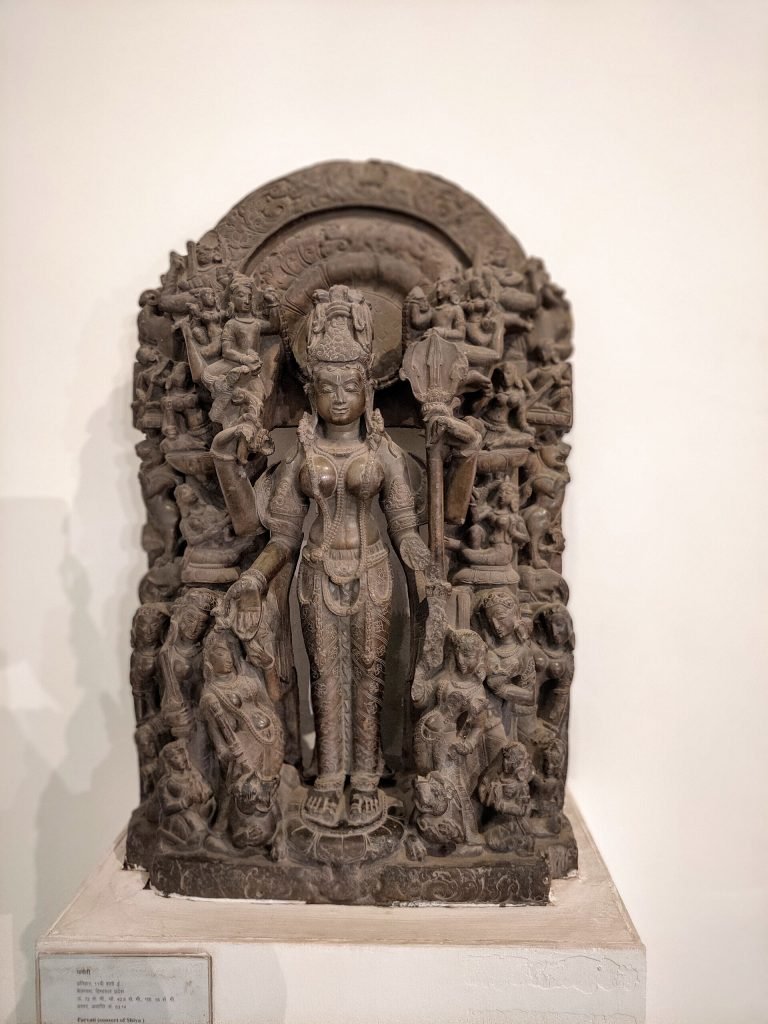
Parvati is one of the central goddesses of Hindu tradition. She is widely known as the wife of Shiva and the mother of Ganesha and Kartikeya, but her religious identity extends well beyond those family relationships.
Her stories present her as a determined ascetic, devoted partner, mother, teacher and manifestation of divine power. In some traditions she appears as gentle Uma or Gauri. In others, her relationship with fierce forms such as Durga and Kali becomes important. She is also central to the theology of Shiva and Shakti, where divine consciousness and divine power are understood as inseparable.
The name Parvati means, in a straightforward sense, “daughter of the mountain.” Her mythology identifies her as the daughter of Himavat, the personification of the Himalayas, and Mena. Her connection with mountains, austerity and Shiva’s own ascetic identity gives her stories a distinctive landscape and emotional texture.
Oxford’s overview of Parvati emphasizes these multiple dimensions. She is Shiva’s wife, mother of Ganesha and Skanda, a disciplined ascetic in her own right, and a major expression of the benign side of Mahadevi.
What Does the Name Parvati Mean?
The Sanskrit name Pārvatī means “she of the mountain” or “daughter of the mountain.”
Devanagari:
पार्वती
IAST:
Pārvatī
The name reflects her mythological birth as the daughter of Himavat, the Himalaya mountain, and his wife Mena.
Several of Parvati’s other names preserve related ideas.
Girija means “mountain-born.”
Haimavati connects her with Himavat.
Shailaja also means “daughter of the mountain.”
Other names emphasize different aspects of her identity. Uma is one of her most ancient and widely used names, while Gauri often evokes brightness, beauty and auspicious femininity.
These names are not always interchangeable in every text or ritual setting, so DurgaShakti should identify the context when a specific form or epithet matters.
Parvati and Sati
Many classical narratives connect Parvati with Sati, Shiva’s earlier wife.
In Puranic traditions, Sati is born as the daughter of Daksha and marries Shiva despite her father’s hostility toward him. Daksha later performs a sacrifice and deliberately excludes Shiva. Sati attends and, according to the narrative tradition being followed, ultimately gives up her body in response to the insult and conflict surrounding the sacrifice.
She is later reborn as Parvati.
This rebirth establishes continuity between Sati and Parvati while also allowing Parvati to develop her own distinctive mythology.
Parvati’s story begins in the Himalayan household of Himavat and Mena, and her path toward Shiva becomes one of the best-known narratives of devotion and ascetic discipline in Hindu literature.
The relationship between Sati and Parvati develops across epic and Puranic traditions and should not be compressed into one supposedly universal version. Oxford’s overview identifies Parvati’s emergence in classical literature as the reincarnation of Sati and notes how these stories became foundational for later art and devotion.
Parvati’s Austerities for Shiva
One of Parvati’s defining qualities is tapas, disciplined ascetic practice.
Shiva is frequently represented as the great yogi, withdrawn from ordinary household life. Parvati’s desire to marry him therefore leads not through courtly romance alone but through intense spiritual discipline.
Puranic narratives describe her undertaking austerities in the mountains, gradually demonstrating a resolve equal to Shiva’s own ascetic power.
This is one reason the common modern image of Parvati as only a gentle wife or mother is incomplete.
She is also a tapasvini, a female ascetic.
Oxford’s scholarly overview specifically identifies Parvati’s austerities as a major part of her mythic profile and emphasizes that she possesses disciplined ascetic agency rather than functioning only as Shiva’s passive companion.
The theme also survives in South Asian regional traditions. The Swasthani Vrata Katha, especially important in Nepal, includes episodes in which Parvati performs austerities in pursuit of Shiva and participates actively in sacred narratives tied to Himalayan places.
The Marriage of Shiva and Parvati
The marriage of Shiva and Parvati is one of the most important divine marriage narratives in Hindu tradition.
It brings together two apparently different religious ideals.
Shiva is the ascetic, associated with mountains, cremation grounds, meditation and withdrawal.
Parvati embodies household life, fertility, relationship and continuity, but she has also proven herself through ascetic discipline.
Their marriage therefore does more than create a divine household. It brings asceticism and domestic life into relationship.
This tension appears repeatedly in their mythology. Shiva may withdraw into meditation; Parvati draws him into family life. Parvati may challenge Shiva intellectually, tease him, question him or participate with him in divine play.
The marriage became an important subject in Indian sculpture, painting, ritual and local sacred geography.
Some temples and pilgrimage sites maintain regional traditions identifying particular places with the wedding of Shiva and Parvati. Government of India tourism material, for instance, records such a local tradition at Baijnath in Uttarakhand. Such claims should be presented as local sacred tradition rather than as historical proof that a mythological event occurred at one exclusive physical site.
Parvati and Shiva
Parvati’s relationship with Shiva is among the most developed divine partnerships in Hindu mythology.
She is frequently shown beside him, seated with him on Mount Kailash, listening to his teachings, engaging him in conversation or appearing with him and their children.
Historical paintings preserve this intimacy in many ways. A late eighteenth-century Rajasthani painting in the National Museum shows Parvati seated before Shiva while he teaches, while other works show them together with devotees or with their sons.
Their relationship also carries theological meaning.
Within Shaiva traditions, Parvati may be identified as Shiva’s Shakti, the power through which divine consciousness acts.
Within Shakta traditions, the direction of dependence may be described differently, with Shakti understood as supreme.
The couple therefore belongs simultaneously to mythology, household devotion and sophisticated philosophical traditions.
Ardhanarishvara: Shiva and Parvati in One Body
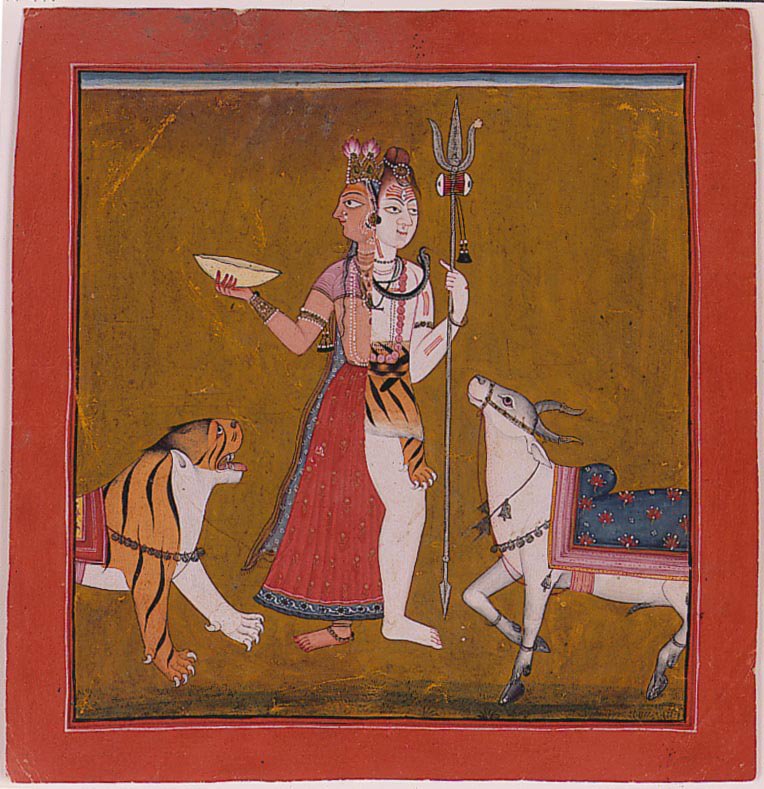
The relationship between Shiva and Parvati reaches one of its most striking visual expressions in Ardhanarishvara, the composite deity whose body combines male and female halves.
The name is commonly translated as “the Lord who is half woman.”
In many representations, Shiva occupies the right side and Parvati the left. Iconographic details distinguish them through hairstyle, clothing, body form, jewelry and attributes.
Oxford’s overview of Ardhanarishvara notes that the female half is variously identified as Parvati, Gauri, Uma, Shiva or Shakti and that the image developed with regional and canonical variation.
The image has generated many later philosophical interpretations concerning unity, gender, consciousness and power.
It is best approached first through its actual textual and iconographic traditions rather than treated as a universal ancient statement that “masculine and feminine energies must be balanced.”
A Rajasthan painting in the National Museum, New Delhi, depicts Ardhanarishvara as a single composite figure holding attributes associated with Shiva and Parvati.
Read about symbols and philosophy →

Parvati as Mother of Ganesha
Parvati is closely associated with Ganesha, one of Hinduism’s most widely worshipped deities.
The story of Ganesha’s birth has several versions, but a widely known Puranic narrative describes Parvati creating him independently while Shiva is absent. Ganesha guards her privacy and refuses Shiva entry. The conflict ends with Ganesha losing his head and later receiving the head of an elephant.
This story places Parvati at the center of Ganesha’s origin.
She creates him, establishes his role as guardian and demands his restoration after the conflict with Shiva.
The narrative is especially important because it shows Parvati exercising creative power independently.
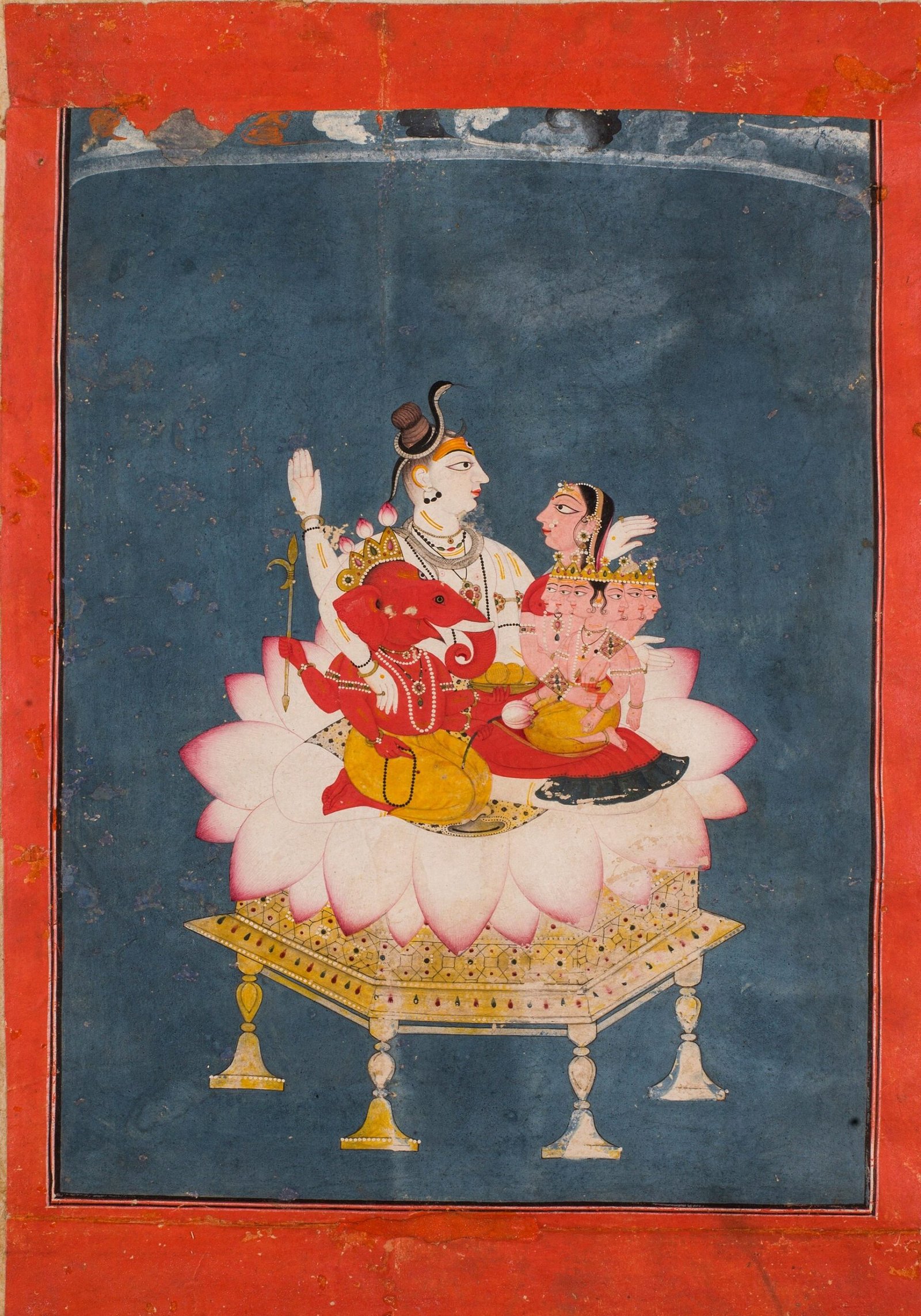
Later art often presents Ganesha within a divine family setting alongside Parvati and Shiva.
The National Museum’s eighteenth-century Pahari painting known as The Holy Family shows Shiva and Parvati together with Ganesha and Kartikeya in an intimate family composition.
Parvati and Kartikeya
Parvati is also the mother of Kartikeya, known by names including Skanda and, especially in South India, Murugan.
His birth stories differ substantially among Sanskrit and regional traditions. Some emphasize the extraordinary divine circumstances required for Shiva’s powerful offspring to come into being, while others develop distinct regional mythologies.
In Tamil traditions, Murugan has an especially important religious identity of his own.
Parvati’s relationship with both sons contributes to her role in divine-family imagery, yet Ganesha and Kartikeya should not be treated merely as supporting characters in her biography. Each has independent traditions extending well beyond the family framework.
Historical images nevertheless show how important the family grouping became. The National Museum’s Pahari painting of Shiva, Parvati, Ganesha and Kartikeya presents the divine family together in a composition from around 1750.

Parvati, Durga and Kali
Parvati’s relationship with Durga and Kali is significant, but it changes according to text and tradition.
Later Hindu traditions frequently identify Durga as a powerful or martial form of Parvati.
Kali may also be connected with Parvati through stories in which a fierce Goddess emerges from her body or anger.
The Devi Mahatmya, however, develops its Goddess theology in ways that cannot always be reduced to a simple Parvati family tree.
This distinction matters because modern diagrams often present:
Parvati → Durga → Kali
as though Hindu Goddess traditions were arranged in one fixed hierarchy.
Actual textual traditions are more varied.
Parvati can be understood as a manifestation of Mahadevi, while Durga or Kali may occupy the supreme position in another theological setting.
The shared idea of Shakti connects these traditions without requiring every Goddess to be reduced to a single genealogical formula.
Learn about Durga →
Learn about Kali →
Explore Forms of Devi →
Parvati as Goddess of the Household
Parvati occupies an especially strong place in Hindu ideas about marriage and household life.
She is often invoked as a devoted wife and mother, and stories of her relationship with Shiva have influenced religious ideals surrounding marriage.
Care is needed here.
Religious ideals involving divine marriage have been interpreted in many ways across history, and Parvati should not be turned into a simple behavioral model for contemporary women.
Her mythology includes devotion, but also resolve, ascetic independence, argument, desire, anger and intellectual participation.
She does not merely follow Shiva.
She pursues him through her own tapas, challenges him in narrative traditions, participates in divine teaching and appears as his Shakti.
Oxford scholarship specifically cautions against reading Parvati only through the lens of the ideal wife. Her myths contain a much broader range of religious roles.
Parvati as Teacher and Disciple
Shaiva and Tantric literature frequently places Parvati in dialogue with Shiva.
In some texts she asks questions and receives teachings concerning yoga, ritual, philosophy or sacred practice.
In other traditions the relationship is more reciprocal, and the Goddess herself becomes a source of knowledge.
Oxford’s overview notes that Agamic traditions portray Parvati as Shiva’s principal disciple to whom esoteric teachings are transmitted.
This teacher-disciple framework became an important literary device in Shaiva and Tantric texts.
It also complicates any attempt to treat Parvati only as a domestic deity. Her presence extends into theological and esoteric literature.
Parvati in Dance and Art
Parvati appears frequently in Indian sculpture, painting and dance traditions.
She may be shown:
- standing beside Shiva
- seated with Shiva on Kailash
- holding a lotus or mirror
- performing austerities
- participating in marriage scenes
- with Ganesha and Kartikeya
- as part of Ardhanarishvara
- watching Shiva Nataraja’s dance
- performing the graceful lasya tradition associated with feminine dance
Oxford’s Parvati overview notes early images from places including Mathura, Ellora and Tanjore and identifies the lotus and mirror among recurring attributes. It also discusses her presence in Indian dance traditions.
A nineteenth-century Tanjore painting in the National Museum shows Shiva and Parvati seated on Mount Kailash while devotees approach them.
Another Tanjore painting shows Parvati and other deities watching Shiva as Nataraja.
Such works reveal the variety of roles available to Parvati in Indian visual culture.
Parvati and the Himalayas
Mountains are built into Parvati’s identity.
She is the daughter of Himavat and is closely associated with Kailash, Shiva’s mythic mountain abode.
The Himalayas therefore function as more than scenery in her stories.
They connect:
- her birth
- her austerities
- Shiva’s ascetic world
- divine marriage
- pilgrimage
- sacred geography
Regional traditions in India and Nepal continue to place Shiva-Parvati narratives within actual Himalayan landscapes.
Recent scholarship on Nepal’s Swasthani Vrata Katha, for example, documents narratives in which Parvati undertakes austerities, interacts with Shiva in Nepal’s sacred geography and appears within traditions connected to the Bagmati River, Gaurighat and Shleshmantak forest.
These regional traditions add another dimension to Parvati’s identity as daughter of the mountain.


Parvati in Nepalese Tradition
Parvati occupies an important place in Nepal’s Shaiva and Goddess traditions.
One particularly rich example is the Swasthani Vrata Katha, a devotional narrative tradition widely associated with Nepal.
Its stories weave Shiva and Parvati into local sacred geography and describe episodes of austerity, marriage, disguise, pilgrimage and divine intervention.
Recent scholarship and translation of the Swasthani Vrata Katha documents Parvati performing austerities, showing compassion toward devotees and participating actively in narratives situated around places such as the Bagmati River and Shleshmantak forest.
Including Nepalese material is valuable because Parvati’s living traditions extend beyond modern India’s national borders.
These Nepalese traditions need to be understood in their own regional context.

Parvati in Temple Traditions
Parvati’s presence is widespread in Shiva temples even where the temple is not named specifically for her.
Oxford’s overview notes that relatively few major temples are dedicated exclusively to Parvati compared with the enormous number of Shiva temples in which she appears.
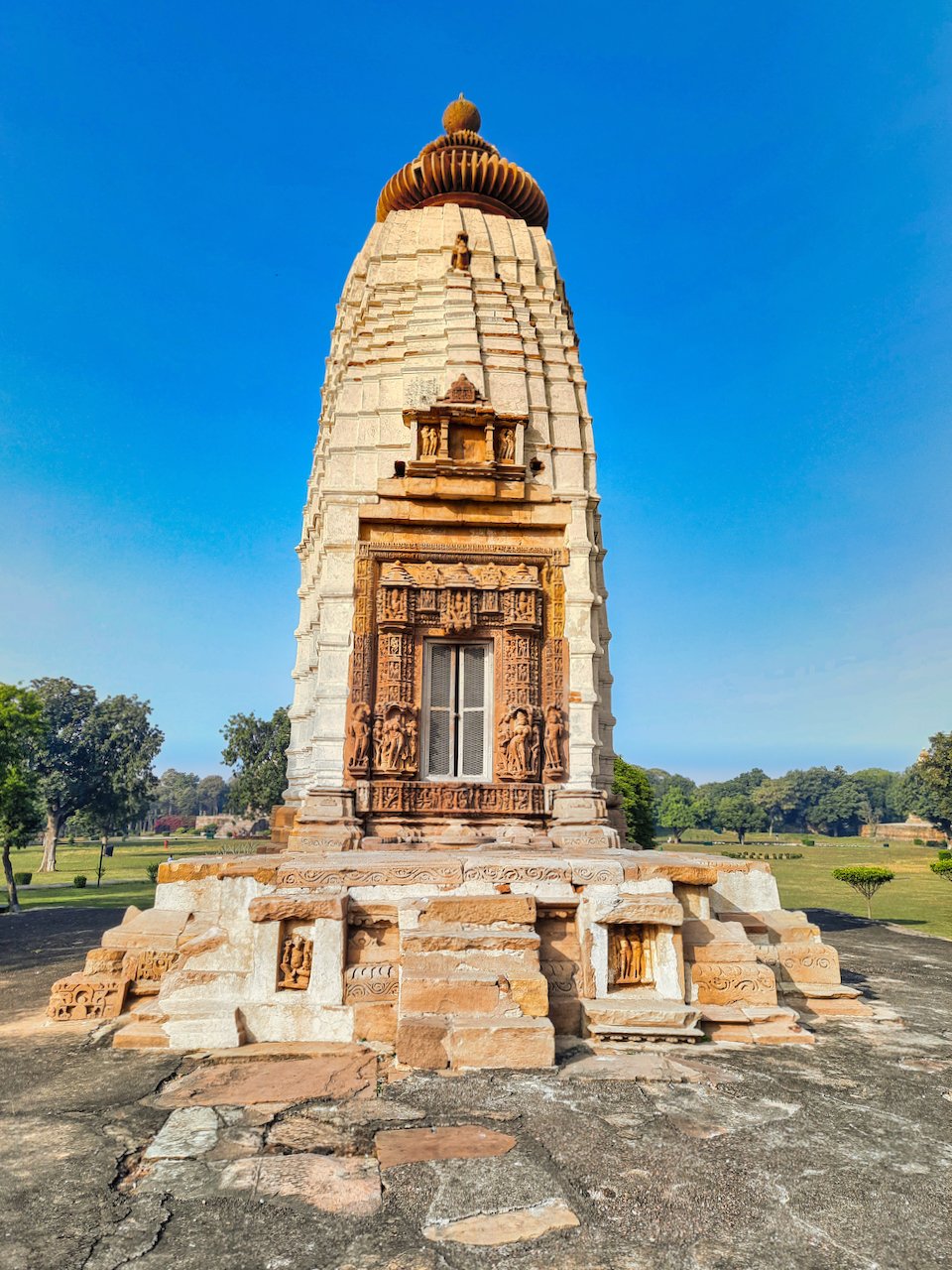
There are, however, temples dedicated to particular forms of Parvati and Gauri.
The Parvati Temple at Khajuraho provides a historic example. Government of India tourism documentation identifies the shrine within the Western Group of Khajuraho temples and notes its image of Gauri.
At the Baijnath temple complex in Uttarakhand, Parvati appears within a broader sacred landscape that also includes Shiva, Ganesha, Kartikeya and other deities.
These examples show how Parvati appears both independently and within larger Shaiva sacred environments.

What Does Parvati Represent?
Parvati’s traditions bring together several themes that may initially appear unrelated.
She is associated with:
- devotion
- ascetic discipline
- marriage
- motherhood
- fertility
- household life
- divine power
- sacred knowledge
- mountain landscapes
- Shiva-Shakti theology
Her religious identity is especially interesting because she connects the ascetic and domestic worlds.
She chooses Shiva, a deity identified strongly with renunciation, yet she also establishes divine household life around him.
She is represented as an ideal partner while possessing ascetic and theological authority of her own.
She appears gentle in many forms while remaining closely connected with powerful Goddess traditions.
These tensions are part of what has made Parvati such an enduring figure in Hindu literature and worship.
Parvati as a Living Goddess
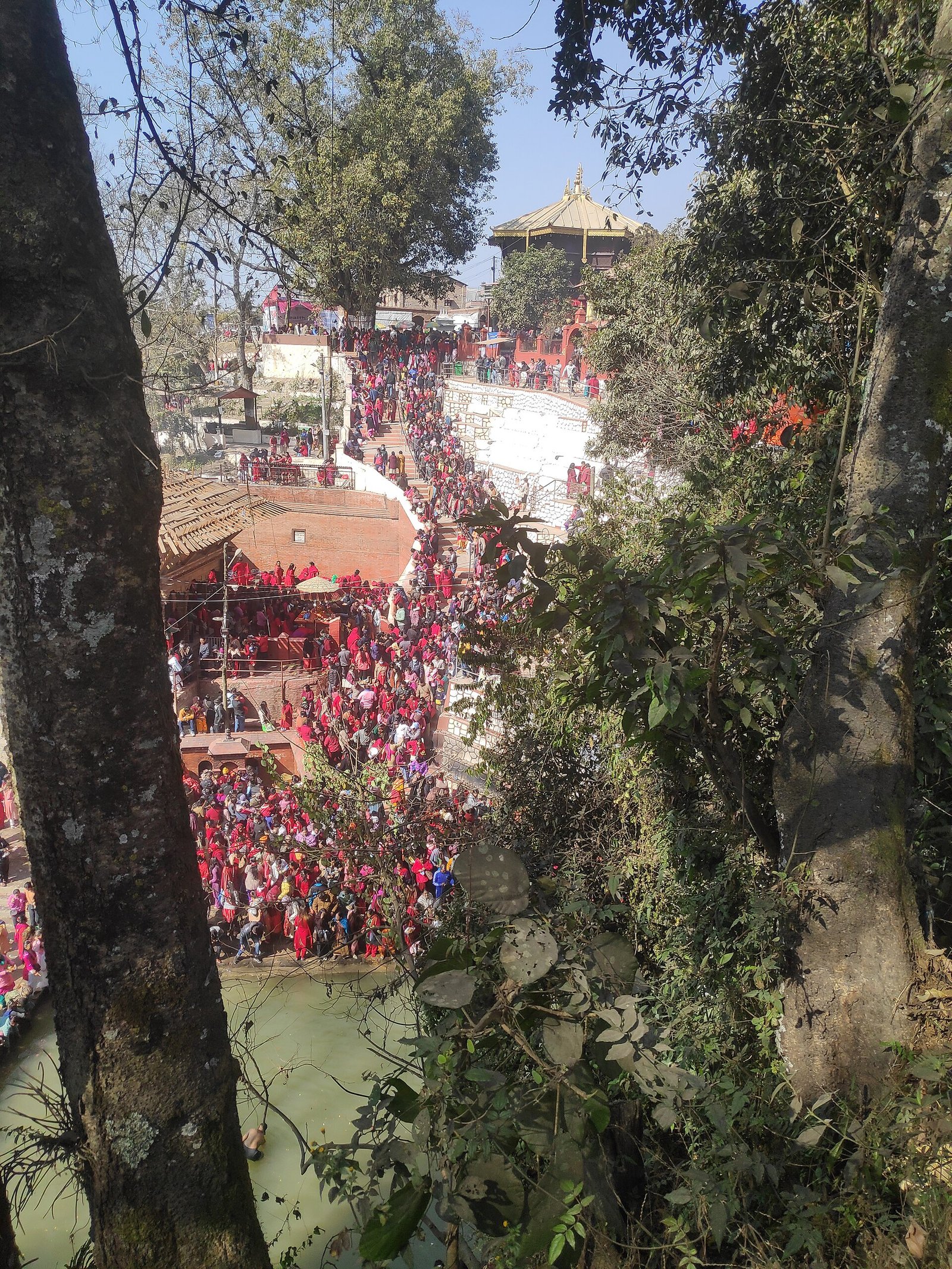
Parvati remains present in household worship, Shiva temples, festivals, pilgrimage traditions, storytelling, dance and sacred art.
Devotees may know her as Parvati, Uma, Gauri or through a more regional form.
Women may worship Gauri in connection with marriage or family traditions. Shaiva devotees encounter her beside Shiva. Families recognize her through stories of Ganesha and Kartikeya. Artists continue to represent the divine household and the unity of Shiva and Shakti.
Her identity also continues to change through regional retellings.
That flexibility is not evidence that the traditions are inconsistent. Hindu sacred narratives have long developed through multiple texts, languages, communities and places.
Parvati’s continuity lies less in one fixed biography than in a recognizable network of relationships: mountain daughter, ascetic, Shiva’s Shakti, mother, Goddess and participant in the life of the cosmos.
Continue Exploring
Goddess traditions
Relationships
- Divine Relationships →
- Shiva and Parvati
- Ardhanarishvara
Texts and philosophy
Sacred places and practice
Explore related Devi profiles
Sources & Further Reading
Academic scholarship
Ellen Goldberg, “Pārvatī,” Oxford Bibliographies in Hinduism.
Primary academic overview for this profile.
Useful for:
- Parvati’s origins
- Sati and Parvati
- tapas
- Shiva-Parvati marriage
- Ganesha and Kartikeya
- Ardhanarishvara
- Parvati in dance and art
- Agamic traditions
Mandakranta Bose, ed., The Oxford History of Hinduism: The Goddess.
Useful for situating Parvati in the wider history of Hindu Goddess traditions.
Jessica Vantine Birkenholtz and Alaka Atreya Chudal, The Swasthani Vrata Katha: A Secret Vow to the Goddess.
Useful for:
- Nepalese Parvati traditions
- Himalayan sacred geography
- Parvati’s austerities
- Parvati and Mahadev narratives
- living South Asian regional tradition
Indian museum and cultural sources
National Museum, New Delhi, The Holy Family: Shiva, Parvati, Ganesha and Kartikeya, Pahari, c. 1750.
Useful for:
- divine family imagery
- Parvati as mother
- Shiva-Parvati relationship
National Museum, New Delhi, Ardhanarishwar, Rajasthan.
Useful for:
- composite Shiva-Parvati iconography
- Shiva-Shakti relationship
National Museum, New Delhi, Devotees Worshiping Shiva and Parvati.
Useful for:
- devotional context
- couple imagery
- music and worship
National Museum, New Delhi, Shiva-Parvati Seated on Mount Kailash, Tanjore, nineteenth century.
Useful for:
- Kailash imagery
- South Indian painting
- living visual tradition of the divine couple
Indian cultural and archaeological sources
IGNCA, Indian Temple Sculpture.
Useful for historical Parvati imagery and Indian temple iconography.
Government of India, Incredible India, Parvati Temple at Khajuraho.
Useful for:
- temple architecture
- Gauri image
- Parvati as temple deity
Government of India, Incredible India, Baijnath Temple.
Useful for:
- regional Parvati tradition
- Shiva-Parvati sacred geography
- local marriage tradition