

Durga Puja 2026: Dates at a Glance
Durga Puja 2026 runs from 17 to 21 October in the West Bengal government’s public festival calendar for Kolkata and West Bengal. Mahalaya is 10 October, Maha Ashtami is 19 October and Vijaya Dashami is 21 October in that reference.
The Government of West Bengal’s 2026 Puja portal lists:
| Observance | 2026 date |
|---|---|
| Mahalaya | Saturday, October 10 |
| Maha Shashthi | Saturday, October 17 |
| Maha Saptami | Sunday, October 18 |
| Maha Ashtami | Monday, October 19 |
| Maha Navami | Tuesday, October 20 |
| Vijaya Dashami | Wednesday, October 21 |
The Government of India tourism portal likewise gives the principal Kolkata festival period as October 17 through October 21, 2026.
A note about Shashthi in 2026
Festival dates follow lunar tithis, not midnight-to-midnight civil dates.
Some Bengali panjika calculations place the Shashthi tithi beginning on Friday, October 16, while the West Bengal government’s public Puja calendar identifies Saturday, October 17 as Maha Shashthi. For exact ritual timing, devotees should follow the calendar used by their temple, priest or Puja committee.
The Navratri 2026 guide uses city-specific ritual calendars that place Vijayadashami on 20 October. This page retains the West Bengal government’s public festival dates; the two references should not be read as one universal ritual timetable. Public-calendar dates were rechecked on 7 October 2026. Exact rites follow the calendar used by the temple, priest or Puja committee.
Is Durga Puja on Diwali?
Durga Puja is not on Diwali. The West Bengal public calendar places Vijaya Dashami on 21 October 2026 and Kali Puja, coinciding with Diwali, on 8 November 2026. The festivals have different dates and distinct devotional settings.
Durga Puja takes place within the autumn Goddess season alongside Navratri, but has its own Bengali ritual sequence, clay images and pandals. It is separate from Diwali and Kali Puja, which fall later in the season.
- Associated deities
- Durga
- Traditions
- Bengali Durga / Goddess festival; Kolkata is a major contemporary center
- Calendar basis
- Lunar tithis and the calendar followed by each temple, priest or Puja committee
- Typical Gregorian period
- Autumn
- Duration
- Principal rites from Shashthi through Vijaya Dashami, preceded by Mahalaya
- Calendar and local-date guidance
- Public festival dates and ritual timings can differ. Follow the local Puja calendar for exact rites.
On this page
Durga Puja is one of the most important festivals dedicated to Goddess Durga and one of the defining religious and cultural celebrations of Bengal.
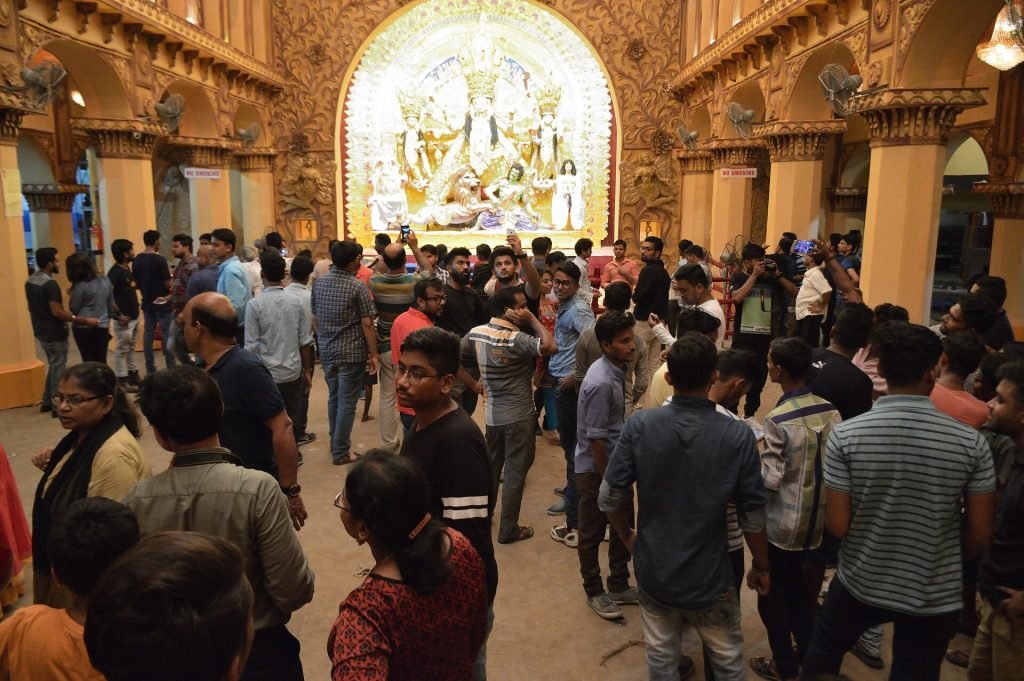
For several days each autumn, temples, homes, neighborhoods and public spaces are transformed. Clay images of Durga are installed inside temporary structures known as pandals. Priests perform ritual worship, drummers play the distinctive dhaak, families and friends move through the city visiting one installation after another, and artisans, designers, electricians, craftspeople and volunteers participate in creating an enormous temporary festival landscape.
The festival reaches its most visible public scale in Kolkata and West Bengal, but Durga Puja is also celebrated elsewhere in India, Bangladesh, Nepal and Bengali communities around the world.
UNESCO inscribed Durga Puja in Kolkata on the Representative List of the Intangible Cultural Heritage of Humanity in 2021. Its documentation describes the festival as a major public meeting point of religion, collaborative art, temporary architecture, craftsmanship and community participation.
At its religious center, however, remains the Goddess.
Durga is invoked, welcomed, worshipped and finally immersed. The temporary nature of the images and pandals is part of the festival’s character. Months of human work culminate in a few intense days before the sacred forms are dismantled or returned to water.
What Is Durga Puja?
Durga Puja is the ritual worship of Goddess Durga, but the festival extends far beyond the formal puja itself.
Its contemporary Bengali form brings together:
- sacred image-making
- scriptural recitation and ritual
- household worship
- community pujas
- pandal architecture
- sculpture and installation art
- music and drumming
- food
- social gathering
- neighborhood organization
- public processions
- immersion
UNESCO describes Durga Puja as a tradition sustained by families, Puja committees, priests, drummers, artists and craftspersons. Knowledge is transmitted through households, community celebrations, hereditary ritual practice, artisan workshops and professional artistic networks.
That combination makes Durga Puja unusual even among large religious festivals.
A pandal may simultaneously be:
- a temporary temple
- a work of architecture
- an art installation
- a community project
- the setting for ritual worship
For devotees, these categories are not necessarily separate.
Durga Puja and the Story of Mahishasura
Durga Puja centers on Durga as Mahishasuramardini, the slayer of the buffalo demon Mahishasura.
The most influential Sanskrit narrative of this battle appears in the Devi Mahatmya, part of the Markandeya Purana.
The text describes the gods combining their energies as the Goddess emerges to confront Mahishasura, whose power has disrupted the divine order.
After a prolonged battle, Durga kills him.
This narrative is central to Durga’s martial identity and provides the theological foundation for much of her festival imagery.
The familiar Bengali Durga image often shows the Goddess at the moment of victory, with:
- multiple arms
- divine weapons
- lion
- Mahishasura
- accompanying deities
The festival, however, gives this cosmic warrior another identity as well.
In Bengali devotional culture, Durga is also welcomed as a daughter returning to her parental home.
These two understandings coexist: cosmic Goddess and beloved returning daughter.
Durga Comes Home
One of the most distinctive emotional dimensions of Bengali Durga Puja is the idea of the Goddess’s homecoming.
Durga is associated with Parvati, daughter of the mountain, who returns temporarily to her maternal home with her children.
The festival can therefore be imagined through the emotional language of a daughter’s annual visit.
This theme appears in agomoni songs, devotional poetry and popular understandings of the festival.
UNESCO’s description of Durga Puja specifically notes that the festival has come to signify a seasonal “home-coming” or return to one’s roots.
This domestic interpretation exists alongside Durga’s identity as Mahishasuramardini.
The Goddess who defeats a cosmic enemy can also be welcomed with the affection reserved for family.
That combination of power and intimacy helps explain much of Durga Puja’s emotional character.
Mahalaya and the Beginning of Devi Paksha
Mahalaya occurs before the principal days of Durga Puja.
It marks an important transition in the Bengali festival calendar and is closely associated with the beginning of the Goddess season.
For many Bengali families, Mahalaya morning is inseparable from listening to Mahishasura Mardini, the celebrated radio program traditionally associated with the voice of Birendra Krishna Bhadra.
The broadcast combines Sanskrit recitation, narration and devotional music recounting the manifestation and victory of the Goddess.
Mahalaya also occurs at the end of Pitri Paksha, a period associated with remembrance and offerings for ancestors.
Care is needed when describing the transition. Mahalaya itself is not simply “the first day of Durga Puja.” The major public rituals occur later.
UNESCO’s festival description associates Mahalaya with the beginning of the Goddess’s public emergence and the finishing stages of sacred image-making.
In 2026, Mahalaya falls on October 10.
Kumartuli and the Making of Durga
Long before the festival begins, artisans are already at work.
In Kolkata, the neighborhood of Kumartuli is one of the most important centers of Durga image-making.
Clay modelers build the Goddess and her accompanying figures through a complex process involving:
- structural frameworks
- straw
- layers of clay
- drying
- painting
- ornament
- clothing
- final detailing
UNESCO documentation identifies hereditary clay modelers, particularly those based in Kumartuli, as major bearers of the festival tradition. It also notes that artisans work alongside contemporary designers, architects and other creative professionals in producing the enormous range of Puja installations seen today.
The image is sacred, but it is also visibly handmade.
This matters.
Durga Puja does not hide the human process through which the sacred form is created. Visitors can see unfinished faces, straw frames, clay bodies and workshops filled with half-completed images in the months before Puja.
Artisanship is part of the religious ecology of the festival.

Chokkhu Daan and the Eyes of the Goddess
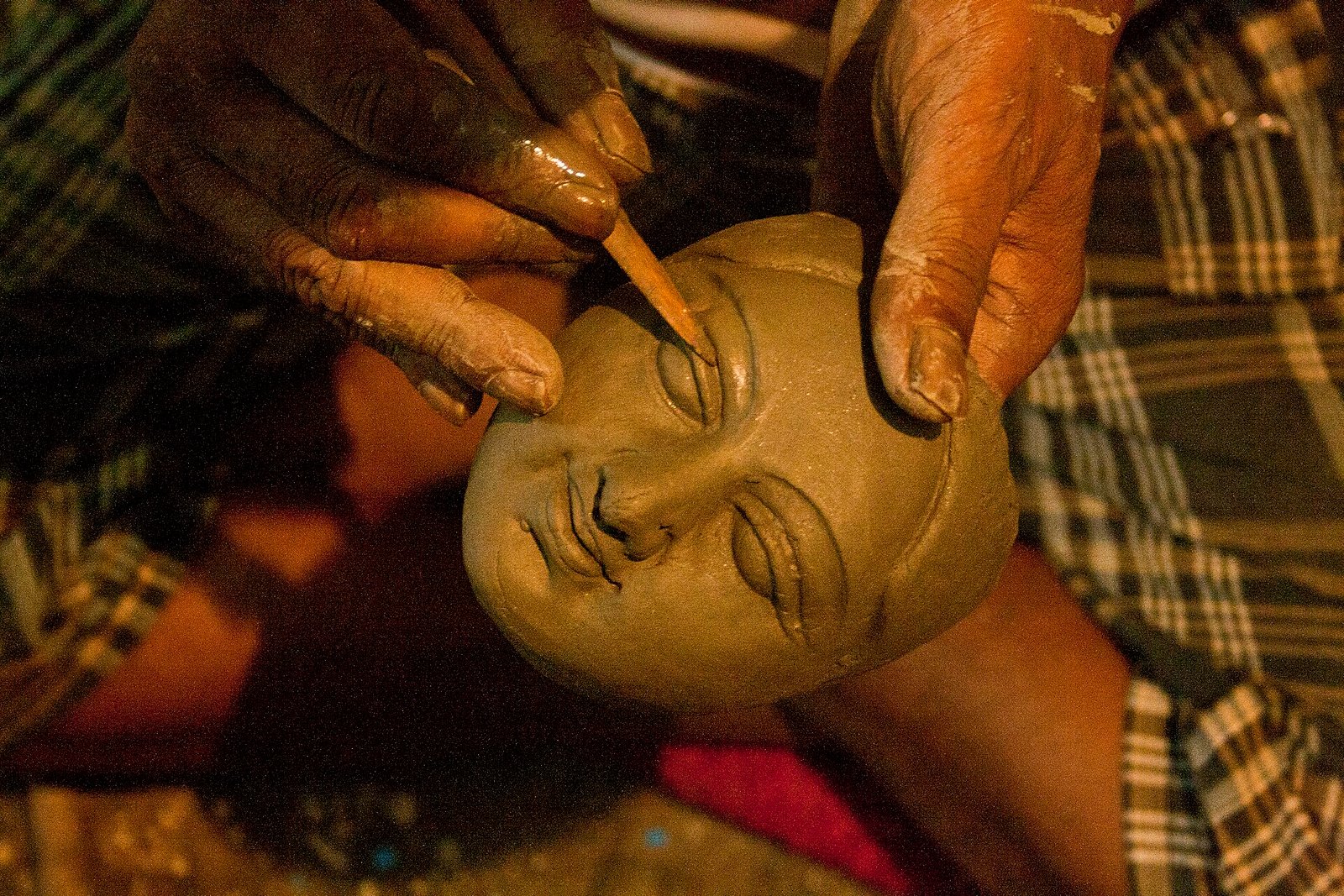
One of the most evocative stages of Durga image-making is associated with the painting of the Goddess’s eyes.
The practice is commonly referred to as Chokkhu Daan, literally the giving of eyes.
Popular descriptions frequently place this moment on Mahalaya, although actual workshop schedules and ritual practices can vary.
UNESCO’s account of Durga Puja describes the eyes being painted onto the clay images as part of the festival’s transition into the Goddess season.
The visual significance is powerful.
An image that has existed for weeks as clay and paint suddenly acquires a gaze.
Pandals: Temporary Sacred Architecture
A pandal is the temporary structure in which Durga is installed and worshipped.
Some pandals follow relatively traditional temple-like forms.
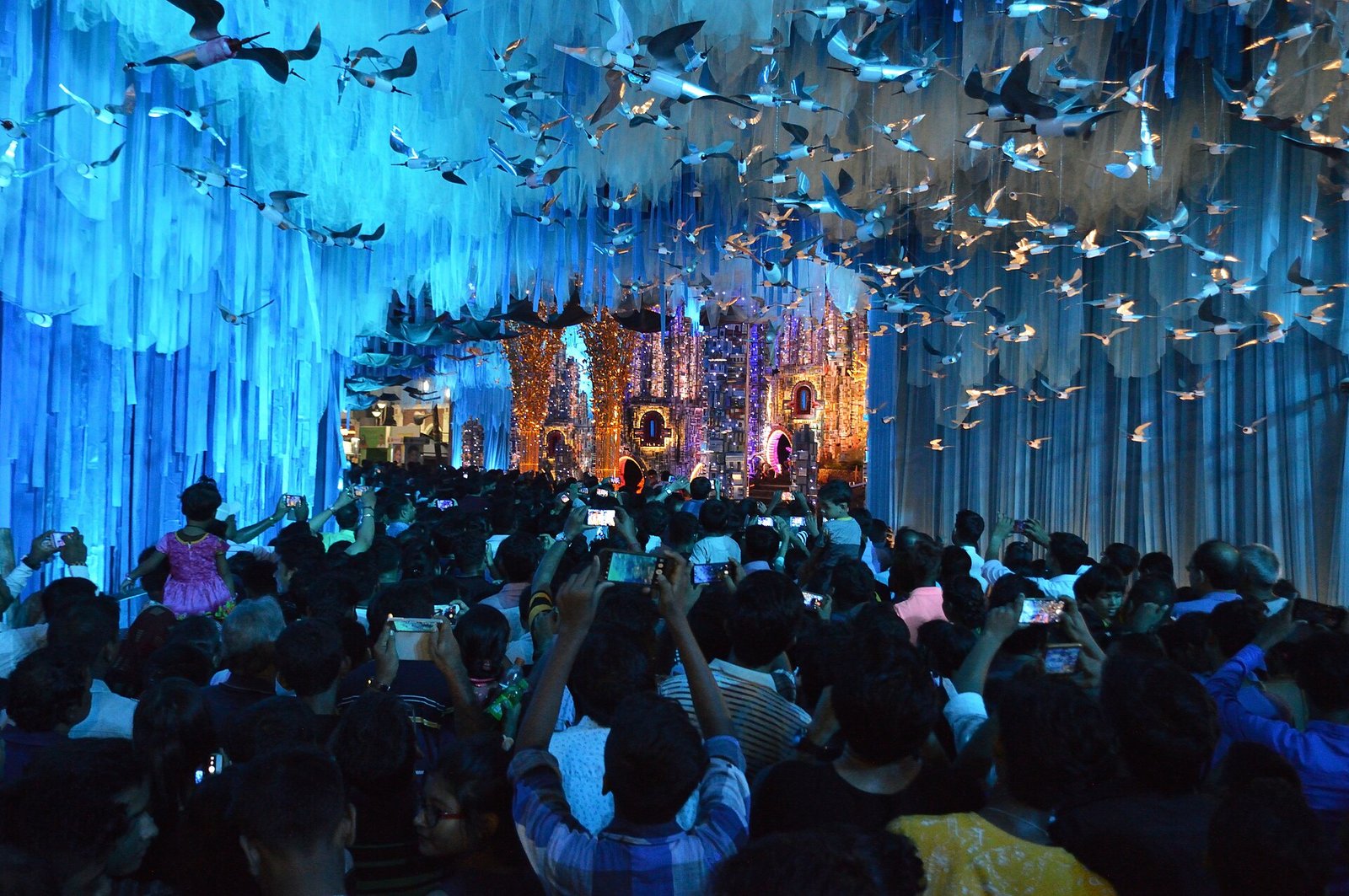
Others are elaborate contemporary installations drawing inspiration from:
- architecture
- folk traditions
- social themes
- environmental concerns
- historical places
- craft traditions
- experimental design
The temporary architecture of Puja has become one of Kolkata’s most visible artistic traditions.
UNESCO describes the festival’s large-scale installations and pavilions as central to its public character and recognizes the collaborative work of artists and designers as part of the living heritage.
Government tourism documentation likewise notes the role of sculptors, lighting designers and artists in creating themed pandals throughout Kolkata.
Yet the pandal remains a ritual space.
Visitors may admire its design while devotees perform worship before the Goddess inside.
This coexistence of sacred space and public art is one of Durga Puja’s defining characteristics.

Shashthi: Welcoming the Goddess
Shashthi marks the formal opening of the principal Durga Puja rites.
Rituals connected with awakening, invitation and installation of the Goddess take place as the festival moves into its most intensive phase.
In contemporary Kolkata, public celebration may already be well underway before the formal rites begin.
Pandals open early, visitors start circulating through neighborhoods, and the city’s festival atmosphere builds over several days.
This difference between ritual calendar and public festival calendar is worth recognizing.
For many visitors, Puja begins when pandal hopping begins.
For ritual purposes, the sequence follows the tithi-based observances established by the Puja tradition.
Saptami and the Nabapatrika
Maha Saptami introduces one of the festival’s distinctive ritual forms: the Nabapatrika, a grouping of nine plants bound together and ritually incorporated into Durga worship.
The Nabapatrika is popularly called Kola Bou, often translated loosely as “banana bride.”
That popular name has generated many simplified explanations online, including the claim that Kola Bou is simply Ganesha’s wife.
The ritual history is more complex.
The Nabapatrika involves nine plants associated through ritual interpretation with divine powers and forms part of the larger worship of Durga.
In Bengal, it is traditionally bathed and installed during Saptami rites.
This is a good example of why festival practices should be explained from ritual and regional sources rather than repeated from popular summaries.
Maha Ashtami
Maha Ashtami is one of the most important days of Durga Puja.
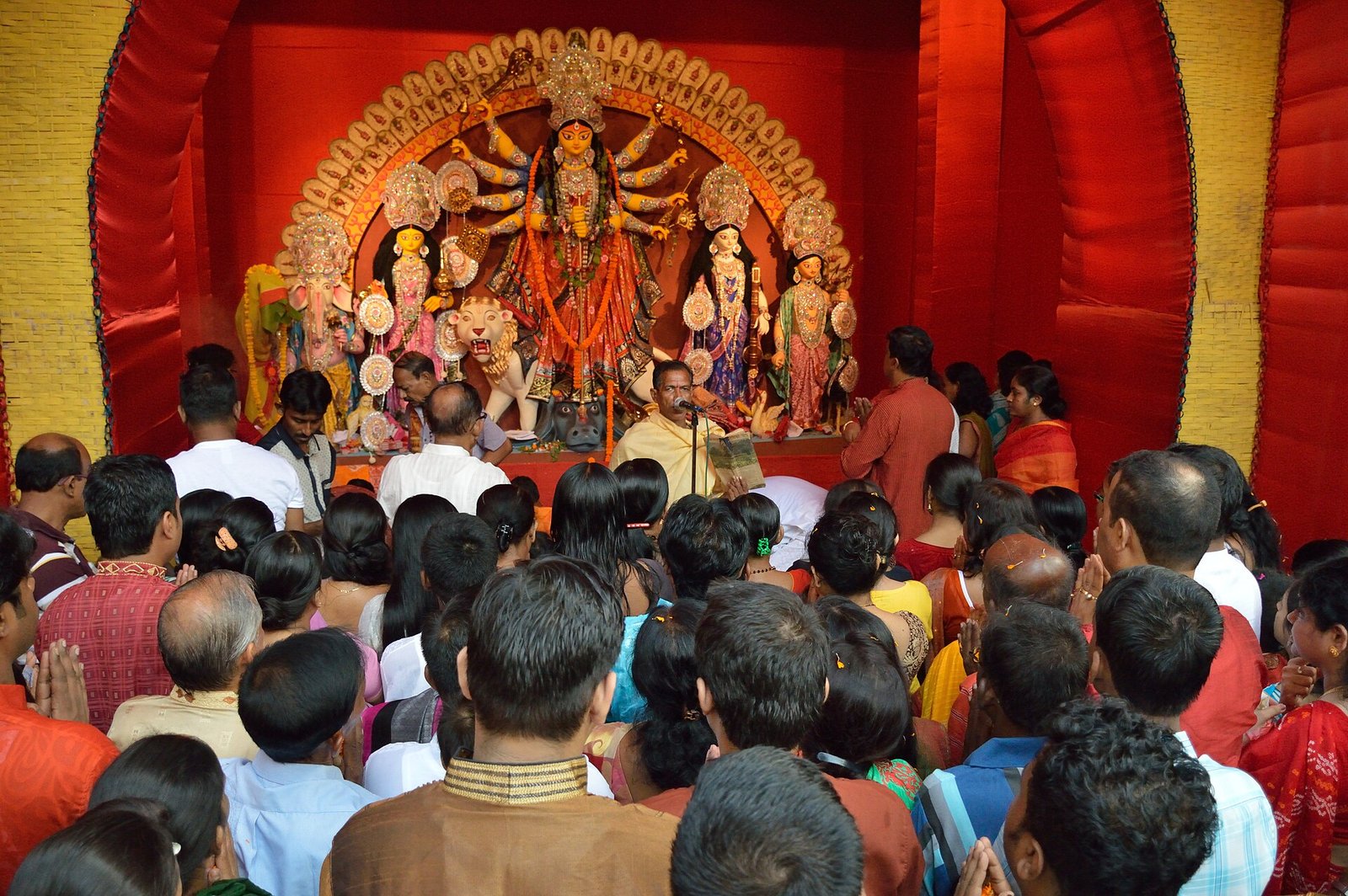
Large numbers of devotees participate in pushpanjali, offering flowers while prayers and mantras are recited.
Community pandals may become especially crowded on Ashtami morning.
The day is also associated with:
- formal worship
- bhog
- devotional gathering
- Kumari Puja in certain traditions
- Sandhi Puja at the transition between Ashtami and Navami
For many Bengali devotees, Ashtami has a particularly strong devotional atmosphere even within the wider public festival.
In 2026, Maha Ashtami falls on Monday, October 19 according to the West Bengal government’s festival calendar.

Sandhi Puja
Sandhi Puja takes place at the transition between Ashtami and Navami tithis.
The ritual is associated with a particularly intense moment in the Goddess’s battle tradition.
In many Durga Puja celebrations, Sandhi Puja has a markedly different atmosphere from general pandal visiting.
Lamps, ritual offerings, mantras and drumming can create an intense devotional setting around the transition between the two lunar periods.
The precise timing changes annually because it depends upon the tithi calculation.
Maha Navami
Maha Navami is the final full day of worship before Vijaya Dashami.
Ritual worship continues, often alongside:
- bhog
- community meals
- cultural programs
- music
- visiting friends and relatives
- final rounds of pandal hopping
The atmosphere can carry a sense of approaching departure.
The Goddess has been welcomed, worshipped and celebrated, but the temporary nature of her visit is becoming increasingly visible.
In 2026, Maha Navami falls on Tuesday, October 20 on the official West Bengal calendar.
The Dhaak: The Sound of Durga Puja
The sound of the dhaak is one of Durga Puja’s most distinctive sensory markers.
The large Bengali drum is played by specialist drummers known as dhakis.
Its sound accompanies:
- ritual worship
- arati
- processions
- festival gatherings
- dance
UNESCO specifically identifies traditional Bengali drumming as a defining element of Durga Puja and recognizes drummers among the communities who transmit festival knowledge.
The dhaak should therefore be treated as more than festive background music.
It is part of the ritual and cultural language through which Puja is recognized.

Dhunuchi Dance
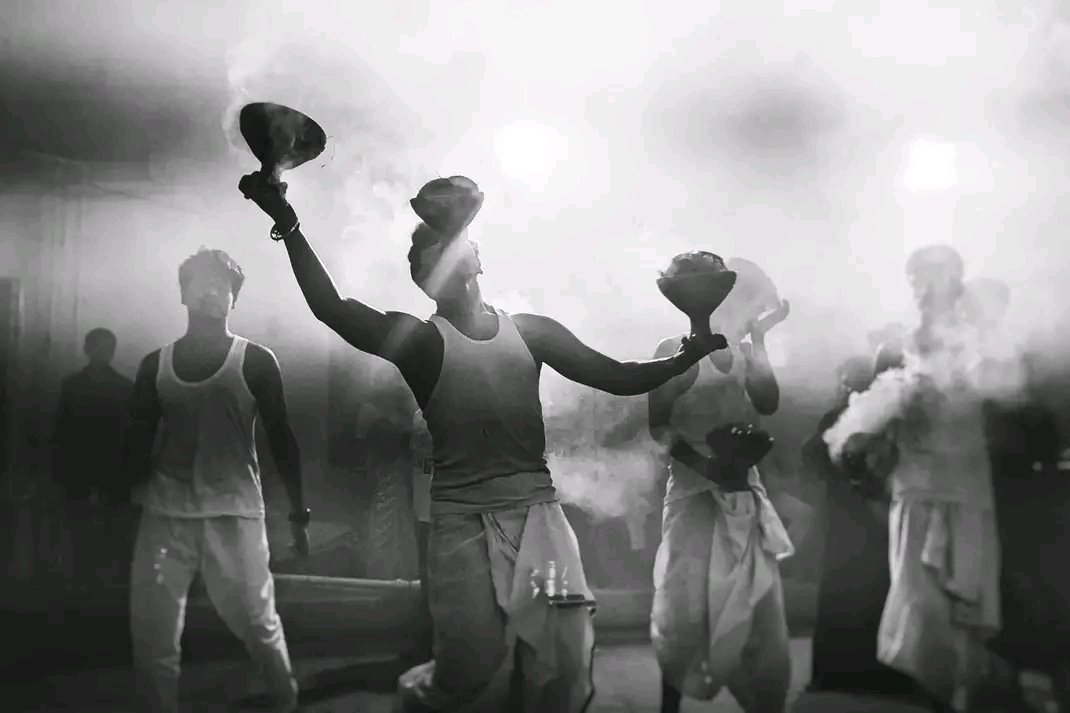
Another highly visible Durga Puja tradition is dhunuchi dance.
A dhunuchi is an incense burner, traditionally held during arati and filled with smoldering materials that produce fragrant smoke.
During festival celebrations, participants may dance while carrying one or more dhunuchis as dhaak rhythms intensify.
The result is visually dramatic:
- smoke
- fire
- rhythmic movement
- drums
- ritual space
Although widely photographed today, dhunuchi dance should not be reduced to a performance staged for spectators.
Its context lies in worship and arati.

Bhog and Shared Food
Food is also central to Durga Puja.
Community pujas commonly prepare bhog, food offered to the Goddess and later distributed.
Khichuri and accompanying dishes are particularly familiar in Bengali Puja contexts, although offerings and menus vary.
Sharing food extends the festival beyond ritual specialists.
Visitors, volunteers, neighbors and families participate in a common festival environment.
Like music and art, food becomes part of how the community experiences sacred time.
Bonedi Bari and Household Pujas
Kolkata’s spectacular public pandals receive enormous attention, but Durga Puja also has important household and family traditions.
Historic family pujas, often described as bonedi bari pujas, preserve ritual practices within old Bengali households.
Their atmosphere can differ greatly from large public installations.
Courtyards, family shrines and inherited ritual customs create a more intimate setting.
Durga Puja’s modern identity therefore includes both:
- enormous public celebrations
- long-standing domestic or family pujas
The rise of community pujas did not eliminate household traditions.
Both continue to shape Bengali festival culture.
Barowari and Community Durga Puja
Public community worship expanded Durga Puja beyond elite household patronage.
The development of barowari and later neighborhood or community pujas helped transform the festival into the large participatory public institution familiar today.
Local committees organize:
- fundraising
- ritual arrangements
- pandal construction
- cultural programs
- security
- crowd management
- food
- immersion logistics
UNESCO explicitly recognizes Puja committees as one of the communities through which Durga Puja is organized and transmitted.
The neighborhood committee is therefore not merely an administrative body.
It is part of the festival’s living social structure.
Sindoor Khela
On Vijaya Dashami, one of the most photographed Bengali traditions is Sindoor Khela, the playing or exchange of vermilion.
Traditionally, married women apply sindoor to the Goddess and to one another before the image leaves for immersion.
Contemporary practice is not identical everywhere, and participation has changed in some communities.
The ritual should therefore be described as a Bengali tradition with particular historical social conventions rather than as a universal practice for all women or all Durga Puja celebrations.
Vijaya Dashami and the Departure of Durga
Vijaya Dashami brings Durga Puja to its emotional conclusion.
The Goddess who was welcomed home must now leave.
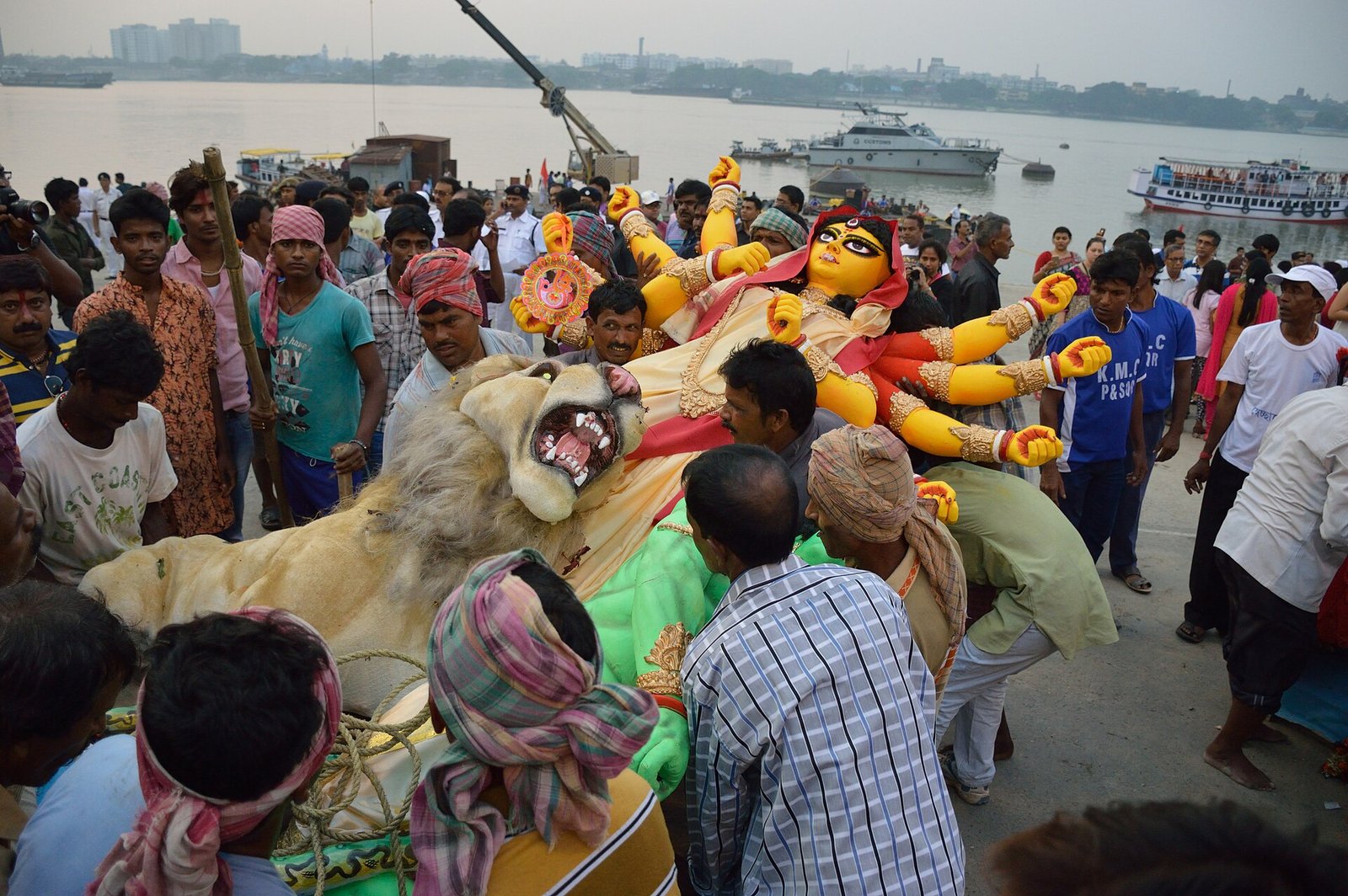
Images are carried out of pandals and homes and taken in procession for visarjan, immersion in water.
UNESCO describes immersion as the final stage in the festival cycle, returning the temporary clay image to the river from which its material originated.
For many devotees, Dashami therefore combines:
- celebration
- victory
- farewell
- affection
- sadness
- renewal
After the Goddess’s departure, people exchange Bijoya greetings and visit family and friends.
The festival ends, but the social relationships renewed during it continue.
In 2026, Vijaya Dashami falls on Wednesday, October 21.

Immersion and the Temporary Sacred Image
The immersion of the Durga image can appear puzzling to viewers unfamiliar with Hindu sacred image traditions.
Why spend months creating a beautiful image only to immerse it days later?
The answer lies partly in the temporary ritual nature of the image.
The Goddess is invoked into a sacred form for the festival and then ritually bid farewell.
The material object is temporary.
Divine presence is not understood to be destroyed when the clay dissolves.
The cycle of:
- creation
- invocation
- worship
- departure
- dissolution
is part of the religious structure of the festival itself.
UNESCO’s description emphasizes this return of the clay image to water as one of Durga Puja’s defining practices.
Durga Puja Beyond Kolkata
Kolkata has become the most internationally visible center of Durga Puja, but the festival is not limited to one city.
It is celebrated throughout:
- West Bengal
- other parts of eastern and northeastern India
- Bangladesh
- Nepal in related Durga festival contexts
- Bengali communities elsewhere in India
- the global Bengali diaspora
UNESCO’s documentation itself notes celebration beyond Kolkata and among Bengali communities internationally.
Regional differences remain important.
A community Puja in Virginia, London or Singapore may preserve Bengali ritual forms while adapting:
- dates
- venue
- schedule
- food
- cultural programming
Weekend scheduling is common in diaspora communities because local work and school calendars shape participation.
The festival therefore continues to evolve while retaining recognizable ritual and cultural features.
Durga Puja and Navratri
Durga Puja takes place during the broader autumn Goddess season associated with Sharad Navratri, but the two should not simply be treated as interchangeable names.
Navratri includes multiple regional systems of Goddess worship.
In Bengal, Durga Puja developed its own distinctive sequence centered on:
- Durga’s arrival
- the Bengali Durga image
- Bodhan
- Nabapatrika
- Ashtami worship
- Sandhi Puja
- community pandals
- Dashami farewell
- immersion
Elsewhere, Navratri may be experienced through:
- Garba
- Navadurga worship
- fasting
- Shakti Peetha pilgrimage
- Golu
- Saraswati worship
- other regional traditions
The festivals overlap in sacred time but are not culturally identical.
Durga Puja and Diwali
Durga Puja and Diwali are separate festivals.
This distinction is especially useful for readers unfamiliar with the Hindu festival calendar because both occur during the broader autumn season.
In Bengal:
- Durga Puja occurs earlier
- Lakshmi Puja follows
- Kali Puja comes later
- Kali Puja coincides with Diwali in the 2026 West Bengal calendar
For 2026:
Vijaya Dashami: October 21
Kali Puja / Diwali: November 8
The West Bengal government’s Puja calendar confirms these dates.
UNESCO Recognition
In 2021, UNESCO inscribed Durga Puja in Kolkata on the Representative List of the Intangible Cultural Heritage of Humanity.
The recognition is significant because it focuses not simply on a monument or historic object but on a living cultural practice.
UNESCO identifies:
- families
- Puja committees
- priests
- drummers
- clay modelers
- artists
- designers
- craftspersons
as participants in sustaining the tradition.
The inscription also highlights the festival’s temporary architecture, public installations and collective participation.
This makes Durga Puja an especially important example of the approach DurgaShakti takes toward Hindu traditions.
A festival cannot be understood only by reading its mythology.
Its living meaning also exists in the knowledge, labor, art and relationships through which people continue to celebrate it.
What Makes Durga Puja Distinctive?
Durga Puja brings together several layers of religious and cultural life in an unusually concentrated form.
It is simultaneously:
- worship of a powerful Goddess
- remembrance of Durga’s victory over Mahishasura
- the homecoming of a divine daughter
- a season of family reunion
- a public art movement
- an artisan tradition
- temporary sacred architecture
- community organization
- music and food
- a city-wide social experience
No single layer explains the festival completely.
For some devotees, the central memory may be Ashtami anjali.
For an artisan, it may be months of building sacred images.
For a neighborhood committee, it may involve a year of planning.
For a family living abroad, Puja may mean returning to Bengali language, food, music and community for a few days each autumn.
Together, these experiences help explain why Durga Puja can feel both intensely religious and much larger than the ritual itself.
Continue Exploring
Goddess traditions
Festivals
Texts and practices
Related Devi profiles
Related scriptures
- Devi Mahatmya, part of the Markandeya Purana
Related festivals
Sources & Further Reading
UNESCO Intangible Cultural Heritage
Inscribed in 2021 on the Representative List of the Intangible Cultural Heritage of Humanity.
Especially useful for:
- clay image-making
- Kumartuli artisans
- Mahalaya
- immersion
- pandals
- traditional Bengali drumming
- public art
- community participation
- festival transmission
Source: UNESCO Intangible Cultural Heritage.
UNESCO New Delhi
UNESCO visits India ahead of the Durga Puja in Kolkata
Useful for:
- Kumartuli
- artisan workshops
- festival preparation
- living heritage documentation
Source: UNESCO New Delhi.
UNESCO nomination documentation
Useful for:
- clay modelers
- Kumartuli
- pandal makers
- contemporary designers
- folk artists
- safeguarding and transmission
Source: UNESCO nomination materials.
Government of India, Incredible India
Durga Puja: An incomparable celebration of devotion and art
Useful for:
- Kolkata
- public festival environment
- pandals
- artists and designers
- dhaak
- 2026 festival dates
Source: Ministry of Tourism, Government of India.
Government of West Bengal
SAHAJ Puja Permission Portal, 2026 Puja Calendar
Useful for:
- Mahalaya date
- main Durga Puja dates
- Vijaya Dashami
- Kali Puja / Diwali relationship
Source: Government of West Bengal.