
Shiva–Shakti names a relationship between divine being and divine power that is expressed differently across Shaiva and Shakta traditions. Parvati’s marriage to Shiva, Ardhanarishvara’s composite body and Kali standing above Shiva give it distinct narrative and visual forms. A relationship guide needs to distinguish those forms before comparing them.
Parvati and Shiva in the divine household
Parvati is Shiva’s consort in a large body of narrative and devotional tradition. The Devi Bhagavata Purana, book 7, chapters 30–31, places her birth in the aftermath of Sati’s death and Shiva’s grief. That work gives the birth a Goddess-centered cosmic setting, including the gods’ need for the son who will defeat Taraka.
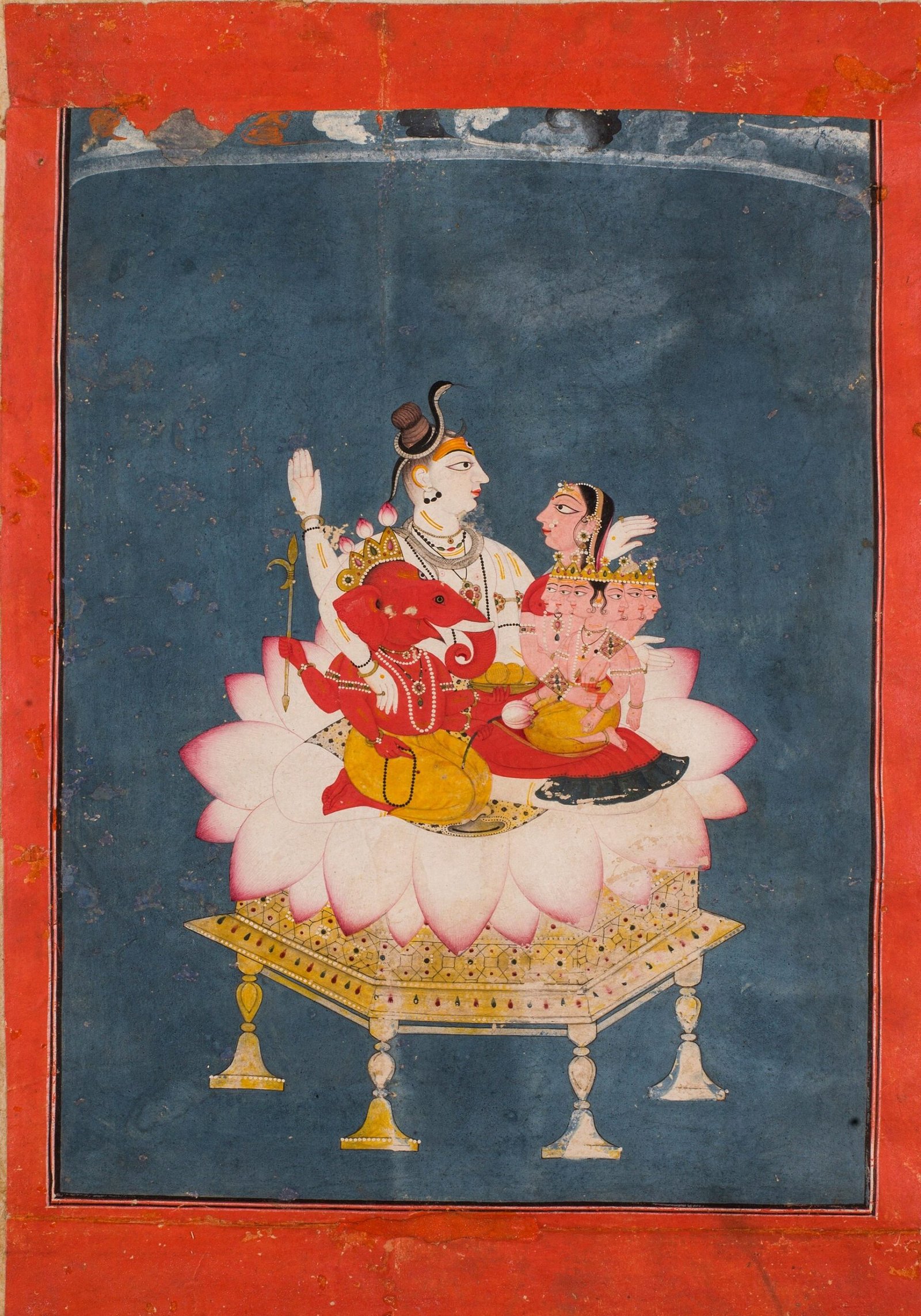
Family imagery presents another aspect of the relationship. The Pahari painting shown here brings Shiva, Parvati, Ganesha and Kartikeya together on a lotus seat. It is a documented eighteenth-century work in the National Museum, New Delhi. Its arrangement evokes a divine household; it does not settle the many different accounts of each child’s birth.

Ardhanarishvara: a composite divine body
Ardhanarishvara (Ardhanārīśvara) combines Shiva and Parvati in one body, conventionally divided into male and female halves. National Museum documentation identifies that combined form in a painting whose hands hold distinct attributes. The work makes unity visible through bodily composition, rather than placing two complete figures side by side.
Himalayan Academy’s Shaiva teaching reads Ardhanarishvara through Shiva’s never-separate Shakti. Goddess-centered accounts may approach divine power with a different theological emphasis. The form can support discussion of unity and difference without establishing one metaphysics shared by every worshipper. Modern reflections on gender should be identified as modern readings when compared with historical art or theology.
Kali standing on Shiva
In familiar Bengali images, Kali stands on a recumbent Shiva. The Gospel of Sri Ramakrishna’s introduction describes the Dakshineswar image through the active Goddess and the still Absolute. This is an identifiable devotional interpretation associated with Ramakrishna’s setting.
That image should be distinguished from Kali’s emergence during the Chanda–Munda battle in chapter 7 of the Devi Mahatmya. The battle episode does not tell the story of her accidentally stepping on Shiva. Popular explanations of her extended tongue belong to later narratives and devotional interpretation; they should not be silently inserted into the earlier battle text.
Durga and Shiva in Bengali devotion
In Bengali Durga Puja, Durga can be approached as Uma, the daughter returning to her parental home from Shiva’s household. Belur Math describes the emotional world of Agamani songs through Menaka’s longing for her daughter. The familial reading coexists with worship of the independent, victorious Goddess.
The Durga, Kali and Parvati guide follows these overlapping identities. Durga’s weapons from the gods in the Devi Mahatmya belong to a different narrative setting; Shiva’s gift of the trident does not by itself establish a marriage story.
Unity without a single formula
For a fuller conceptual account, read Shakti. Shaiva and Shakta discussions may connect divine consciousness and power, but neither the word “energy” nor a modern masculine–feminine chart explains their complete theological setting.
Prakriti and Purusha provides a useful comparison precisely because classical Samkhya distinguishes nature from a plurality of conscious witnesses. Identifying Shiva and Shakti with those terms requires the context of the text or lineage making the comparison. The Kali Puja guide places one form of Goddess devotion in its own living setting.
Sources and further reading
- Devi Bhagavata Purana 7.31, Swami Vijnanananda’s historical translation; Parvati’s birth and the gods’ appeal
- Himalayan Academy, Dancing with Śiva, sloka 20 (Shaiva interpretation)
- National Museum, New Delhi, Ardhanarishwar, 82.446
- The Gospel of Sri Ramakrishna, introduction, “Kali” (Dakshineswar devotional interpretation)
- Belur Math, Durga Puja at Belur Math; Uma, Agamani songs and family devotion
- Devi Mahatmya, chapter 7; Kali’s battle manifestation