
The trishula (triśūla) is a three-pronged weapon especially associated with Shiva. It also appears in the hands of Durga and other Goddess forms. Its identity as a weapon, its use as a divine emblem and its theological interpretations can be studied together, provided that the source for each reading is clear.
The weapon in the Devi Mahatmya
In chapter 2 of the Devi Mahatmya, the gods equip the newly manifested Goddess for battle. Shiva draws a trident from his own and gives it to her (2.20 in the cited Sanskrit edition). Other deities contribute their characteristic weapons, and Himavan gives the lion. This episode places the trident within the Goddess’s collective armament.
The gifts connect her with the gods, but her victory drives the narrative. Reading the weapon only as a sign that Durga depends on Shiva misses the work’s sustained presentation of the Goddess’s power. Chapter 3 names the trident among her weapons in the battle; the surrounding action establishes its immediate role before any later symbolic explanation is added.
An emblem that encloses a divine form
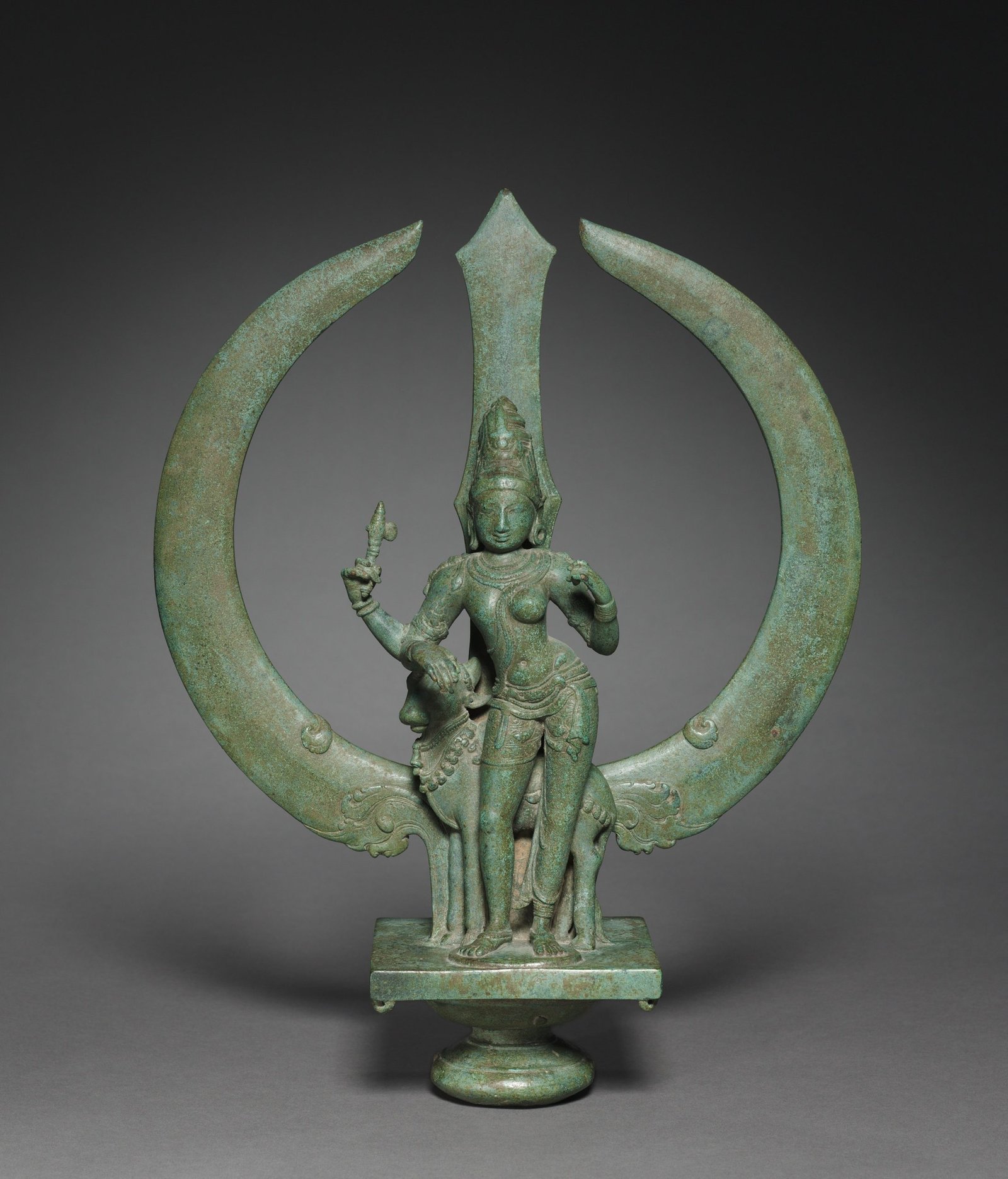
The Chola-period bronze shown here comes from Tamil Nadu and is dated about 1050 by the Cleveland Museum of Art. Its three prongs frame Ardhanarishvara, the combined Shiva–Parvati form. The weapon has become the setting for a representation of the deity, with the bull beside the figure.
This work makes a useful comparison with a weapon carried in a narrative painting. Its outline still identifies a trident, but the central figure asks the viewer to consider Shiva’s composite form as well. The museum reads this particular image through the conjunction of seemingly opposed aspects, including ascetic and royal identities. That interpretation is attached to a documented object, not used as a definition of every trident.
How threefold interpretations work
Three prongs invite threefold explanations, but the number alone does not establish which explanation belongs to a particular image or tradition. Himalayan Academy’s Dancing with Śiva, for example, associates the trident with love, wisdom and action in its Shaiva teaching. This is an identified traditional interpretation.
A claim that the prongs always mean the three gunas, the three cosmic functions or three divisions of time needs its own textual or traditional support. Such correspondences should not be merged into a single ancient decoding key. In a catalogue or temple setting, first establish the object’s name and function, then ask whether a specific explanation is supplied.
Reading Durga’s attributes together
Durga’s discus, conch, bow, sword and trident appear in combinations that depend on the form and work. A single weapon rarely provides a complete identification. Follow the Durga cornerstone for the Mahishasuramardini image and the lion guide for her mount’s part in the story.
The Shiva–Shakti guide examines Ardhanarishvara as a divine relationship. For philosophical uses of the three gunas, read Prakriti and Purusha; their place in Samkhya should be understood independently of any proposed interpretation of the weapon.