
Durga’s lion is her vahana (vāhana), or divine vehicle, and an active participant in the battles of the Devi Mahatmya. It can carry her, fight beside her or appear at the edge of an image. Reading the lion within that narrative gives a firmer basis than assigning it a single psychological meaning.
Himavan’s gift and the battle
Chapter 2 of the Devi Mahatmya describes the gods furnishing the Goddess with weapons and ornaments. At 2.29, Himavan gives her a lion as her vehicle, together with jewels. This gift follows the formation of her radiant body and places the mount within her preparation for battle.
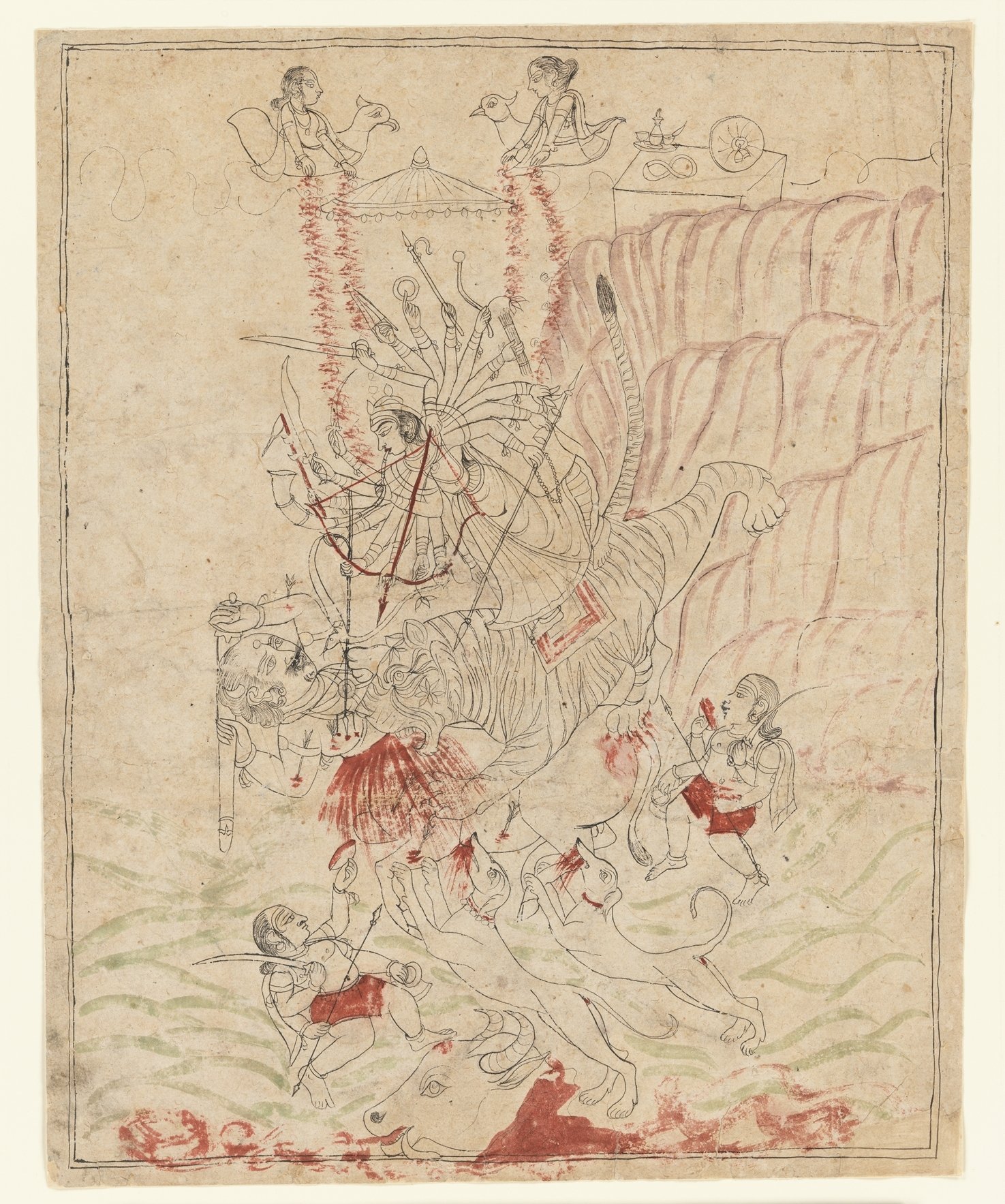
The lion then fights in its own right. In chapter 3 it attacks Chamara; in chapter 6 its roar defeats Dhumralochana’s forces. These episodes give it a role beyond transportation. Their sequence also helps distinguish the Goddess’s lion from Mahisha’s changing animal forms during the battle.
How the lion appears in an image
The Mewar painting reproduced here, dated about 1760, concentrates on the defeat of Mahisha. Durga’s many arms and weapons surround the battle, with her lion near the action. A painting can gather several narrative details into a compact field, so the animal’s position should be read alongside the Goddess and the buffalo demon.
A contrasting sculpture catalogued by the University of Michigan Museum of Art shows a tranquil four-armed Durga seated on a crouching lion. Its catalogue notes that lion mounts occur with goddesses bearing different names. A mount helps identify a subject, but it cannot settle every identification without the rest of the image and its documentation.
Power and devotional interpretation
The lion’s strength and its service to the Goddess support devotional readings of protective power. The narrative itself supplies concrete actions: receiving a divine mount, entering battle and overcoming an attacking force. An interpretation about mastery of anger, courage or the human mind should be identified as an interpretation and supported by its own source.
This distinction matters when short explanations circulate without references. The ancient story does not need to be converted into a modern self-improvement lesson to be intelligible. Readers can follow the mount’s actions and the Goddess’s authority before considering further symbolic readings in a named commentary or devotional setting.
Lion, tiger and regional images
Some Goddess images use a tiger or a stylized animal whose features need careful description. Do not silently relabel every large feline as the lion of the Devi Mahatmya. Use the catalogue or community’s identification, and describe what can be seen. Local forms and artistic conventions deserve their own names.
A regional image may also combine a divine mount with attendants and family figures. The animal is then part of a broader devotional arrangement. Museum dating, location and a festival’s documented practice answer different questions and should be kept distinct.
Durga Puja and the living image
Durga Puja gives the Mahishasuramardini image a place in living celebration. In Bengali settings, the Goddess’s battlefield identity can coexist with the homecoming of Uma and her family. The Durga, Kali and Parvati guide explains how that relationship differs from a single narrative genealogy.
For the Goddess’s weapons, continue to Trishula. The Durga cornerstone introduces the larger textual and iconographic setting, while Navratri places Goddess worship across several regional traditions.