
Meenakshi Amman Temple is the great city temple of Madurai in Tamil Nadu, with paired shrines for Meenakshi and Sundareswarar. Meenakshi is identified with Parvati in the temple’s sacred narrative, and Sundareswarar with Shiva. The Goddess also has a distinctive identity as Madurai’s queen and the focus of the city’s festival traditions.
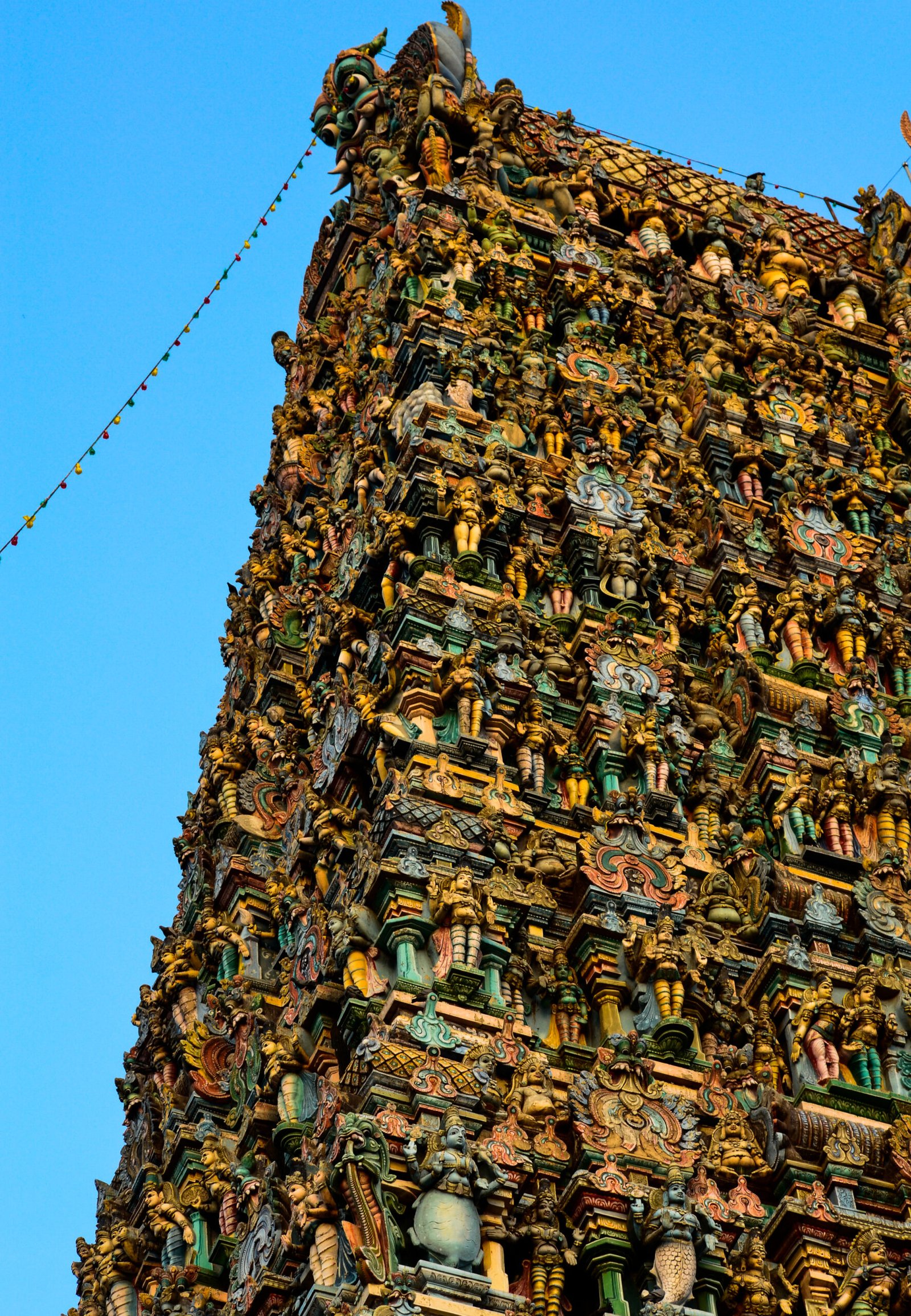

- Location: Madurai, Tamil Nadu, India
- Deities: Meenakshi and Sundareswarar
- Regional setting: Tamil temple worship and Madurai’s sacred history
- Historical background: A complex developed through successive periods, with major Nayak patronage
- Festivals: Chithirai, Navaratri and other temple observances
Meenakshi and Madurai’s sacred story
The wedding of Meenakshi and Sundareswarar gives the temple a central place in Madurai’s sacred narrative. Her connection with Parvati allows readers to follow a wider Goddess tradition, but her local sovereignty and relationship to the city remain essential to the account.
The Shiva–Shakti guide considers divine relationships in several theological and artistic settings. Here the paired shrines and festival cycle give that relationship a specific Tamil setting, sustained by worship in a living urban temple.
History, patronage and architecture
Madurai District’s institutional account describes a temple that expanded across successive periods. It highlights the contribution of Thirumalai Nayak, whose reign in the seventeenth century belongs to a major phase of building and patronage. The present complex should therefore be approached as an accumulated work, rather than the product of a single construction date.
Tall gopurams mark entrances into the complex, with sculpted figures arranged across their tiers. Halls, courtyards and the paired sanctuaries organize movement and worship within. The photograph here shows a detail of the west gopuram; its visible painted surfaces should not be used to date all of the underlying architecture.
Chithirai and the festival calendar
Madurai’s Chithirai festival includes the divine wedding and the traditions surrounding Alagar’s journey. The district’s account frames the journey as legend, a distinction worth retaining when describing the festival. Procession, performance and the city’s participation give the narrative a public form.
The district also records Navratri, when Meenakshi appears in changing forms of adornment and a kolu display is arranged. These Tamil observances share a wider Goddess festival setting while retaining their own temple practices. Dates for a particular year should come from the current temple calendar, not a fixed Gregorian month quoted as an annual rule.
Sacred significance and visiting context
Meenakshi’s importance can be explained through her temple, regional narratives and continuing worship without assigning the site a universal Shakti Peetha status. Peetha lists and identifications vary; this profile does not claim a body-part association unsupported by its cited sources.
Consult Madurai District’s temple information for an institutional introduction. Confirm current arrangements directly with the temple. Entry into different areas, photography and festival access may be subject to specific rules. The Temples hub offers comparisons with other sacred sites without treating their calendars, sacred forms or histories as interchangeable.