
Kalighat Kali Temple
Kali / Kalika · Kolkata, West Bengal, India
Shakti Peetha
Kalighat is a living Kali shrine beside Kolkata’s Adi Ganga, with a distinctive sacred image, a documented nineteenth-century temple and an enduring urban pilgrimage tradition.

Quick facts
- Primary deity
- Kali / Kalika
- Location
- Kolkata, West Bengal, India
- Classification
- PN 51 working list
- City / regional gateway
- Kolkata
- Airport
- Netaji Subhas Chandra Bose International Airport, Kolkata (CCU)
- Major railway station
- Sealdah, major city gateway; Howrah is another major terminal
- Approx. distance from Delhi
- About 1,310 km straight-line; not road distance
- Major festival periods
- Kali Puja; Durga Puja; Poila Baisakh; Sankranti
On this page
Spiritual importance and significance
Kalighat brings Kali worship into the dense religious and civic life of Kolkata. The temple stands in relation to the Adi Ganga, and its continuing pilgrimage reaches beyond the surviving nineteenth-century building. The Goddess’s distinctive image, local stories and festival calendar give the place its own identity within Bengali Shakta devotion.
The selected Pithanirnaya entry Kalipitha is associated here with Kolkata: it names Kālī / Kālikā, Nakuleśa Bhairava and the toes of Sati’s right foot. A separate Kalighata entry later in the same textual list has another geographical discussion. This profile does not merge those two entries simply because their names resemble one another.
West Bengal Tourism, Kalighat: sacred form, complex, festivals and transport.
Sacred story and textual tradition
Institutional accounts preserve stories of the Goddess’s discovery and the devotees associated with her image. The Ministry of Tourism names Atmaram and Brahmananda in this tradition. Such accounts describe the recognition and manifestation of the sacred form, rather than provide an archaeological foundation date.
The Peetha association places Kalighat in Sati’s sacred geography. The Kali profile distinguishes the Devi Mahatmya, Tantric and Bengali devotional settings; the temple’s own traditions should likewise retain their particular sources.
Ministry of Tourism, Kalighat Temple: image and sacred narratives.
What makes this temple distinctive?
- A distinctive Kali image described through its three eyes, four arms and prominent gold tongue.
- A living urban shrine linked to the Adi Ganga and the Kundupukur tank.
- A place-name also associated with Kalighat painting, whose works must not automatically be treated as portraits of the temple image.
History and development
Kolkata Municipal Corporation dates the present temple to 1809 and connects it with Santosh Roy and the Sabarna Roy Chowdhury family. This documented account of the standing building should be distinguished from older claims about the sacred place.
The surrounding neighborhood and river relationship have changed as the city developed. The temple also belongs to the history of Kalighat painting and urban pilgrimage. A painting made for that market may depict many subjects; it is not automatically evidence for the sanctuary’s exact image.
Kolkata Municipal Corporation, regional religious places: 1809 temple and urban context.
The Devi and sacred form
The Ministry of Tourism describes the image through its four arms, three eyes and gold tongue. West Bengal Tourism also emphasizes the Goddess’s distinctive appearance. These details should not be replaced by a generic blue- or black-skinned Kali illustration.
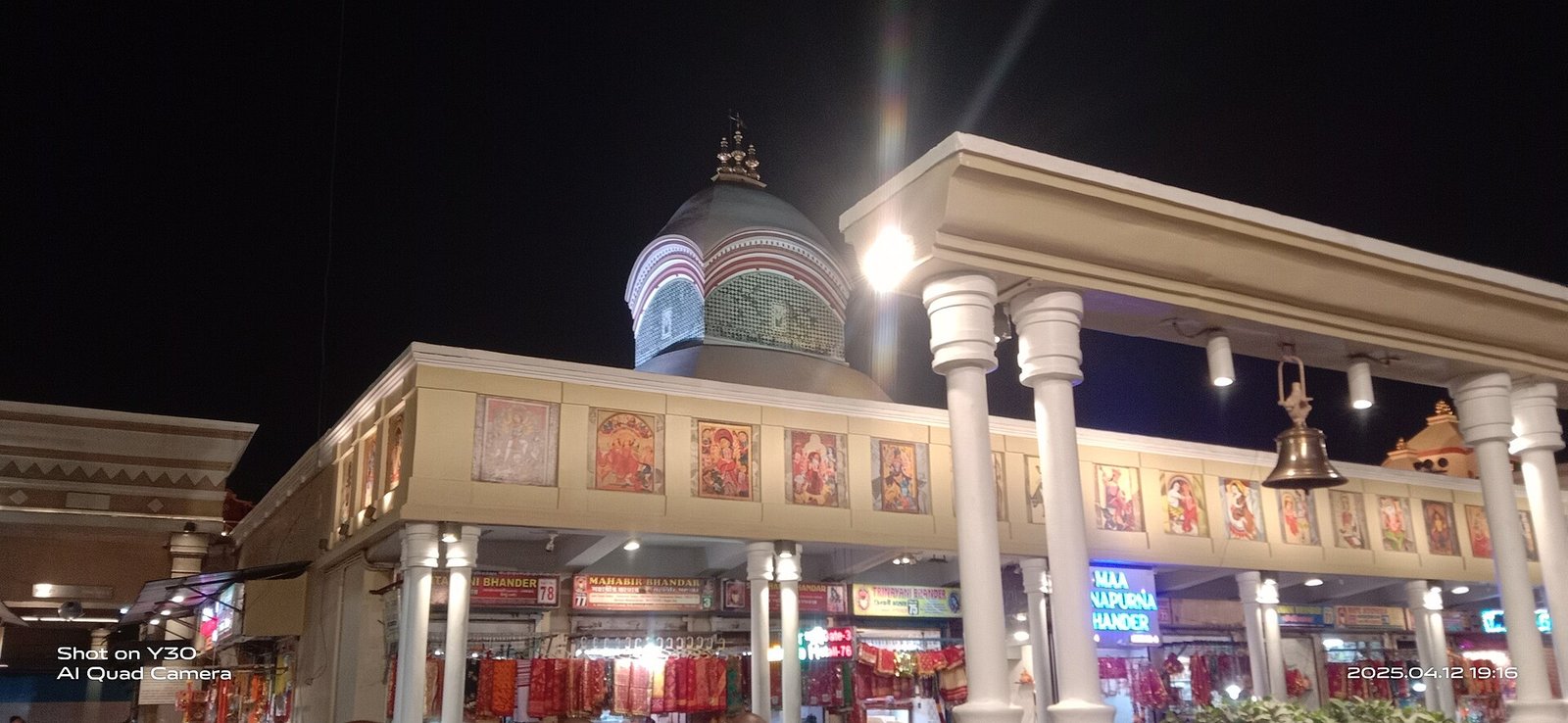
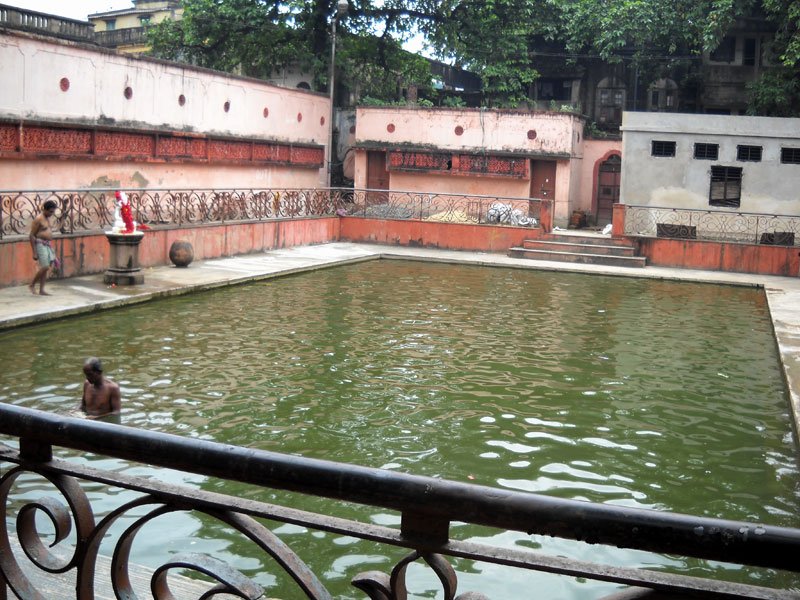
No photograph of the central image with sufficiently secure identity and permission has been selected. The renovated exterior and temple tank photographs document the place itself. Neither is captioned as an image of the Goddess.
Ministry of Tourism, Kalighat Temple: image and sacred narratives.
Architecture and temple complex
The state account describes the natmandir, subsidiary shrines and the relationship with the Adi Ganga. The Kundupukur tank provides another important part of the sacred setting. The two selected photographs show the built entrance at night and the tank in an earlier public-domain view.
Nakuleshwar is associated with the Bhairava tradition of the site. A nearby shrine’s name and location should remain specific rather than be used as a label for any Shiva image photographed in the neighborhood.
West Bengal Tourism, Kalighat: sacred form, complex, festivals and transport.
Worship, rituals and festivals
Kali Puja is especially important to this temple’s Bengali devotional context. State tourism also identifies Durga Puja, Poila Baisakh and Sankranti among significant gathering periods. These are named observances, not a permanent timetable for daily access.
The municipal account adds seasonal congregations in Bhadra, Paush and Chaitra. Festival crowds and the temple’s ordinary worship are different settings for a visit. Current local arrangements should determine the actual approach and queue entrance.
Kolkata Municipal Corporation, regional religious places: 1809 temple and urban context.
When to visit
A visit during Kali Puja takes place within a major Goddess observance. The supported patterns below identify important gatherings; no claim of a reliably quiet weekday or fixed waiting time is made.
West Bengal Tourism, Kalighat: sacred form, complex, festivals and transport.
- Peak / Very Busy
- Kali Puja and other major observances named by West Bengal Tourism, including Durga Puja, Poila Baisakh and Sankranti.
- Busy / Popular
- Kolkata Municipal Corporation also records pilgrim congregations in Bhadra, Paush and Chaitra. This does not establish a daily queue forecast.
West Bengal Tourism, Kalighat; Kolkata Municipal Corporation, regional religious places. No supported quieter-period claim is added.
Map and geographic orientation
Regional orientation, without route lines or street detail. Delhi is a geographic reference; these maps do not describe a road journey or cross-border access.
City and transport points give regional context; overlapping points can be explored with zoom or the text key.
India and surrounding region
Regional orientation
- Temple: Kalighat Kali Temple, India
- Delhi reference: Delhi, India. Approximate city reference (source precision 0.1 degree); distances are rounded straight-line orientation.
- Major city: Kolkata, India. Approximate city reference, not an entrance.
- Airport: Netaji Subhas Chandra Bose International Airport, India. Geographic orientation point; terminal entrance and services require a current check.
- Railway station: Sealdah railway station, India. Geographic orientation point; terminal entrance and services require a current check.
Natural Earth public-domain land; DataMeet CC0 India outline following the Survey of India depiction. Other political boundaries are omitted. Points identify present-day countries; place markers are orientation points, not entrances.
Planning Your Visit
- Nearest major city
- Kolkata
- Temple location
- Kolkata
- State / province / region
- West Bengal
- Country
- India
- Nearest airport
- Netaji Subhas Chandra Bose International Airport, Kolkata (CCU)
- Nearest major railway station
- Sealdah, major city gateway; Howrah is another major terminal
- Approx. distance from Delhi
- About 1,310 km straight-line; not road distance
- Distance source, endpoints and method
- Delhi distance: great-circle calculation (Earth radius 6,371 km) between the reviewed temple point and approximate Delhi city reference, rounded to 10 km. It is not a road, flight or cross-border itinerary.
- Typical access route
- The state tourism account names Kalighat and Jatin Das Park Metro stations for the local approach. Major rail terminals are city gateways, not stations beside the sanctuary.
- Important festival periods
- Kali Puja; Durga Puja; Poila Baisakh; Sankranti
- Terrain / altitude / stairs / accessibility
- An active urban temple and ghat setting. The current queue entrance, assistance and step-free access must be confirmed locally.
- Government tourism / heritage URL
- Government tourism / heritage URL
- Visitor-information sources and checked date
- Reviewed 2026-10-21 against the institutional sources linked below. Approximate distance endpoints and methods are qualified separately; this is not a live timetable.
Practical temple information
- Practical access note
- Use current temple and city guidance for entry controls. No unverified official booking site or fixed daily schedule is recommended.
Last verified: . Check the linked institution for changed arrangements.
Nearby sacred and cultural context
The Adi Ganga, Kundupukur and Nakuleshwar belong to the immediate sacred setting described by the institutional sources. The wider Kalighat neighborhood also gives context for the painting tradition. These are connections for understanding the temple, rather than an itinerary or shopping recommendation.
Kolkata Municipal Corporation, regional religious places: 1809 temple and urban context.
Photos and gallery


Watch / Explore Further
Further reading
Related reading
Sources and method
- West Bengal Tourism, Kalighat: sacred form, complex, festivals and transport
- Ministry of Tourism, Kalighat Temple: image and sacred narratives
- Kolkata Municipal Corporation, regional religious places: 1809 temple and urban context
Textual classifications follow the 51-entry PN working list. Our source method distinguishes sacred narrative, institutional testimony and historical evidence. Image sources and reuse terms accompany each photograph.