
Dakshineswar Kali Temple stands on the eastern bank of the Hooghly River near Kolkata, West Bengal. Founded by Rani Rashmoni in 1855, it is dedicated to Kali as Bhavatarini. The temple is also closely associated with Sri Ramakrishna, whose worship of the Divine Mother became central to accounts of his religious life.
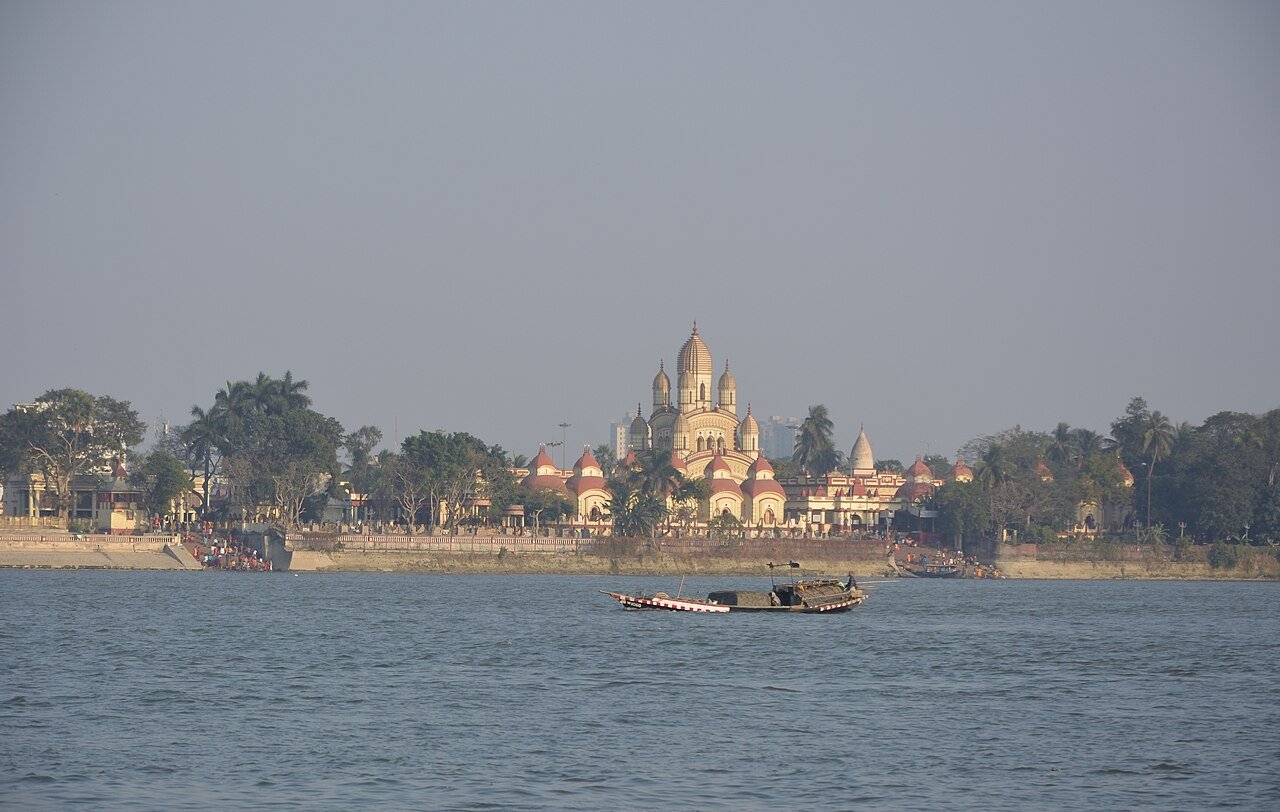

- Location: Dakshineswar, near Kolkata, West Bengal, India
- Deity: Bhavatarini Kali
- Foundation: Rani Rashmoni, 1855
- Architecture: Bengali navaratna, or nine-spired, main temple
- Devotional association: Sri Ramakrishna and worship of the Divine Mother
Rani Rashmoni’s foundation
The temple has a documented nineteenth-century foundation. Government heritage accounts identify Rani Rashmoni as its patron and 1855 as the year of inauguration. That history offers a firmer chronological starting point than an undated claim that every prominent Goddess shrine originated in ancient times.
Rashmoni’s patronage created a substantial religious complex beside the river. The main shrine’s nine spires rise over a courtyard, accompanied by twelve Shiva shrines and a Radha-Krishna temple. The arrangement places devotion to Kali within a complex that also accommodates other forms of Hindu worship.
Bhavatarini and the temple image
Bhavatarini is the local name under which Kali is worshipped here. In the image described in The Gospel of Sri Ramakrishna, the Mother stands on Shiva. The relationship belongs to a devotional and theological setting in which the Goddess is addressed as the active Divine Mother.
The Shiva–Shakti guide compares that image with other ways of understanding the two deities. A description of Dakshineswar should preserve its particular form of worship rather than assuming that every image of Kali has the same identity or local history.
Sri Ramakrishna and Bengali devotion
The Gospel’s introduction presents Kali through Ramakrishna’s religious experience and language of the Mother. It is a source for a devotional interpretation associated with him, rather than a neutral description of every Shakta school. Its testimony should be read alongside the temple’s institutional and architectural history.
Bengali devotion also gives the Mother a presence in song, festivals and household worship. Kali Puja provides a wider regional context for understanding devotion to Kali. Current temple observances and access arrangements need their own institutional calendar; a general festival date does not settle a specific shrine’s schedule.
Pilgrimage and sacred geography
Dakshineswar and Kalighat are distinct temples. Kalighat’s traditional Shakti Peetha association should not be transferred to Dakshineswar merely because both are prominent Kali shrines in the Kolkata area. This profile follows the sources’ account of Dakshineswar as Rashmoni’s foundation and a place associated with Ramakrishna.
The river setting and surviving buildings are important to a visit, but the complex remains a place of worship. Follow posted rules for entry and photography, and distinguish a documentary view of the exterior from images of the sanctuary. Return to the Temples hub to compare this nineteenth-century foundation with cave, Peetha and city-temple settings.