
The lotus is a recurring flower, divine seat and attribute in Hindu art. It is closely associated with Lakshmi, but it also appears with Vishnu, Brahma, Saraswati and many other deities. Its meaning is shaped by how it is used: a blossom held in a hand, a seat supporting a deity and a flower rising in a creation scene do different work within an image.
Lakshmi and the lotus
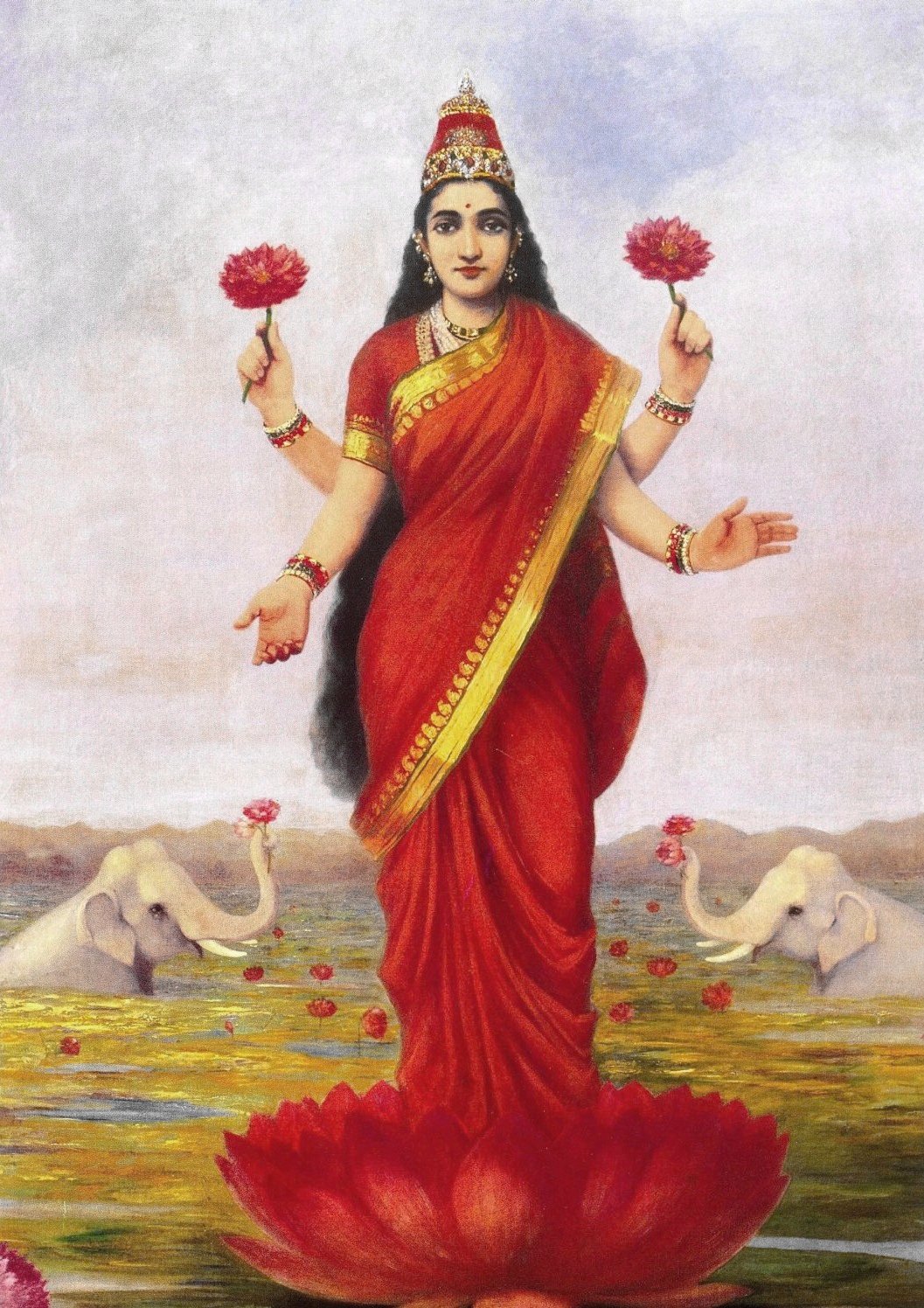
Names such as Padma and Kamala connect Lakshmi with the lotus. In Raja Ravi Varma’s 1896 painting reproduced here, she stands on an open flower and holds blossoms in her upper hands. Those repeated forms make the lotus integral to her visual presentation, alongside the elephants and gestures.
The painting belongs to a particular period of Indian art, even though its composition has become familiar through later reproductions. Identifying the artist and date helps distinguish this work from an ancient sculpture or a current household print. A familiar devotional image can have a history of its own.

A flower, a seat and a setting
A lotus pedestal may appear beneath several different deities. Its presence by itself cannot establish that the figure is Lakshmi. Look at the hands, accompanying figures, inscriptions and the work’s documented subject. The same care applies to a flower held as an attribute: it should be read alongside the figure’s other signs.
In eastern Indian images of Vishnu, the Metropolitan Museum of Art identifies Lakshmi by her lotus and fly-whisk and Sarasvati by her vina. These combinations belong to a regional iconographic arrangement. Seeing a lotus beside another object or deity is therefore more informative than treating it as an isolated sign of a single quality.
Vishnu, Brahma and the cosmic waters
A Chamba painting of Lakshmi and Vishnu shows Vishnu reclining on Ananta, with Brahma seated on the lotus that rises from Vishnu’s navel. Lotuses also fill the surrounding water. The Cleveland Museum describes their role in indicating water and its life-supporting capacity.
The flower supporting Brahma belongs to the scene’s account of creation; the flowers surrounding the serpent establish its aquatic setting. These roles can be considered alongside associations with auspiciousness and divine presence, without collapsing every lotus into one abstract meaning. The narrative explains why this flower appears where it does.
Purity and the act of looking
Purity is a familiar devotional interpretation of the lotus. It can be a helpful starting point, but a picture needs closer reading than a caption consisting of the word “purity.” A lotus may also organize the composition, support a figure, identify a person or connect the image with a story. Ask which of those roles is actually visible.
Cross-religious use also matters. Gajalakshmi imagery occurs in Buddhist and Jain architectural settings as well as Hindu ones. The Lakshmi profile includes documented examples from Bharhut and Shravanabelagola. Their locations should remain part of the explanation; a shared visual form does not make the religious settings interchangeable.
Following the setting into worship
The Lakshmi Puja guide places Goddess imagery in household and temple worship. The Saraswati profile considers musical and learning attributes, and the Saraswati–Brahma guide shows why the Goddess’s identity extends beyond one relationship.
When reading a photographed altar, distinguish a flower offered in worship from a flower painted into the image. One is a ritual offering visible at a particular moment; the other belongs to the artwork’s composition. Both can matter, but they call for different descriptions.
Sources and further reading
- Raja Ravi Varma, Goddess Lakshmi, 1896, object and reproduction documentation
- The Metropolitan Museum of Art, Vishnu Accompanied by Lakshmi and Sarasvati, Bangladesh, 12th century
- Cleveland Museum of Art, Vishnu on Ananta, ca. 1700
- Vishnu Purana 1.9, H. H. Wilson’s historical translation, story of Shri