
Lakshmi, also called Shri, is Vishnu’s consort in major Vaishnava textual and devotional traditions. Their relationship can express the inseparability of the sustaining deity and auspicious divine power. Narratives of her emergence, hymns of praise and regional images describe that relationship in different ways.
Shri and Vishnu in the Vishnu Purana
Vishnu Purana 1.8 answers a question about Shri’s origins by describing her as eternal and all-pervading, as Vishnu is. It then presents a series of complementary pairs, connecting them with meaning and speech, creation and its agent, light and its source. The passage’s purpose is theological praise.
Book 1.9 tells the churning-of-the-ocean narrative and Lakshmi’s appearance within it. The two chapters allow an eternal divine identity and a particular manifestation story to coexist. Reading the origin story alone would miss the explanation that precedes it.
The ocean narrative and divine appearances
In the churning narrative, the gods’ lost prosperity and strength frame the appearance of Shri. Her relationship with Vishnu belongs to the restoration of cosmic order. The story places auspiciousness within a larger religious account, not merely a request for personal wealth.
The same chapter connects her appearances with Vishnu’s manifestations, including Sita with Rama and Rukmini with Krishna. This is a stated Puranic way of relating divine identities. It should be distinguished from a historical claim that every Goddess associated with prosperity originated as a single consort figure.
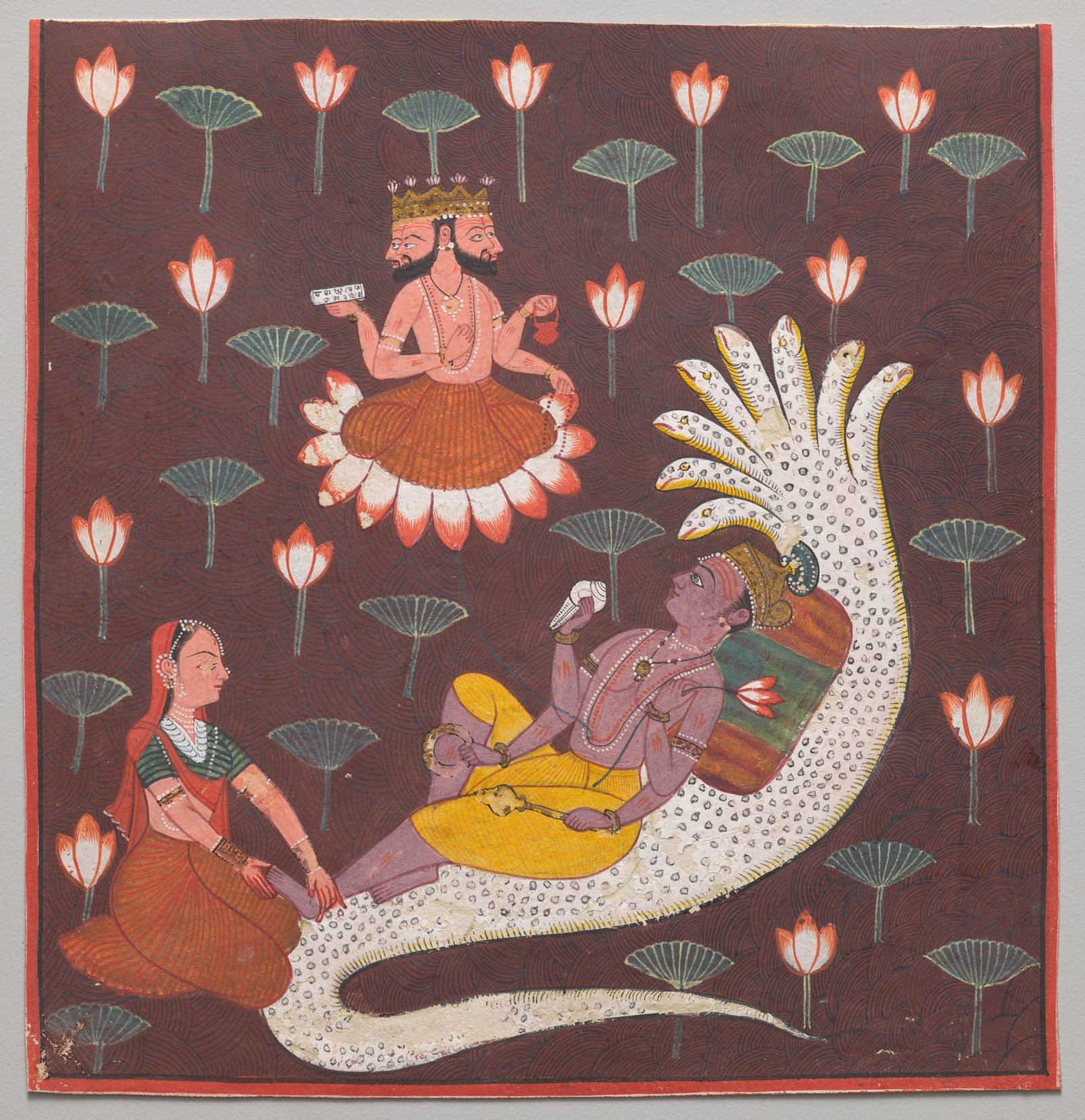
Reading a Himalayan painting
The Chamba painting reproduced here, dated about 1700, places Lakshmi at the feet of Vishnu reclining on Ananta. Brahma appears on the lotus rising from Vishnu’s navel. The artist has filled the surrounding field with lotuses, making the cosmic waters visible through a pond-like setting.
This composition gives a narrative and devotional relationship a particular visual form. Lakshmi’s position beside Vishnu is part of that scene. It should not be used by itself to define her status in every Shakta, Vaishnava or regional account. The work’s date, region and named subject remain part of its meaning.
Regional arrangements and Goddess identity
A twelfth-century Bangladesh sculpture in the Metropolitan Museum places Lakshmi and Sarasvati beside Vishnu. The museum identifies this as a medieval Bengal convention, contrasting it with arrangements including Shri Devi and Bhu Devi. Such evidence complicates a single universal chart of divine couples.
Lakshmi’s own profile also considers her auspicious imagery and independent worship. The Saraswati–Brahma guide explains why an eastern Indian image of Sarasvati beside Vishnu should not be mistaken for a catalogue error simply because another tradition pairs her with Brahma.
Worship and related reading
Lakshmi Puja and Diwali provide living contexts for Lakshmi devotion. A household festival’s principal image need not reproduce the full cosmic scene shown in the Chamba painting. Identify the observance and community before interpreting its arrangement.
The lotus guide follows an attribute shared across these works. For another theological account of Devi, read the Devi Bhagavata Purana profile. The different sources illuminate a relationship without requiring one textual framework to stand for all of Hindu worship.
Sources and further reading
- Vishnu Purana 1.8, H. H. Wilson, historical public-domain translation
- Vishnu Purana 1.9, churning narrative and Shri’s manifestations, H. H. Wilson translation
- Cleveland Museum of Art, Vishnu on Ananta, Chamba, ca. 1700, 2018.155
- The Metropolitan Museum of Art, Vishnu Accompanied by Lakshmi and Sarasvati, Bangladesh, 12th century