
Guhyeshwari
Guhyeshwari / Sati · Kathmandu, Bagmati Province, Nepal
Shakti Peetha: local tradition; PN identification qualified
Guhyeshwari’s water-centered sanctuary connects Goddess worship, local Sati tradition and the Pashupati sacred landscape in Kathmandu.

Quick facts
- Primary deity
- Guhyeshwari / Sati
- Location
- Kathmandu, Bagmati Province, Nepal
- Classification
- PN 51 working list: identification qualified
- City / regional gateway
- Kathmandu
- Airport
- Tribhuvan International Airport, Kathmandu (KTM)
- Approx. distance from Delhi
- About 800 km straight-line; not road distance
On this page
Spiritual importance and significance
Guhyeshwari is a Goddess shrine near Pashupatinath and the Bagmati River in Kathmandu, Nepal. The Pashupati Area Development Trust identifies it as a Shakti Peetha associated with Sati. Its place within the Pashupati sacred landscape makes it especially useful for understanding the presence of Goddess worship alongside a major Shaiva pilgrimage center.
The local Peetha tradition is retained without imposing the selected PN entry’s knee association on this sanctuary. The name Nepala is a regional designation in that witness; it does not explicitly name Guhyeshwari.
Pashupati Area Development Trust, Guheswori Temple.
A Shakti Peetha in Nepal
Nepal Tourism Board recounts the dispersal of Sati’s body and identifies this site with the guhya, which its account glosses as the anal portion. The Trust likewise identifies the shrine with Sati. These are accounts of sacred geography, not evidence that can establish the physical cause or date of a temple’s foundation.
Body-part lists and their translations differ across pilgrimage traditions. Retaining the particular attribution given by a source is more accurate than replacing it with an unqualified universal list. The profile therefore identifies the account being followed and does not present a competing identification as settled history.
Nepal Tourism Board, Pashupatinath: Guhyeshwari sanctuary, tradition and entry guidance.
What makes this temple distinctive?
- A water-filled sacred opening covered by a kalash, rather than a conventional standing Goddess statue.
- A local Sati account preserved alongside, rather than replaced by, the PN Nepala entry.
- A Goddess shrine within the riverine Pashupati sacred landscape of Kathmandu.
The Pashupati landscape and historical evidence
Guhyeshwari belongs to a wider landscape of shrines, riverbanks and pilgrimage routes. The proximity to Pashupatinath connects the Goddess’s sacred place with a major center of Shiva worship. Read the Shiva–Shakti guide for other expressions of this relationship, while keeping Nepal’s local traditions distinct.
UNESCO’s Kathmandu Valley documentation provides heritage context for the Pashupati monument zone. That designation is broader than this individual shrine. It should not be cited as proof of a sacred origin narrative or used to supply an unverified date for the present building.
UNESCO, Kathmandu Valley: wider monument-zone context.
The Goddess and the sacred form
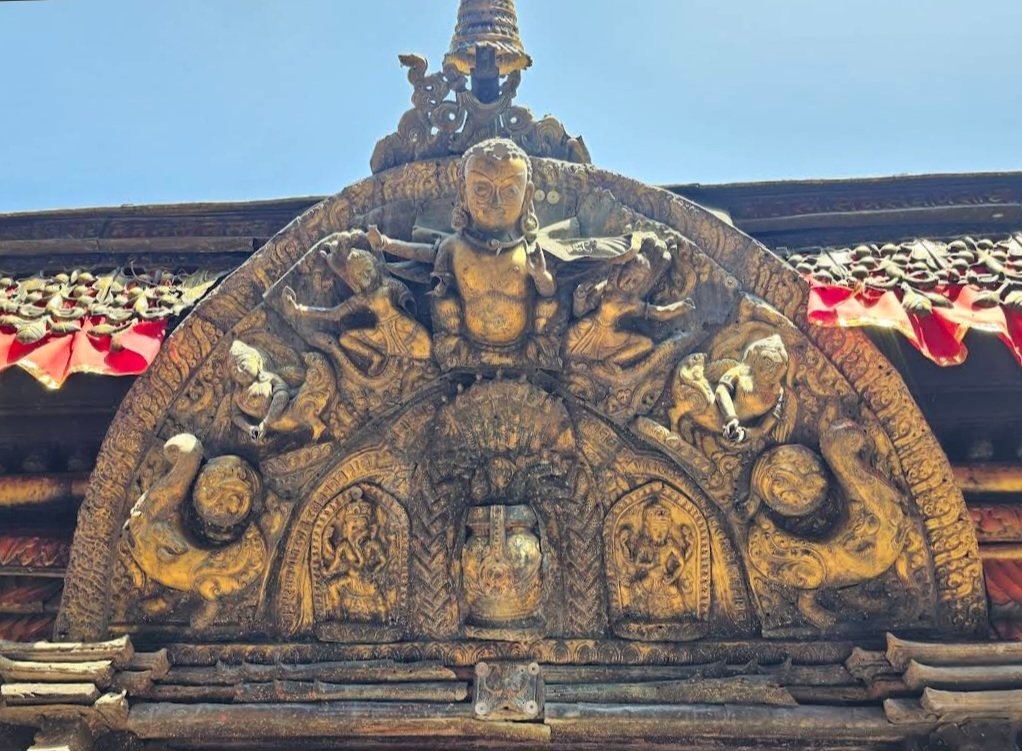
Nepal Tourism Board describes worship centered on a water-filled sacred opening covered by a silver kalash. This account is important because it distinguishes the sanctuary’s sacred form from a conventional standing statue. The exterior torana pictured here is an architectural detail, not an image of the sacred form within.
The name Guhyeshwari is commonly encountered in several English spellings, including Guheshwori and Guheswori in institutional accounts. These variations need not indicate different temples. The Shakti guide provides a broader introduction to Goddess theology; the local form of worship needs to be understood through sources specific to this place.
Nepal Tourism Board, Pashupatinath: Guhyeshwari sanctuary, tradition and entry guidance.
Temple entrance and architectural detail
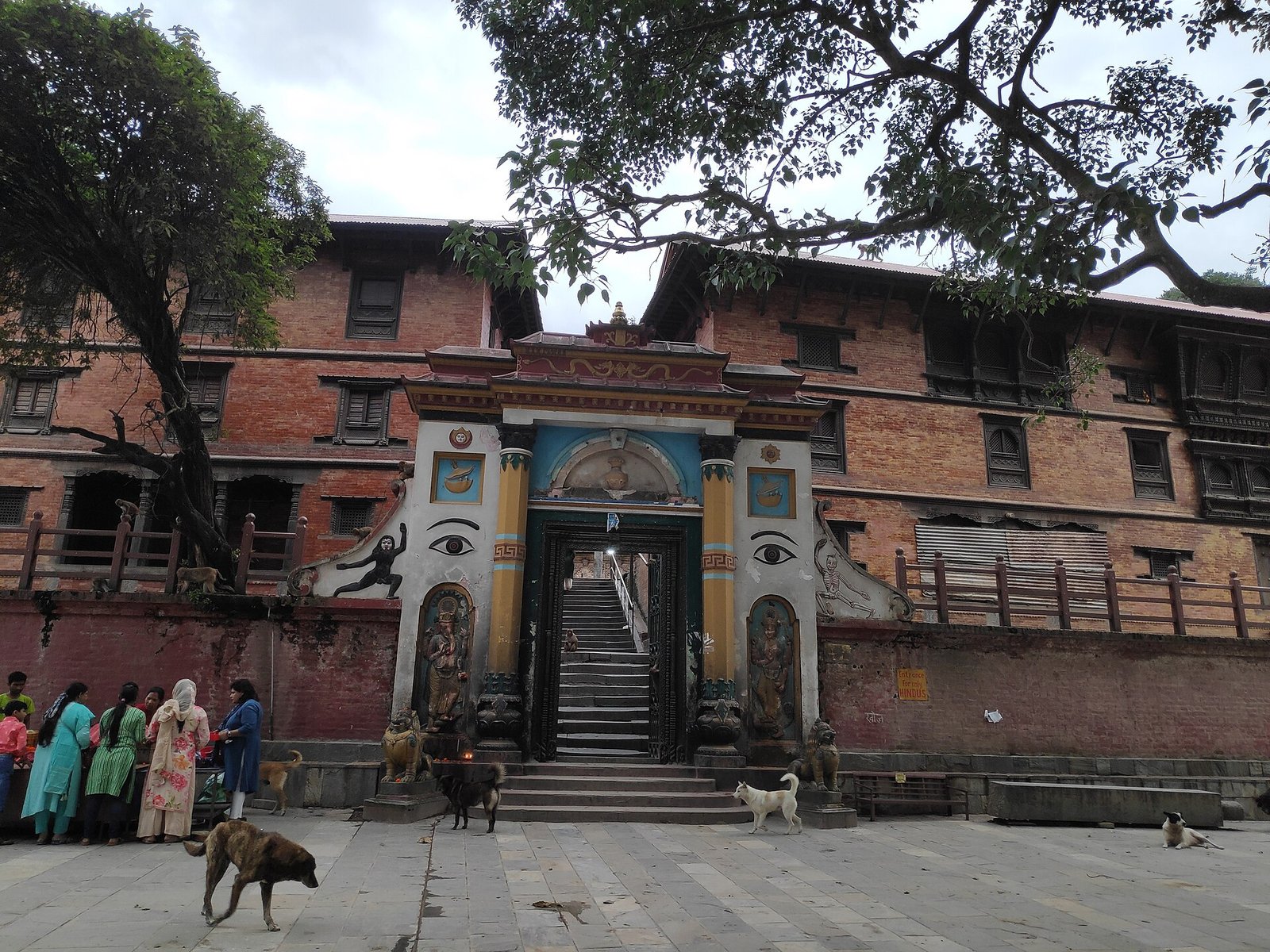
The entrance photograph places the shrine within Kathmandu’s brick-built, tree-lined sacred area. The retained torana photograph offers a closer architectural record. Its sculpted figures should not be confused with the water-centered form described within the sanctuary.
No image of the sacred opening has been imported without a secure identity and reuse basis. The public exterior and torana together document the place while preserving that distinction.
Pashupati Area Development Trust, Guheswori Temple.
Pilgrimage and current observances
The Pashupati Area Development Trust is a source for institutional notices and the surrounding sacred area. Consult current local guidance for access, photography and festival arrangements. This profile does not assign an annual ritual date without a temple-specific announcement.
Compare Kamakhya for another Peetha tradition in which the sacred form is central to understanding the sanctuary. Such comparison can reveal meaningful differences in regional worship without turning either site into a universal model for all Goddess temples.
Pashupati Area Development Trust, Guheswori Temple.
When to visit
A dependable temple-specific peak, intermediate and quieter-period pattern has not been established from the reviewed institutional material. No generic weekday claim is substituted. Consult the Trust for observances and access around the intended date.
Pashupati Area Development Trust, Guheswori Temple.
Map and geographic orientation
Regional orientation, without route lines or street detail. Delhi is a geographic reference; these maps do not describe a road journey or cross-border access.
No nearby major railway point has been verified; it is omitted.
India and surrounding region
Regional orientation
- Temple: Guhyeshwari Temple, Nepal. Geographic orientation point; terminal entrance and services require a current check.
- Delhi reference: Delhi, India. Approximate city reference (source precision 0.1 degree); distances are rounded straight-line orientation.
- Major city: Kathmandu, Nepal. Approximate city reference, not an entrance.
- Airport: Tribhuvan International Airport, Nepal. Geographic orientation point; terminal entrance and services require a current check.
Natural Earth public-domain land; DataMeet CC0 India outline following the Survey of India depiction. Other political boundaries are omitted. Points identify present-day countries; place markers are orientation points, not entrances.
Planning Your Visit
- Nearest major city
- Kathmandu
- Temple location
- Kathmandu
- State / province / region
- Bagmati Province
- Country
- Nepal
- Nearest airport
- Tribhuvan International Airport, Kathmandu (KTM)
- Approx. distance from Delhi
- About 800 km straight-line; not road distance
- Distance source, endpoints and method
- Delhi distance: great-circle calculation (Earth radius 6,371 km) between the reviewed temple point and approximate Delhi city reference, rounded to 10 km. It is not a road, flight or cross-border itinerary.
- Typical access route
- The Nepal Tourism Board identifies the Pashupati area with the Gaushala transport approach. Confirm the final local approach to Guhyeshwari separately.
- Terrain / altitude / stairs / accessibility
- A temple landscape with paths and steps near the Bagmati. A verified step-free route is not supplied.
- Official temple website
- Official temple website
- Government tourism / heritage URL
- Government tourism / heritage URL
- Visitor-information sources and checked date
- Reviewed 2026-10-21 against the institutional sources linked below. Approximate distance endpoints and methods are qualified separately; this is not a live timetable.
Practical temple information
- Entry / security rules
- Nepal Tourism Board states that entry to Guhyeshwari is restricted to Hindus. Confirm current arrangements with the institution.
- Practical access note
- No nearby major passenger railway gateway is asserted. The airport and Kathmandu points provide orientation, not a surveyed entrance route.
Last verified: . Check the linked institution for changed arrangements.
Nearby sacred and cultural places
Pashupatinath and the Bagmati riverbanks are the immediate sacred context. UNESCO’s Kathmandu Valley documentation is useful for the larger monument landscape. Entry rules and photography arrangements for one sanctuary should not automatically be transferred to another.
UNESCO, Kathmandu Valley: wider monument-zone context.
Photos and gallery

Watch / Explore Further
Further reading
Related reading
Sources and method
- Pashupati Area Development Trust, Guheswori Temple
- Nepal Tourism Board, Pashupatinath: Guhyeshwari sanctuary, tradition and entry guidance
- UNESCO, Kathmandu Valley: wider monument-zone context
Textual classifications follow the 51-entry PN working list. Our source method distinguishes sacred narrative, institutional testimony and historical evidence. Image sources and reuse terms accompany each photograph.