
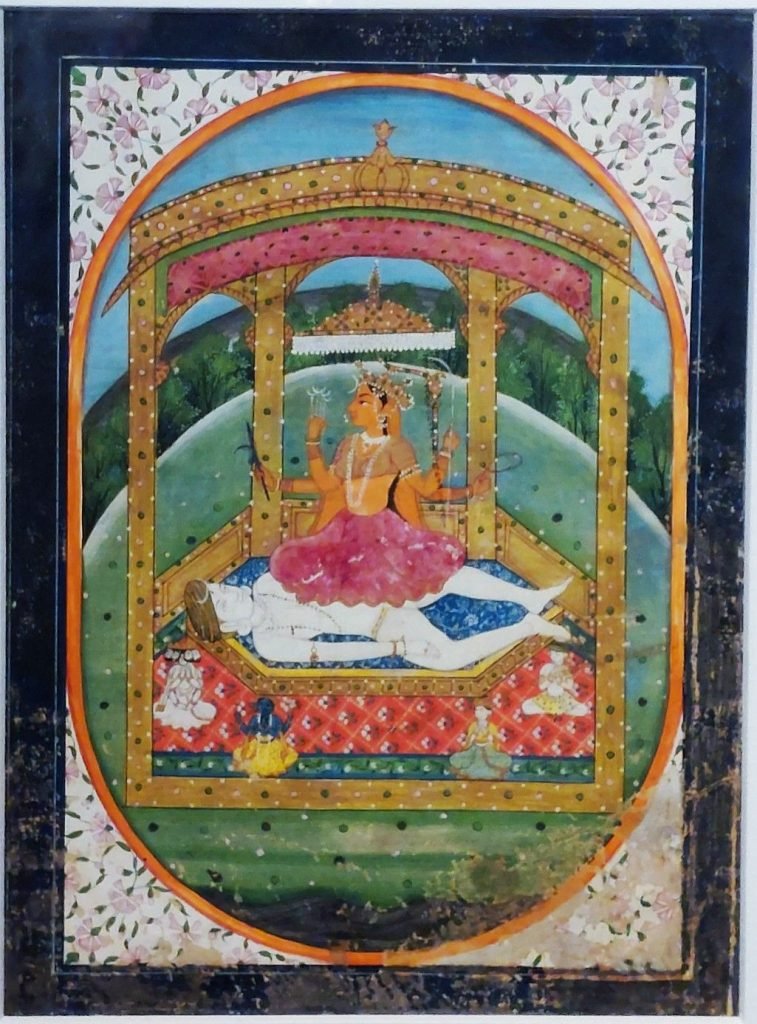

- Alternate names
- Lalita; Tripurasundari; Mahatripurasundari; Rajarajeshwari; Rajarajesvari; Tripura; Shodashi; Shodasi
- Traditions / lineages
- Sri Vidya; Shakta Tantra; Srīkula; South Indian Smarta Sri Vidya where specifically relevant
- Scriptural associations
- Lalitopakhyana; Lalita Sahasranama; Sri Vidya Tantric literature; Tripura Rahasya where carefully contextualized
On this page
Lalita Tripurasundari is the central Goddess of Sri Vidya, one of the most developed Goddess-centered Tantric traditions in Hinduism.
She is worshipped as beautiful, sovereign and compassionate, but her significance extends far beyond appearance. Within Sri Vidya theology she may be understood as Mahadevi, the supreme Goddess, whose presence is expressed through divine form, sacred mantra and the geometric structure of the Sri Chakra.
The name Tripurasundari is commonly translated as “the Beauty of the Three Cities” or “the Beautiful One of the Three Worlds.” Sri Vidya traditions interpret her threefold nature through several sets of triads, including worlds, states of consciousness and levels of manifestation.
Modern scholarship describes Sri Vidya as a Shakta Tantric tradition centered on Tripurasundari under names including Lalita, Rajarajeshwari and Tripura. Its historical development involved both esoteric Kaula lineages and later forms integrated into South Indian Smarta and temple traditions.
This complexity is important. Lalita is both a personal Goddess addressed through devotion and the center of a sophisticated ritual and philosophical system.
What Does Lalita Tripurasundari Mean?
Her name combines several layers of meaning.
Lalita can convey grace, charm, playfulness and beauty.
Tripura literally suggests “three cities” or “three realms.”
Sundari means “beautiful woman” or “the beautiful one.”
Taken together, Tripurasundari is often translated as “the Beauty of the Three Worlds.”
Sri Vidya traditions develop the meaning much further by interpreting the “three” through different sacred triads. These may include the three worlds, three states of consciousness, three powers or other threefold frameworks used within Tantric and Vedantic interpretation.
Oxford’s recent overview of Sri Vidya notes that Tripura’s nature is deliberately understood through many triads in the tradition rather than through one single literal explanation.
Formal transliteration:
Lalitā Tripurasundarī
Devanagari:
ललिता त्रिपुरसुन्दरी
What Is Sri Vidya?
Sri Vidya, Sanskrit Śrīvidyā, may be translated broadly as “Auspicious Wisdom.”
It is a major Shakta Tantric tradition centered on Lalita Tripurasundari.
Its ritual and theological system developed over many centuries and includes:
- mantra
- Sri Chakra worship
- meditation
- internal and external ritual
- Goddess theology
- philosophical interpretation
- initiation and lineage transmission
The tradition is not reducible to one practice.
Douglas Renfrew Brooks’s major study of Sri Vidya describes a system that joins devotion, knowledge and ritual and focuses on three principal manifestations of the Goddess: Lalita Tripurasundari as divine form, her mantra, and the Sri Chakra.
Oxford’s overview likewise describes Tripurasundari through three levels: the visible Goddess form, the subtle Sri Chakra and the still subtler mantra.
That framework helps explain why art, geometry and sacred sound are so closely connected in this tradition.
Lalita as Supreme Goddess
Within Sri Vidya, Lalita is not simply one Goddess among many.
Brooks describes Lalita Mahatripurasundari as a Mahadevi, a Great Goddess who is conceived as encompassing or surpassing other divine forms within the theology of the tradition.
This does not mean every Hindu tradition recognizes Lalita as supreme.
It is a theological claim belonging specifically to Sri Vidya and related Shakta traditions.
Within that framework, other gods and goddesses can be understood as expressions within her cosmic order.
This is one of the clearest examples of why DurgaShakti must distinguish between:
- “Hinduism says”
- “Shaktism says”
- “Sri Vidya teaches”
The third is the accurate formulation here.
Lalita’s Iconography
Lalita Tripurasundari is typically represented as a beautiful Goddess with a youthful and serene appearance.
Common attributes include:
- a sugarcane bow
- five flower arrows
- a noose
- a goad
- a red or rosy complexion
- a royal throne
- elaborate ornaments
- imagery of sovereignty and beauty
Her iconography differs noticeably from the fierce visual language associated with Kali.
The difference is theological as well as aesthetic. Sri Vidya frequently emphasizes Lalita’s auspicious and beautiful form.
Oxford’s overview describes her visible, or sthula, form as a beautiful maiden with rosy complexion, playful and maternal in character.
The four principal objects in her hands should not automatically be given one fixed modern psychological meaning. Their interpretation belongs within specific ritual, textual and theological traditions.
The Sugarcane Bow and Five Flower Arrows
Lalita’s sugarcane bow and flower arrows are among her most recognizable attributes.
They evoke beauty, attraction and divine sovereignty rather than the battlefield weapons usually associated with Durga.
The imagery also connects her with Kama, the Hindu deity of desire, whose bow and arrows have similar associations.
Within Sri Vidya, these objects receive layered ritual and philosophical interpretations.
Some later teachings associate the bow with the mind and the arrows with the senses or subtle faculties.
Such readings should be identified as interpretive traditions rather than presented as the only meaning of the objects.
The visual contrast remains striking: Lalita wields flowers and sugarcane as instruments of divine power.
The Noose and Goad
Lalita’s other two common attributes are the pasha, or noose, and ankusha, or goad.
Both appear widely in Indian sacred iconography.
Within Sri Vidya commentarial traditions, they can receive symbolic interpretations connected with attraction, control, guidance and the forces that shape consciousness.
Their meanings vary by text and lineage.
DurgaShakti should avoid reducing them to simplified statements such as:
“Noose equals attachment”
“Goad equals discipline”
unless a specific source or commentary is being cited.
The objects belong first to Lalita’s traditional iconography. Their philosophical interpretation can then be presented within the framework of the text or teacher offering it.
What Is the Sri Chakra?
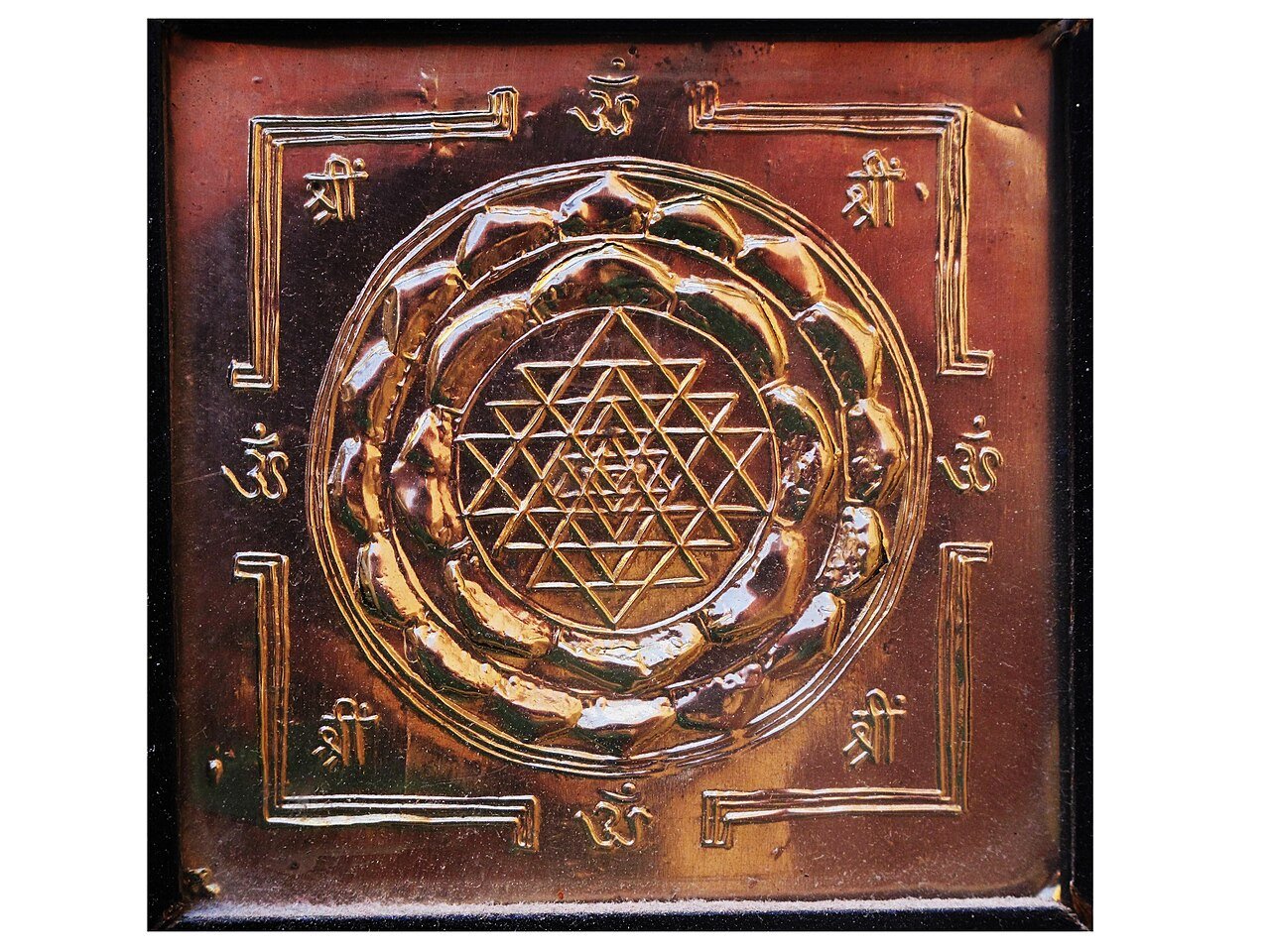
The Sri Chakra, also called Sri Yantra, is one of the defining symbols of Sri Vidya.
It consists of nine interpenetrating triangles arranged around a central point, or bindu, with surrounding lotus petals, enclosures and gateways.
Its geometry represents a sacred cosmos.
Within Sri Vidya, the diagram is not simply decorative. It functions as a ritual and contemplative form of the Goddess.
Oxford’s overview calls the Sri Chakra Tripurasundari’s subtle form and notes its central role in the tradition by around the eleventh century.
Brooks similarly identifies the Sri Chakra as one of the three principal manifestations through which Lalita is approached.
The Sri Chakra can appear:
- drawn
- engraved on metal
- installed as a three-dimensional Sri Meru
- incorporated into temple worship
- used within initiated ritual practice
The Sri Chakra requires careful study within its specific ritual and theological traditions.
Read about symbols and philosophy →

The Bindu and the Goddess
At the center of the Sri Chakra lies the bindu, a single central point.
Within Sri Vidya this is not merely geometric.
The bindu is closely associated with Lalita and with the center from which the rest of the diagram unfolds.
The Sri Chakra moves visually from multiplicity toward unity.
Its many triangles, lotuses and enclosures ultimately converge upon a single point.
This structure supports several layers of ritual and philosophical interpretation concerning manifestation, consciousness and return to the divine center.
The precise ritual meanings of the Sri Chakra belong partly to initiated traditions. DurgaShakti should explain publicly documented theology without pretending to teach restricted ritual practice.
Mantra and Lalita
Mantra is another central dimension of Sri Vidya.
The tradition includes hierarchies of sacred mantras connected with Lalita, including the well-known Panchadashi, or fifteen-syllable mantra, and other related forms.
Brooks describes repetition and interpretation of Lalita’s root mantra as central to Sri Vidya ritual and initiation.
Because these practices are embedded within traditions of diksha, or initiation, DurgaShakti should distinguish between describing the existence and significance of such mantras and publishing ritual instructions for their use.
The site can responsibly explain:
- what a mantra is
- which texts discuss it
- its role in Sri Vidya
- its relationship to Lalita
It should not present itself as a substitute for lineage instruction.
Lalita Sahasranama
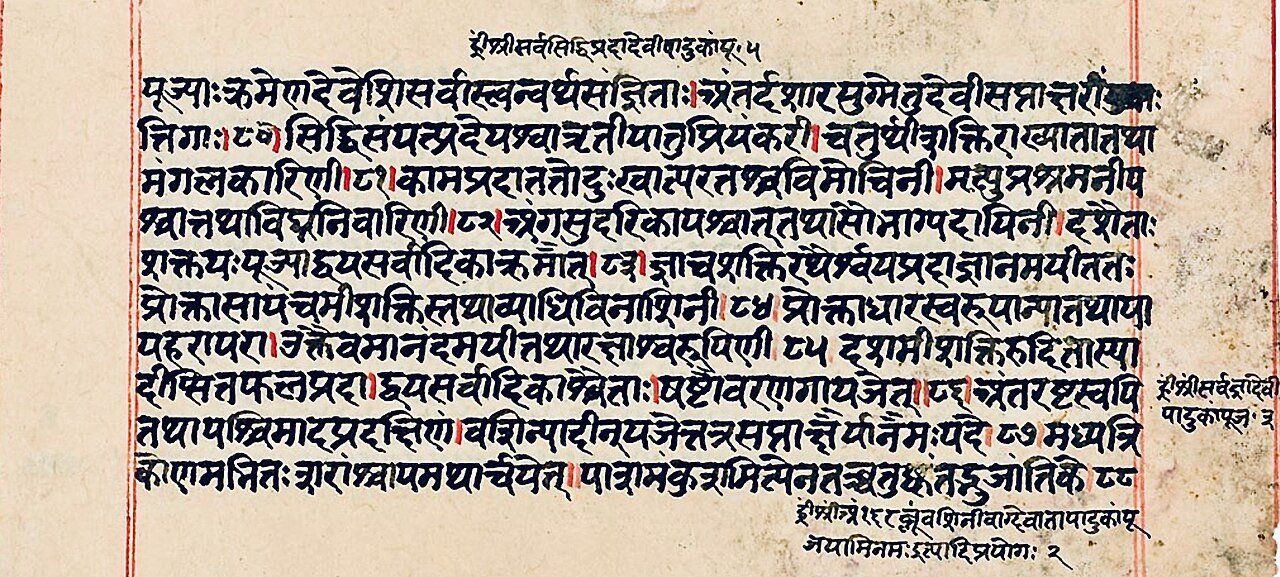
The Lalita Sahasranama, the “Thousand Names of Lalita,” is one of the most widely known devotional texts associated with Lalita Tripurasundari.
It appears within the Brahmanda Purana tradition and presents one thousand names through which the Goddess’s qualities, forms, theology and sacred geography are praised.
The text is important both devotionally and doctrinally.
Its names connect Lalita with:
- supreme Goddess theology
- Sri Chakra
- mantra
- cosmic sovereignty
- beauty
- compassion
- knowledge
- divine motherhood
For many devotees, regular recitation of the Lalita Sahasranama is one of the most accessible points of contact with Lalita outside more specialized Sri Vidya ritual.
A dedicated DurgaShakti guide should eventually examine the text, its source tradition and selected names in more detail.

Lalita and the Brahmanda Purana
Much of Lalita’s widely known mythology comes through the Lalitopakhyana, a narrative associated with the Brahmanda Purana.
The text describes Lalita’s manifestation, divine city, army and battle with the demon Bhandasura.
This narrative provides an important mythological framework for her iconography and theology.
Within the story, Lalita is not presented merely as a beautiful Goddess seated passively on a throne. She is sovereign, commands divine forces and defeats a major demonic adversary.
This introduces a dimension sometimes lost when Lalita is contrasted too sharply with fierce goddesses.
Her beauty and benevolence coexist with power and sovereignty.
Study of the Lalitopakhyana requires distinguishing the narrative text from later devotional summaries and modern retellings.
Lalita and Bhandasura
The battle with Bhandasura is the major martial narrative associated with Lalita.
According to the Lalitopakhyana tradition, the Goddess leads divine forces against Bhandasura and his armies.
Figures associated with Sri Vidya, including forms such as Varahi and Matangi, participate in the larger divine structure surrounding her.
The story helps explain why Lalita’s royal imagery matters.
She is Rajarajeshwari, sovereign over sovereigns.
Her throne, attendants, divine city and army all belong to a theology of sacred kingship and cosmic order.
The battle narrative therefore differs visually from Durga’s struggle with Mahishasura, but both express the Goddess as capable of restoring divine order.
Why Is She Called Rajarajeshwari?
Rajarajeshwari, “Queen of Kings” or “Sovereign of Sovereigns,” is one of Lalita’s important names.
It emphasizes her royal and cosmic authority.
She is often represented seated upon a throne in a divine city described in Sri Vidya literature.
Royal imagery should not be dismissed as decorative.
Sovereignty is part of Lalita’s theological identity.
Her beauty is not passive beauty. It belongs to a Goddess imagined as the ruler of a sacred cosmos.
This is why terms such as queen, empress and sovereign recur so frequently in Lalita traditions.
Lalita and Sri Nagara
Sri Vidya texts describe Lalita as residing in Sri Nagara, the sacred city associated with her cosmic realm.
Descriptions of Sri Nagara develop an elaborate sacred geography of enclosures, palaces, divine beings and the central seat of the Goddess.
This sacred city corresponds conceptually with the Sri Chakra.
The relationship between architecture, diagram and theology is one of Sri Vidya’s most distinctive features.
A ritual diagram can therefore function as a map of divine reality rather than merely an abstract symbol.
These descriptions of Sri Nagara relate to the Sri Chakra and to Lalita’s title as Rajarajeshwari.
Lalita, Tripurasundari and Shodashi
Lalita is also closely associated with the name Shodashi, meaning “the sixteen-year-old.”
In Tantric Goddess traditions, Shodashi is connected with fullness, beauty and completeness.
She is also counted among the Mahavidyas, where Tripurasundari or Shodashi usually occupies an important place.
This creates a connection between Sri Vidya and the Mahavidya tradition, but the two should not be collapsed into one system.
Sri Vidya has its own texts, lineages, mantras and Sri Chakra ritual structure.
The Mahavidya framework organizes ten powerful forms of the Goddess in a different theological arrangement.
Lalita and the Mahavidyas
The Mahavidyas commonly include:
- Kali
- Tara
- Tripurasundari or Shodashi
- Bhuvaneshwari
- Bhairavi
- Chinnamasta
- Dhumavati
- Bagalamukhi
- Matangi
- Kamala
Lalita’s place within this grouping connects the auspicious, beautiful Goddess of Sri Vidya with a broader Tantric system that includes both gentle and fierce forms.
The presence of both Kali and Tripurasundari among the Mahavidyas shows how Shakta Tantra accommodates very different divine appearances without treating beauty and terror as theological opposites.
Sri Vidya and South India
Sri Vidya became especially influential in South India.
Oxford’s overview describes how South Indian forms of Sri Vidya were adopted within Smarta Shaiva communities and adapted to Brahmanical ritual norms while retaining their Tantric foundations.
The tradition became closely associated with temples, monastic institutions and learned ritual lineages in regions including:
- Tamil Nadu
- Andhra Pradesh
- Karnataka
- Kerala
Kanchipuram’s Kamakshi tradition is particularly important.
IGNCA’s documentation of the Kamakshi temple explains that the temple’s ritual tradition developed around the Goddess understood in the aspect of Lalita Tripurasundari and around Sri Chakra worship.
This is an example of Sri Vidya moving between esoteric ritual systems and public temple religion.
Tripurasundari Beyond South India
Sri Vidya’s strongest historical institutional presence is associated with South India, but the name and worship of Tripura Sundari also appear in other regions.
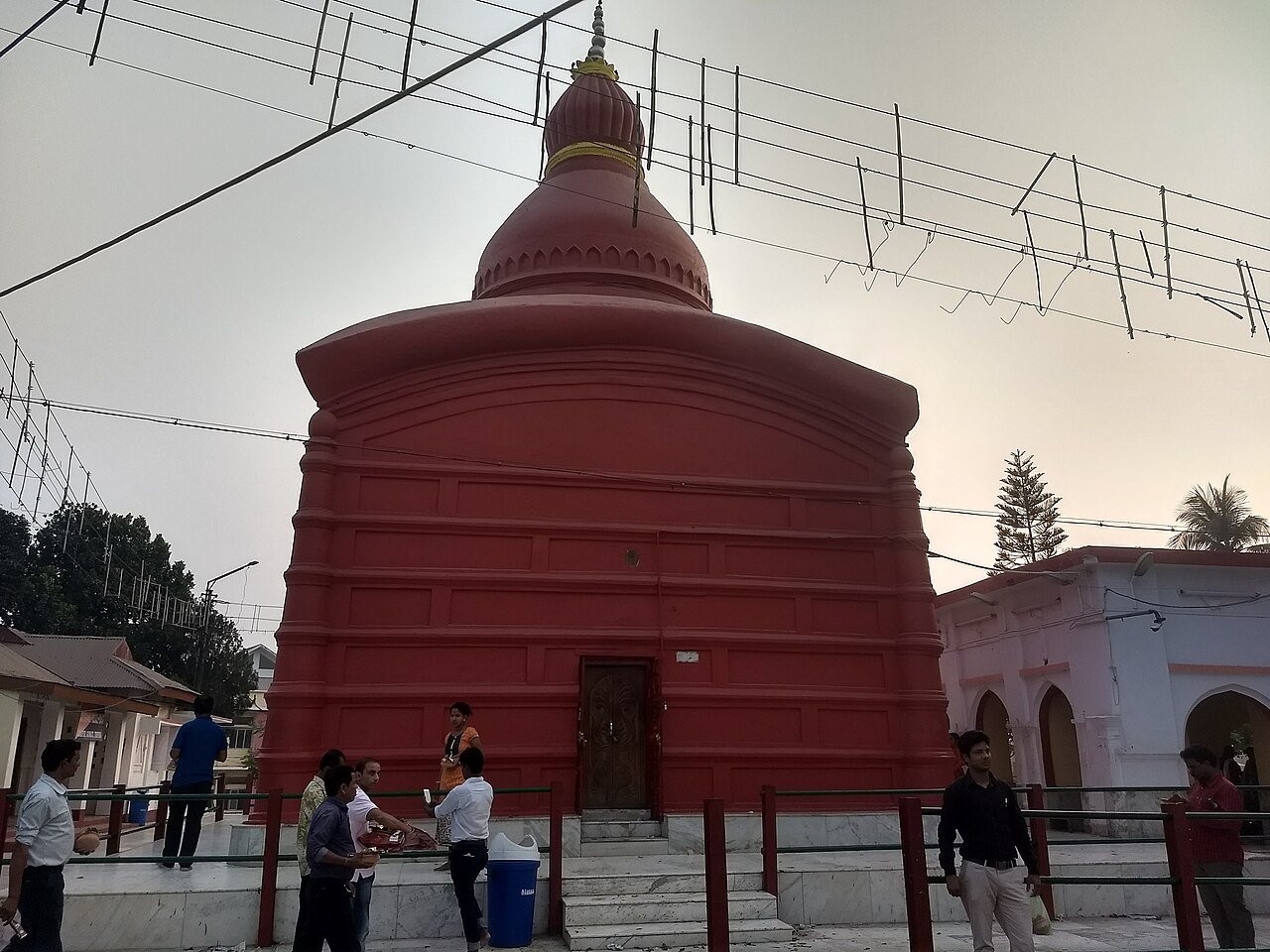
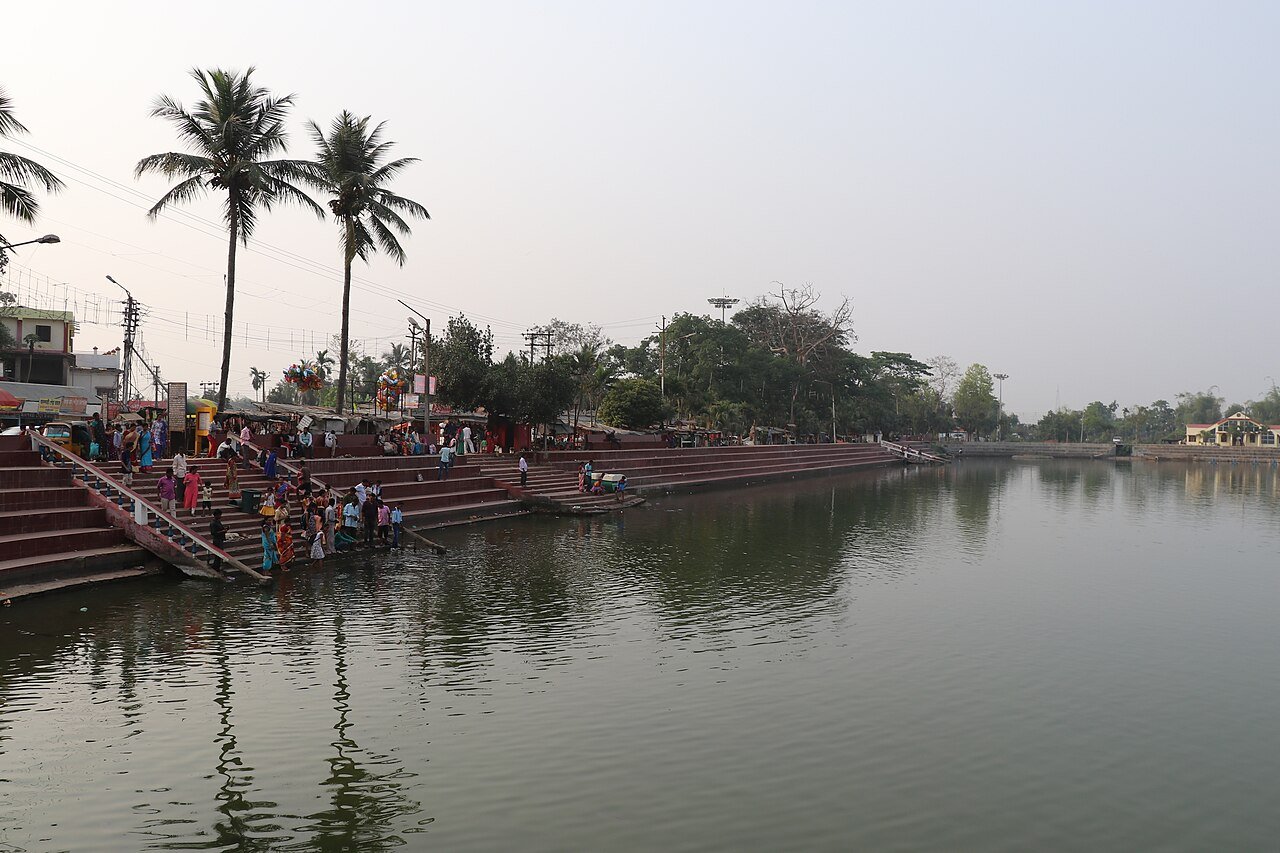
A particularly important example is the Tripura Sundari Temple at Udaipur in Tripura, in Northeast India.
Government sources identify the temple, popularly known as Matabari, as a major Shakti Peetha. The present temple is associated with Maharaja Dhanya Manikya and dates to 1501 CE. It houses a principal image of Tripura Sundari alongside a smaller image known locally as Chhoto Ma.
Local tradition identifies the Goddess with forms such as Tripureshwari and Soroshi, and the temple has a major Diwali festival tradition. Government tourism sources also describe it as one of the important Shakti Peethas of the region.
This regional tradition should not automatically be treated as identical to every South Indian Sri Vidya lineage simply because the deity is called Tripura Sundari.
The shared name connects them, but local history, ritual and theology deserve separate attention.
This is precisely the kind of regional distinction DurgaShakti should preserve.

Tripura Sundari and the Shakti Peetha Tradition
The Tripura temple also introduces a larger subject: the Shakti Peethas.
Shakti Peetha traditions connect sacred sites across the Indian subcontinent with the story of Sati and Shiva. Different textual and regional lists identify varying numbers and locations.
The Matabari tradition identifies the site as the place where Sati’s right foot fell. Government sources describe it among the 51 Shakti Peethas.
This should be presented as sacred geographical tradition, not archaeological verification of a mythological event.
Shakti Peetha traditions connect:
- Devi theology
- pilgrimage
- regional Goddess traditions
- Sati mythology
- temples
- sacred geography

Lalita and Kamakshi
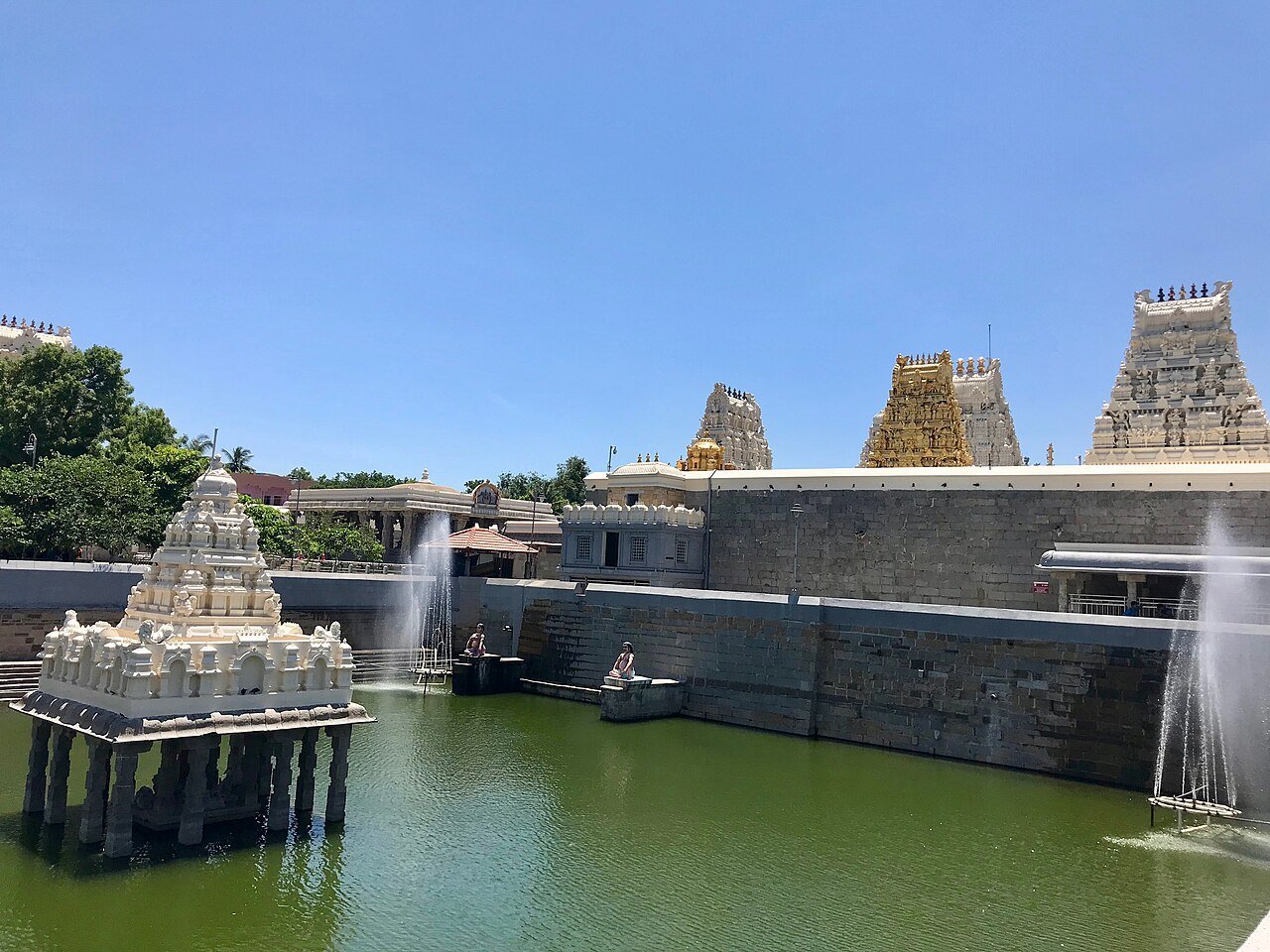
Kamakshi, the principal Goddess of Kanchipuram, has an important relationship with Sri Vidya.
IGNCA documentation of the Kamakshi temple notes that the temple’s ritual system developed with Sri Chakra worship and identifies Kamakshi in the aspect of Rajarajeshwari Lalita Tripurasundari.
This does not mean the names Kamakshi and Lalita should always be treated as interchangeable in every context.
Kamakshi has her own temple history, mythology and regional identity.
Within the Kanchipuram Sri Vidya tradition, however, the relationship is explicit and theologically important.
This makes the Kamakshi temple one of the most useful sites for understanding how Sri Vidya exists as a living temple tradition rather than only as a textual system.

Lalita, Beauty and Power
The name Tripurasundari places beauty at the center of Lalita’s identity.
Yet beauty in Sri Vidya is not simply physical attractiveness.
The Goddess’s beauty belongs to an ordered cosmos in which form, sound, geometry, consciousness and divine power are interconnected.
The Sri Chakra is beautiful because its geometry expresses sacred order.
Mantra is beautiful through sound and pattern.
Lalita’s royal form is beautiful because divine sovereignty is imagined through harmony and plenitude.
This is why describing her only as “the most beautiful Goddess” misses the theological depth of the name.
Her beauty participates in how the tradition imagines reality itself.
Lalita and Shiva
Sri Vidya includes a rich theology of Shiva and Shakti.
Lalita may be represented with Kameshvara, a form of Shiva associated with her.
Their relationship is part of the tradition’s understanding of consciousness and power.
Like other Shiva-Shakti systems, the two may be described conceptually as inseparable aspects of divine reality.
Sri Vidya, however, gives Lalita its own distinctive theological center.
She is not merely introduced as Shiva’s wife and then explained through him.
The tradition’s ritual, mantra and Sri Chakra structures are explicitly Goddess-centered.
Is Lalita the Same as Parvati?
Some traditions identify Lalita with Parvati or place her within a broader Parvati-Shakti framework.
Within Sri Vidya, however, Lalita’s identity is more specific.
She is the central deity of a ritual and theological system with her own:
- mantras
- sacred diagram
- divine city
- iconography
- narratives
- commentarial traditions
Calling her simply “a form of Parvati” can therefore obscure more than it explains.
A more accurate approach is to recognize that Hindu Goddess traditions frequently connect divine forms while also maintaining distinctive theological identities.
Lalita as a Living Goddess
Sri Vidya remains a living tradition.
Practitioners worship Lalita through:
- temple ritual
- household devotion
- Lalita Sahasranama recitation
- Sri Chakra worship
- mantra
- meditation
- lineage-based initiated practice
Some dimensions are public and widely accessible.
Others remain connected with initiation, teacher-student transmission and ritual restrictions.
Modern Sri Vidya communities exist in India and internationally. Oxford’s overview notes that the tradition is practiced globally today through both public and private forms.
DurgaShakti should document that living tradition respectfully without attempting to publish restricted teachings or imply that textual knowledge replaces initiation.
Continue Exploring
Goddess traditions
Sri Vidya and philosophy
- Symbols, Philosophy & Concepts →
- Sri Chakra
- Sri Vidya
Texts
- Scriptures & Sacred Texts →
- Lalita Sahasranama
- Lalitopakhyana
Sacred places
- Temples & Sacred Places →
- Tripura Sundari Temple, Matabari
- Kamakshi Temple, Kanchipuram
Practice
Sources & Further Reading
Academic scholarship
Maciej Karasiński, “Śrī Vidyā,” Oxford Bibliographies in Hinduism.
Primary overview for:
- development of Sri Vidya
- Tripurasundari
- Sri Chakra
- mantra
- Kaula and Smarta forms
- historical development
- contemporary practice
Douglas Renfrew Brooks, Auspicious Wisdom: The Texts and Traditions of Śrīvidyā Śākta Tantrism in South India.
Foundational academic study for:
- Lalita Mahatripurasundari
- Sri Vidya theology
- Sri Chakra
- mantra
- ritual structure
- relationship with wider Hindu traditions
Indian cultural sources
IGNCA documentation of the Kamakshi Temple, Kanchipuram.
Especially useful for:
- Kamakshi and Lalita Tripurasundari
- Sri Chakra
- temple ritual
- public Sri Vidya tradition
Northeast Indian sacred geography
Ministry of Tourism, Government of India, Tripura Sundari Temple.
Useful for:
- Matabari
- temple history
- Tripurasundari image
- Shakti Peetha tradition
- Diwali festival
- temple architecture
Tripura Tourism / Government documentation.
Useful for:
- local names and forms
- Chhoto Ma
- Kalyan Sagar
- local worship
- regional pilgrimage tradition