
Jwalamukhi Temple
Jwala Devi; Siddhidā / Ambikā in the PN witness · Jwalamukhi, Kangra district, Himachal Pradesh, India
Shakti PeethaMaha Shakti Peetha
At Jwalamukhi in Himachal Pradesh, the Goddess is worshipped through flames emerging from rock, with distinct names preserved in the 51- and 18-seat traditions.

Quick facts
- Primary deity
- Jwala Devi; Siddhidā / Ambikā in the PN witness
- Location
- Jwalamukhi, Kangra district, Himachal Pradesh, India
- Classification
- PN 51 working list; 18 Maha hymn list
- City / regional gateway
- Kangra; Dharamsala is another regional gateway
- Airport
- Kangra Airport, Gaggal (DHM)
- Major railway station
- Pathankot Junction, major broad-gauge gateway
- Approx. distance from Delhi
- About 370 km straight-line; not road distance
- Major festival periods
- Chaitra and Sharad Navratri
On this page
Spiritual importance and significance
Jwalamukhi is a Shakta shrine in the Kangra region where flame is the central manifestation of the Goddess. Worship is directed toward fire emerging from the rock rather than a conventional standing image. The district account identifies the sacred place with Sati’s tongue.
The Pithanirnaya witness used on DurgaShakti names Siddhidā or Ambikā, accompanied by Unmatta Bhairava. The selected eighteen-seat hymn names Vaiṣṇavī at Jvālāmukhī. Both groupings can point to this working site without making their Goddess names identical. The two source relationships are retained in the structured facts.
Kangra District, Shri Jawalamukhi Mata Temple: sacred form, Navratri and access.
Sacred story and textual tradition
The tongue association places Jwalamukhi within the Sati narrative of sacred seats. Local accounts also preserve stories involving epic figures and royal visitors. Such narratives explain devotion and recognition; they do not date the rock formation or prove when the present building was constructed.
Stories concerning Akbar and the Goddess’s flame are widely repeated in the institutional description. They are presented here as temple tradition rather than as a verified contemporary court record. Historical patronage requires its own documentary support.
Kangra District, Shri Jawalamukhi Mata Temple: sacred form, Navratri and access.
What makes this temple distinctive?
- Natural flames are the focus of worship, so an unrelated Goddess sculpture would misrepresent the sanctuary.
- The selected 51 and 18 lists preserve different Goddess names for the same working location.
- The built temple frames a rock sanctuary within the Shivalik landscape.
History and development
The government temple portal records royal patronage and the regional history of the shrine. Its gallery notes refer to Ranjit Singh and Sansar Chand in connection with an 1809 agreement. This provides a more specific historical setting than treating every royal legend as a construction record.
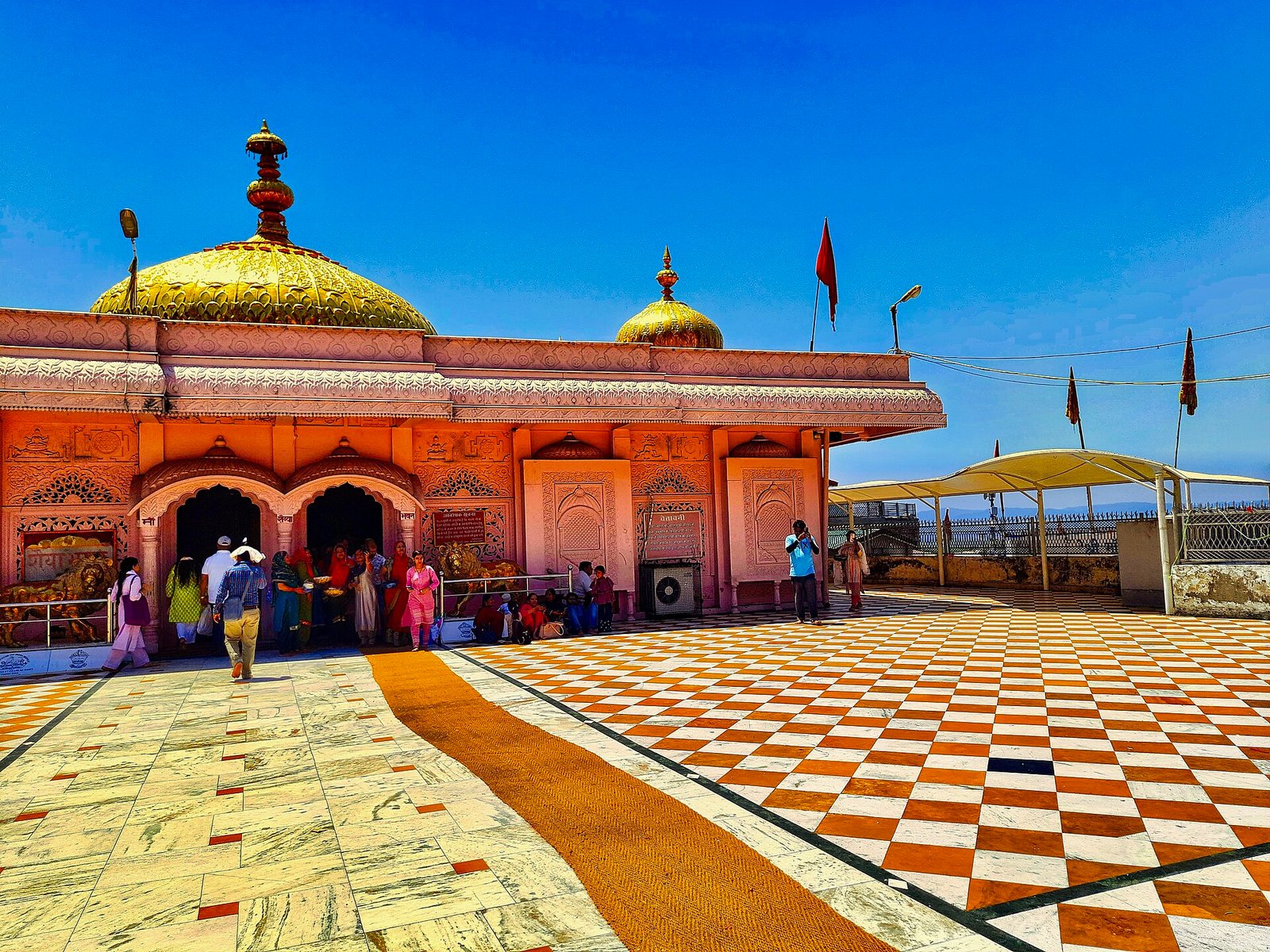
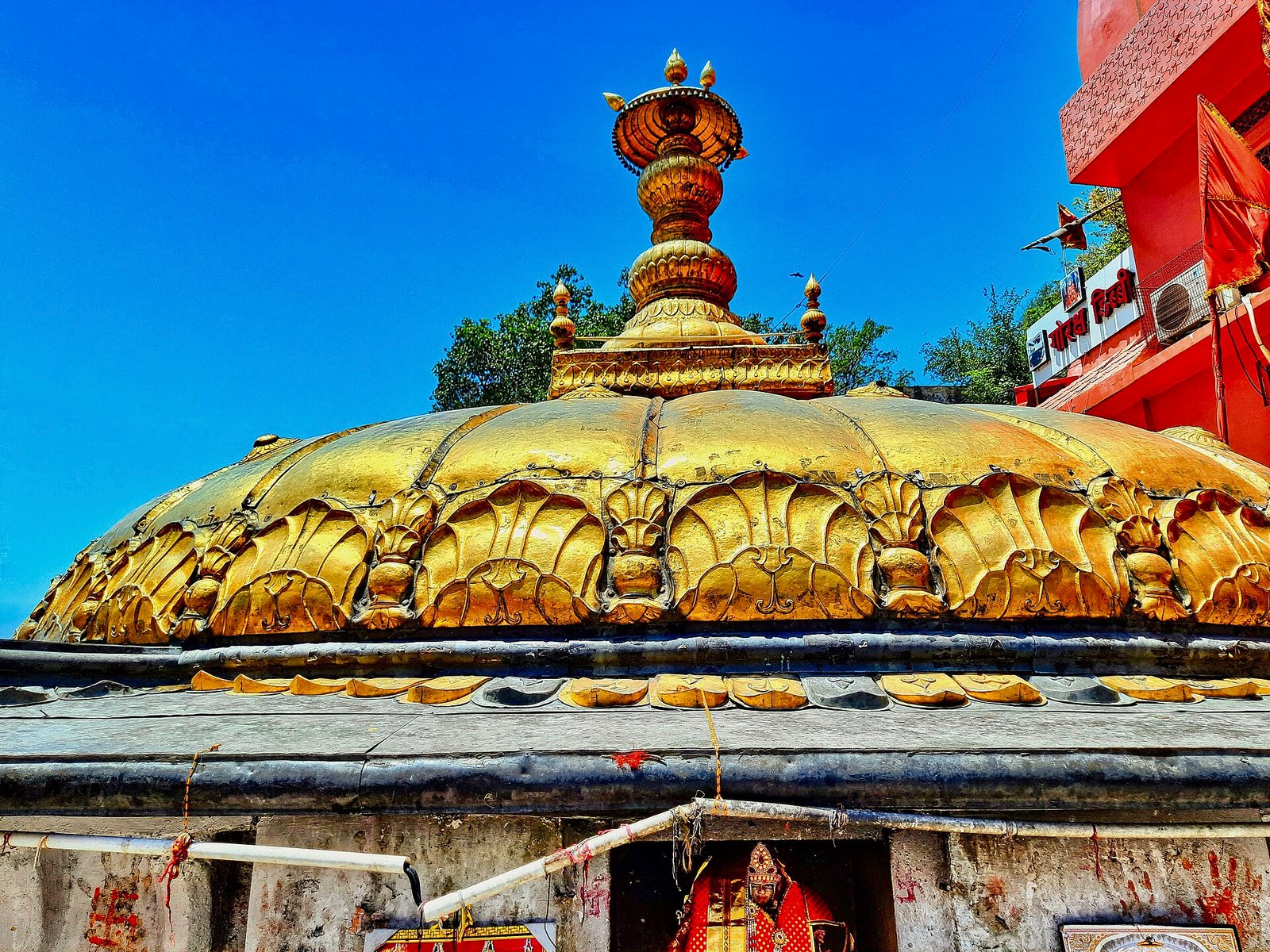
The visible gilded roofs and later fittings should be distinguished from claims about the antiquity of worship. The contemporary photographs document the present exterior, without assigning all of its fabric to a single ruler.
Kangra Temples, government temple portal and institutional information.
The Devi and sacred form
The district describes flames issuing from fissures in the rock and a tradition of nine manifestations. Their presence is understood within worship as the Goddess’s sacred form. A geological description and a devotional understanding address different questions; neither requires inventing a sculptural idol at the center of this shrine.
The images reproduced here are rights-cleared exterior and roof details. No unverified sanctum photograph or stock fire image is used as a substitute for the actual sacred flames.
Kangra District, Shri Jawalamukhi Mata Temple: sacred form, Navratri and access.
Architecture and temple complex
Courtyard buildings, gilded roof surfaces and the spire surround the sanctuary. The broad exterior view and closer roof photograph show how built architecture frames the place of the flames. They also record spaces used by visitors without claiming to document the interior worship itself.
The district’s approach description includes a climb or steps. Architecture and terrain therefore matter to a visit as well as to the visual character of the temple.
Kangra District, Shri Jawalamukhi Mata Temple: sacred form, Navratri and access.
Worship, rituals and festivals
Daily worship centers on the Goddess’s flames, with Navratri bringing the principal fair periods highlighted by the district. Chaitra and Sharad Navratri belong to the local annual calendar. Dates, entry controls and any special darshan arrangements should come from the temple trust’s current notices.
The shared Navratri guide explains the wider festival setting. It does not supply a permanent schedule for Jwala Ji or imply that the temple’s form of worship is identical to an image-based Navratri celebration.
Kangra District, Shri Jawalamukhi Mata Temple: sacred form, Navratri and access.
When to visit
The district distinguishes major Navratri gatherings from its broad March–June travel recommendation. There is no source-supported basis here for promising a short queue on a particular weekday.
Kangra District, Shri Jawalamukhi Mata Temple: sacred form, Navratri and access.
- Peak / Very Busy
- Navratri fairs, the major gatherings identified by the district temple account.
Kangra District, Shri Jawalamukhi Mata Temple. No supported weekday or off-season attendance estimate is supplied.
Map and geographic orientation
Regional orientation, without route lines or street detail. Delhi is a geographic reference; these maps do not describe a road journey or cross-border access.
City and transport points give regional context; overlapping points can be explored with zoom or the text key.
India and surrounding region
Regional orientation
- Temple: Jwalamukhi Temple, India
- Delhi reference: Delhi, India. Approximate city reference (source precision 0.1 degree); distances are rounded straight-line orientation.
- Major city: Kangra, India. Approximate city reference, not an entrance.
- Airport: Gaggal Airport, India. Geographic orientation point; terminal entrance and services require a current check.
- Railway station: Pathankot Junction railway station, India. Geographic orientation point; terminal entrance and services require a current check.
Natural Earth public-domain land; DataMeet CC0 India outline following the Survey of India depiction. Other political boundaries are omitted. Points identify present-day countries; place markers are orientation points, not entrances.
Planning Your Visit
- Nearest major city
- Kangra; Dharamsala is another regional gateway
- Temple location
- Jwalamukhi, Kangra district
- State / province / region
- Himachal Pradesh
- Country
- India
- Nearest airport
- Kangra Airport, Gaggal (DHM)
- Nearest major railway station
- Pathankot Junction, major broad-gauge gateway
- Approx. road distance from airport
- Approximately 46–50 km in the district tourism account
- Approx. road distance from nearest city
- About 30 km from Kangra in the district tourism account
- Approx. distance from Delhi
- About 370 km straight-line; not road distance
- Distance source, endpoints and method
- Kangra District’s Jwalamukhi tourist-place page gives approximate road-access figures, including ranges for airport/rail. Its separate brief-details page conflicts and is not used. Delhi is straight-line orientation, not these road distances. Delhi distance: great-circle calculation (Earth radius 6,371 km) between the reviewed temple point and approximate Delhi city reference, rounded to 10 km. It is not a road, flight or cross-border itinerary.
- Typical access route
- Road approach through the Kangra region; the final temple approach includes a short climb or steps as described by the district.
- Broad visiting season
- The district recommends March–June as a broad visiting period; Navratri arrangements require a separate check.
- Important festival periods
- Chaitra and Sharad Navratri
- Terrain / altitude / stairs / accessibility
- Rock-flame sanctuary with a stepped/climbing approach. Do not assume a step-free route; verify assistance with the temple trust.
- Official temple website
- Official temple website
- Government tourism / heritage URL
- Government tourism / heritage URL
- Visitor-information sources and checked date
- Reviewed 2026-10-21 against the institutional sources linked below. Approximate distance endpoints and methods are qualified separately; this is not a live timetable.
- Approx. road distance from railway station
- Approximately 123–140 km from Pathankot in the district tourism account
Practical temple information
- Current official timing source
- Current official timing source
- Practical access note
- Use the government temple-trust portal for current arrangements. An online listing is not confirmation that every booking service is currently available.
Last verified: . Check the linked institution for changed arrangements.
Regional sacred and cultural context
Kangra is the principal regional reference on the orientation map. The government Kangra Temples portal connects Jwala Ji with other administered temple institutions, but a shared administrative portal does not make them the same Peetha. The profile does not prescribe a multi-temple circuit.
Kangra Temples, government temple portal and institutional information.
Photos and gallery

Watch / Explore Further
Further reading
Related reading
Sources and method
- Kangra District, Shri Jawalamukhi Mata Temple: sacred form, Navratri and access
- Kangra Temples, government temple portal and institutional information
- Kangra Temples, historical and architectural gallery notes
Textual classifications follow the 51-entry PN working list and the eighteen-seat hymn grouping. Our source method distinguishes sacred narrative, institutional testimony and historical evidence. Image sources and reuse terms accompany each photograph.