
Biraja Temple, Jajpur
Biraja / Girija, a local Mahishamardini form · Jajpur, Odisha, India
Shakti Peetha: local tradition; PN identification qualifiedMaha Shakti Peetha
Biraja’s two-armed Mahishamardini form anchors Jajpur’s Goddess worship, ancestral rites and chariot-festival traditions in Odisha.


Quick facts
- Primary deity
- Biraja / Girija, a local Mahishamardini form
- Location
- Jajpur, Odisha, India
- Classification
- PN 51 working list: identification qualified; 18 Maha hymn list
- City / regional gateway
- Jajpur town; Bhubaneswar is the major air gateway
- Airport
- Biju Patnaik International Airport, Bhubaneswar (BBI)
- Major railway station
- Jajpur Keonjhar Road station, distinct from Jajpur town
- Approx. distance from Delhi
- About 1,270 km straight-line; not road distance
- Major festival periods
- Dussehra / autumn Goddess observances and Biraja’s chariot festival
On this page
Spiritual importance and significance
Biraja is central to the sacred identity of Jajpur on the Baitarani. Worship of the Goddess meets a landscape also known for ancestral rites, including Nabhigaya. The state Endowments account describes both the living Shakta institution and this broader ritual setting.
The selected eighteen-seat hymn names Girijā in Oḍhyāna, identified here with Jajpur’s Biraja tradition. The PN Virajakshetra entry requires a separate qualification: it preserves Vimalā / Vijayā and Jagannātha / Jaya, with a navel association and both Jajpur and Puri identifications. Biraja at Jajpur and Vimala at Puri remain distinct temples.
Odisha Commissioner of Hindu Religious Endowments, Biraja Temple.
Sacred story and textual tradition
Regional accounts link Birajakshetra with Brahma’s sacrifice and the manifestation of the Goddess. The navel association is part of the place’s Peetha memory, while Nabhigaya is a named setting for rites to ancestors. Their relationship belongs to a sacred landscape with several forms of worship.
A narrative that locates the Goddess in primordial sacred time cannot by itself date the standing temple. Nor should the use of Biraja, Girija and Vimala in different sources be treated as permission to merge Jajpur and Puri into one mapped shrine.
What makes this temple distinctive?
- A two-armed Mahishamardini form whose action is described specifically in Odisha’s institutional account.
- Goddess worship alongside the ancestral-rite setting of Nabhigaya.
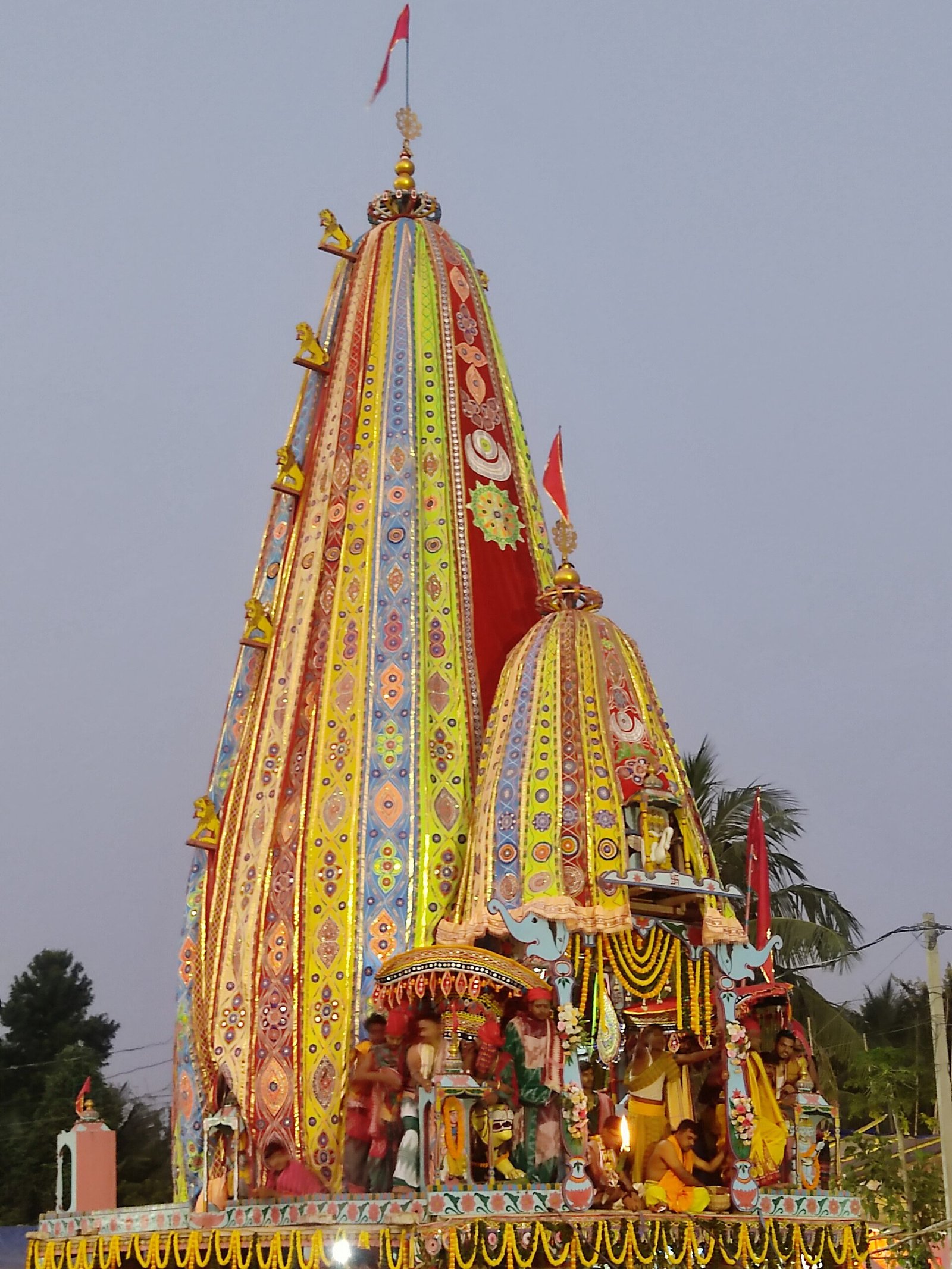
- A living chariot tradition, documented by an exterior photograph of the 2023 festival.
History and development
The Endowments account associates the temple’s development with Somavamsi patronage and records later damage and repair. Its own summary also uses a different century label, so a single exact foundation year is not asserted here.
What can be described responsibly is a complex with successive historical phases and continuing maintenance. The modern exterior and public chariot festival are evidence of a living institution; neither resolves the date of every structural element.
Odisha Commissioner of Hindu Religious Endowments, Biraja Temple.
The Devi and sacred form
Odisha Tourism describes Biraja as a two-armed Goddess overcoming Mahisha, holding the buffalo’s tail and striking with a spear. This differs from the familiar many-armed Durga image. Describing the local form makes that difference visible without reducing it to an interchangeable illustration of the Goddess.
No central-image photograph with secure permission and identification has been selected. The temple exterior and chariot photograph document architecture and public festival life rather than substitute for the murti.
Odisha Tourism, Biraja Temple: sacred form, festivals and transport gateways.
Architecture and temple complex
The Endowments account names the rekha vimana, pidha jagamohana and Chandimandapa among the complex’s elements. These architectural terms describe a sanctuary tower and associated ritual spaces in Odisha’s temple vocabulary.
The broader complex also includes Nabhigaya and subsidiary shrines. Their presence explains why a visit can involve more than the principal Devi sanctuary. The exterior image is captioned as a view of Biraja Temple without assigning every visible feature to one building campaign.
Odisha Commissioner of Hindu Religious Endowments, Biraja Temple.
Worship, rituals and festivals
Goddess worship, Chandi recitation and the autumn festival cycle belong to the institution’s account. The Simhadhwaja chariot tradition adds a public processional form to Biraja’s annual worship. The festival photograph records the 2023 Ratha Jatra, not a current-year schedule.
Nabhigaya’s ancestral rites have a separate purpose from darshan of Biraja. The sacred landscape supports both, but this profile does not provide ritual instructions or promise a religious outcome.
When to visit
The autumn festival period is important for witnessing public celebrations. A broad October–March visiting recommendation from Odisha Tourism should not be read as evidence of uniformly light attendance.
Odisha Tourism, Biraja Temple: sacred form, festivals and transport gateways.
- Peak / Very Busy
- The autumn Goddess and chariot-festival period, documented in state institutional accounts. No queue-time estimate is supplied.
Odisha Tourism and the Commissioner of Hindu Religious Endowments, Biraja Temple. No dependable quieter-day pattern has been established.
Weather and seasonal considerations
The October–March recommendation provides a broad seasonal frame. Current weather and local access should still be checked for the intended date; no unsupported crowd estimate is inferred from climate.
Odisha Tourism, Biraja Temple: sacred form, festivals and transport gateways.
Map and geographic orientation
Regional orientation, without route lines or street detail. Delhi is a geographic reference; these maps do not describe a road journey or cross-border access.
City and transport points give regional context; overlapping points can be explored with zoom or the text key.
India and surrounding region
Regional orientation
- Temple: Biraja Temple, Jajpur, India
- Delhi reference: Delhi, India. Approximate city reference (source precision 0.1 degree); distances are rounded straight-line orientation.
- Major city: Bhubaneswar, India. Approximate city reference, not an entrance.
- Airport: Biju Patnaik Airport, India. Geographic orientation point; terminal entrance and services require a current check.
- Railway station: Jajpur Keonjhar Road railway station, India. Geographic orientation point; terminal entrance and services require a current check.
Natural Earth public-domain land; DataMeet CC0 India outline following the Survey of India depiction. Other political boundaries are omitted. Points identify present-day countries; place markers are orientation points, not entrances.
Planning Your Visit
- Nearest major city
- Jajpur town; Bhubaneswar is the major air gateway
- Temple location
- Jajpur
- State / province / region
- Odisha
- Country
- India
- Nearest airport
- Biju Patnaik International Airport, Bhubaneswar (BBI)
- Nearest major railway station
- Jajpur Keonjhar Road station, distinct from Jajpur town
- Approx. distance from Delhi
- About 1,270 km straight-line; not road distance
- Distance source, endpoints and method
- Delhi distance: great-circle calculation (Earth radius 6,371 km) between the reviewed temple point and approximate Delhi city reference, rounded to 10 km. It is not a road, flight or cross-border itinerary.
- Typical access route
- Approach Jajpur by road from the air or rail gateway. The station named Jajpur Keonjhar Road is not the temple’s town-center location.
- Broad visiting season
- Odisha Tourism recommends October–March as a broad season.
- Important festival periods
- Dussehra / autumn Goddess observances and Biraja’s chariot festival
- Terrain / altitude / stairs / accessibility
- A built temple complex with shrine and ritual spaces. Accessible entrance details have not been independently verified.
- Government tourism / heritage URL
- Government tourism / heritage URL
- Visitor-information sources and checked date
- Reviewed 2026-10-21 against the institutional sources linked below. Approximate distance endpoints and methods are qualified separately; this is not a live timetable.
Practical temple information
- Current official timing source
- Current official timing source
- Practical access note
- Confirm current ritual, entry and assistance arrangements through the temple’s responsible institution. Photography permission is separate from an image’s copyright license.
Last verified: . Check the linked institution for changed arrangements.
Nearby sacred and cultural places
The Baitarani, Varahanatha and Jajpur’s ghat landscape provide context for the town’s interwoven sacred traditions. They are related places within Jajpur’s cultural geography, not a prescribed circuit or a claim that each belongs to the selected Peetha list.
Jajpur Municipality, sacred and cultural places.
Photos and gallery

Watch / Explore Further
Further reading
- Subhashree Mishra, Goddess Biraja and Her Chariot Festival, Odisha Review, September–October 2021, printed p.69 onward
- D. C. Sircar, The Sakta Pithas (1948), numbered Pithanirnaya table, pp. 35–37
Related reading
Sources and method
- Odisha Commissioner of Hindu Religious Endowments, Biraja Temple
- Odisha Tourism, Biraja Temple: sacred form, festivals and transport gateways
- Subhashree Mishra, Goddess Biraja and Her Chariot Festival, Odisha Review, September–October 2021, printed p.69 onward
- Jajpur Municipality, sacred and cultural places
Textual classifications follow the 51-entry PN working list and the eighteen-seat hymn grouping. Our source method distinguishes sacred narrative, institutional testimony and historical evidence. Image sources and reuse terms accompany each photograph.