
Hinglaj Mata Temple
Hinglaj Mata / Hingula · Hingol valley, Las Bela, Balochistan, Pakistan
Shakti Peetha
Hinglaj Mata’s cave shrine in Balochistan is a living Hindu pilgrimage center associated with Hingula in the Pithanirnaya tradition.

Quick facts
- Primary deity
- Hinglaj Mata / Hingula
- Location
- Hingol valley, Las Bela, Balochistan, Pakistan
- Classification
- PN 51 working list
- City / regional gateway
- Karachi, regional transport gateway
- Airport
- Jinnah International Airport, Karachi
- Major railway station
- Karachi Cantonment, major gateway station; no railway to the cave
- Approx. distance from Delhi
- About 1,210 km straight-line; not road distance
- Major festival periods
- Annual Hinglaj pilgrimage in April
On this page
Spiritual importance and significance
Hinglaj gives the worship of the Mother Goddess a distinctive place in the arid landscape of Balochistan. The shrine occupies a cave near the Hingol River. Its continuing importance is especially visible among Hindu communities in Pakistan, for whom the yatra brings worship, family memory and community gathering into the same landscape.
In the selected Pithanirnaya list, Hingula is associated with Sati’s brahmarandhra, the crown of the head. The Goddess is Koṭṭarī and the accompanying Bhairava is Bhīmalocana. Hinglaj Mata is the familiar name in present-day pilgrimage. These textual names describe one list tradition; they should be read alongside the local names rather than used to replace them.
Pakistan Department of Archaeology and Museums, Hinglaj Devi site record.
Sacred story and textual tradition
The Sati narrative connects a dispersed divine body with particular sacred seats. At Hinglaj, that larger sacred geography meets stories of the cave, the Mother and the pilgrim’s approach. Pakistan’s heritage account also records the name Nani and a history of recognition beyond the Hindu community. This shared vocabulary does not make the forms of worship identical.
The cave passage and its associations with renewal belong to the documented pilgrimage tradition. They express how devotees understand entry into the Mother’s sacred place. Neither a narrative of divine presence nor a geological feature establishes a construction date for a temple.
Department of Archaeology and Museums, Hingol cultural landscape and pilgrimage.
What makes this temple distinctive?
- A cave sanctuary in a rocky river valley rather than a large urban temple.
- The names Hinglaj Mata, Hingula and Nani preserve different registers of the site’s religious memory.
- An annual yatra sustained by Pakistan’s Hindu communities, with pilgrimage practices extending into the surrounding landscape.
History and development
Jürgen Schaflechner’s study follows the shrine through changes in roads, pilgrimage organization and Hindu community identity. It dates the establishment of the modern annual festival to the mid-1980s. This is a change in the organization of pilgrimage, not a claim that worship began at that time.
The Makran Coastal Highway altered the practical relationship between the remote shrine and Karachi. The present complex and the scale of the gathering therefore need to be understood through modern developments as well as inherited devotion. UNESCO lists the Hingol Cultural Landscape on Pakistan’s Tentative List; it is not an inscribed World Heritage property.
The Devi and sacred form
The Department of Archaeology and Museums describes a small sacred stone and altar within the cave. The cave setting is integral to the worship of Hinglaj Mata. A conventional sculpted Goddess image should not be substituted as though it documented the central form.
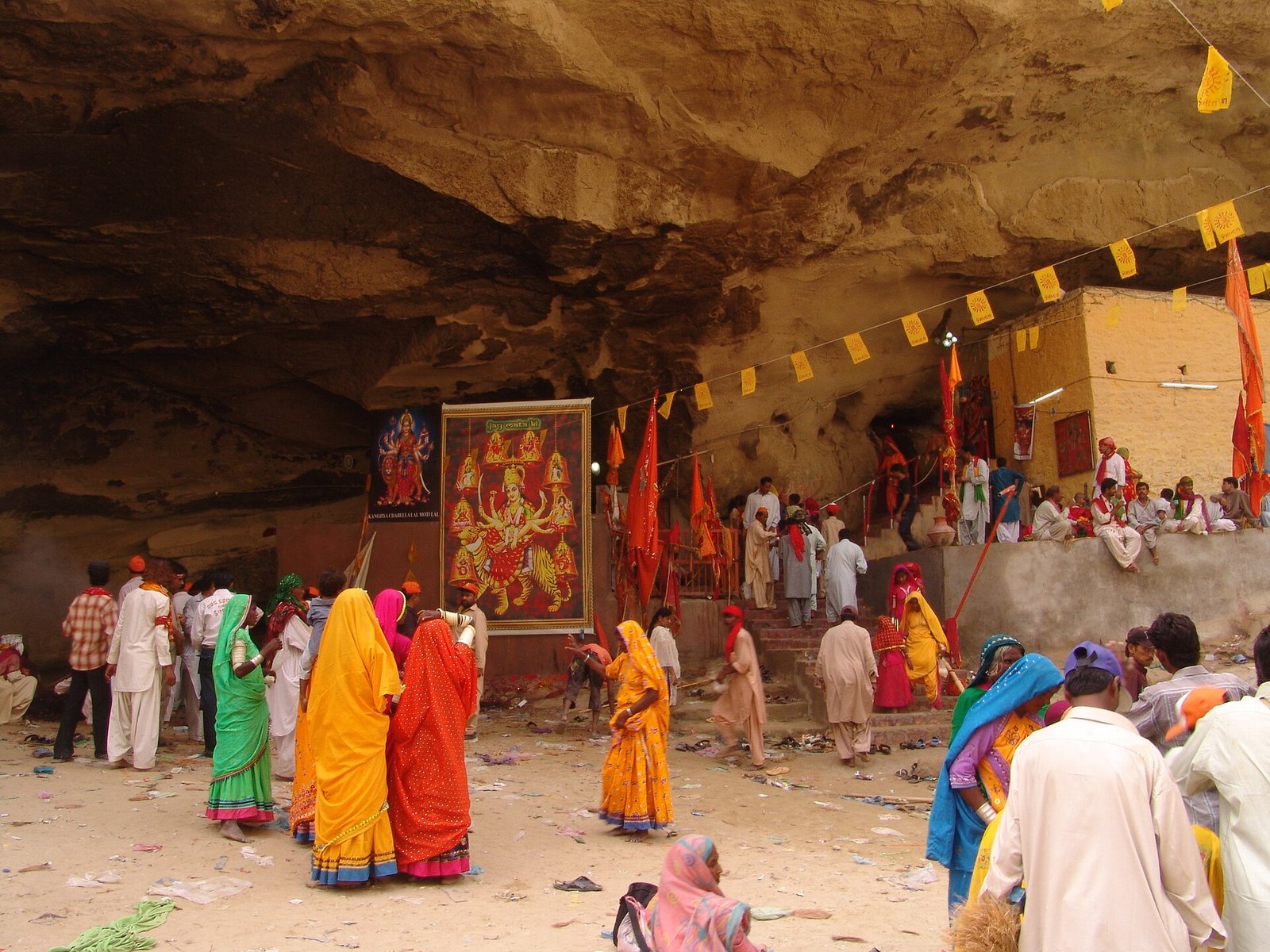
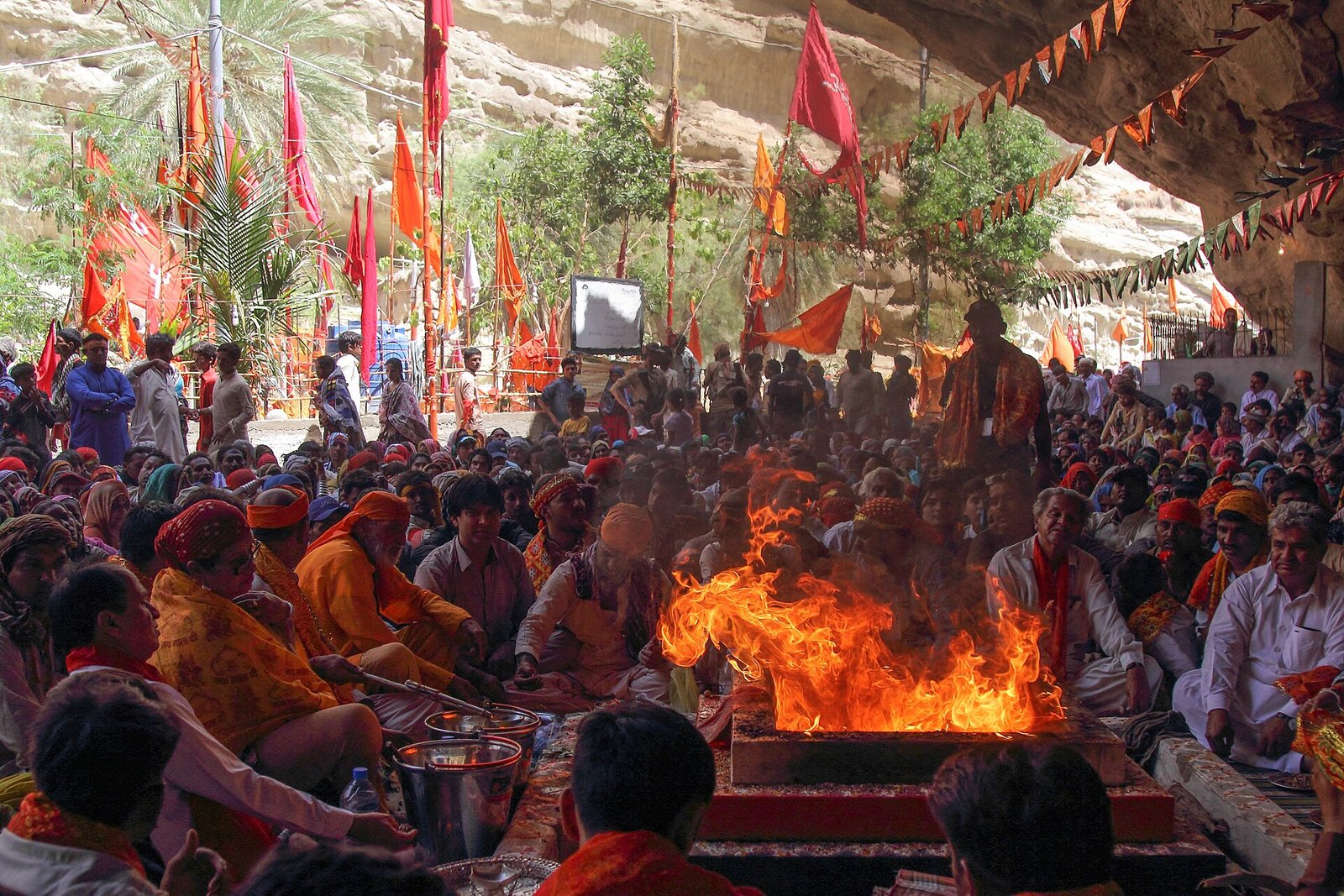
The photographs here show the entrance and a public pilgrimage ritual. They do not claim to reveal or reproduce the sacred object inside the cave.
Department of Archaeology and Museums, Hingol cultural landscape and pilgrimage.
Cave, shrine and surrounding landscape
The broad rock overhang, confined sanctuary and river-valley approach shape this sacred place more directly than a single architectural style. Built surfaces and pilgrimage facilities sit within a much larger geological setting. The exterior image helps distinguish the actual Balochistan cave from similarly named temples elsewhere.
The heritage record discusses the Chandragup and Khandewari mud volcanoes in the wider pilgrimage landscape. They are associated places, not another name for the central cave. No route through them is prescribed here.
Department of Archaeology and Museums, Hingol cultural landscape and pilgrimage.
Worship, rituals and festivals
The April pilgrimage includes gatherings, offerings and ritual activity around the shrine. The havan photograph documents one public scene from 2017, not a fixed order of worship for every year. Schaflechner’s research is useful for understanding how collective pilgrimage is organized and how participants give it meaning.
A description of a public ritual is not an instruction for conducting restricted practice. The site’s local institutions and the communities sustaining the yatra remain the relevant authorities for current observances.
When to visit
April is the principal documented gathering period. Current travel permissions, road conditions and local arrangements need a separate check before departure. The profile does not infer a quieter weekday pattern from the site’s remoteness.
Department of Archaeology and Museums, Hingol cultural landscape and pilgrimage.
- Peak / Very Busy
- The annual April yatra, when pilgrims gather for the organized festival.
Pakistan Department of Archaeology and Museums, Hinglaj landscape record; Schaflechner’s pilgrimage study. No reliable weekly or quieter-period count is published here.
Map and geographic orientation
Regional orientation, without route lines or street detail. Delhi is a geographic reference; these maps do not describe a road journey or cross-border access.
Karachi is a distant regional gateway. No direct rail connection to the cave or cross-border route is implied.
India and surrounding region
Regional orientation
- Temple: Hinglaj Mata Temple, Pakistan
- Delhi reference: Delhi, India. Approximate city reference (source precision 0.1 degree); distances are rounded straight-line orientation.
- Major city: Karachi, Pakistan. Approximate city reference, not an entrance.
- Airport: Jinnah International Airport, Pakistan. Geographic orientation point; terminal entrance and services require a current check.
- Railway station: Karachi Cantonment Railway Station, Pakistan. Geographic orientation point; terminal entrance and services require a current check.
Natural Earth public-domain land; DataMeet CC0 India outline following the Survey of India depiction. Other political boundaries are omitted. Points identify present-day countries; place markers are orientation points, not entrances.
Planning Your Visit
- Nearest major city
- Karachi, regional transport gateway
- Temple location
- Hingol valley, Las Bela
- State / province / region
- Balochistan
- Country
- Pakistan
- Nearest airport
- Jinnah International Airport, Karachi
- Nearest major railway station
- Karachi Cantonment, major gateway station; no railway to the cave
- Approx. distance from Delhi
- About 1,210 km straight-line; not road distance
- Distance source, endpoints and method
- Delhi distance: great-circle calculation (Earth radius 6,371 km) between the reviewed temple point and approximate Delhi city reference, rounded to 10 km. It is not a road, flight or cross-border itinerary.
- Typical access route
- Road access from the Karachi side through the Makran Coastal Highway region, followed by the shrine approach. The map is not a cross-border route.
- Important festival periods
- Annual Hinglaj pilgrimage in April
- Terrain / altitude / stairs / accessibility
- A cave and rocky valley setting. The final approach includes walking; a step-free route and assisted-access facilities have not been independently verified.
- Government tourism / heritage URL
- Government tourism / heritage URL
- Visitor-information sources and checked date
- Reviewed 2026-10-21 against the institutional sources linked below. Approximate distance endpoints and methods are qualified separately; this is not a live timetable.
Practical temple information
- Practical access note
- For current pilgrimage arrangements, confirm access with organizers and the responsible local authorities. Delhi is an orientation reference, not a recommended journey across borders.
Last verified: . Check the linked institution for changed arrangements.
Associated sacred and cultural landscape
The Hingol River valley and the mud-volcano sites discussed in the official heritage record place Hinglaj within a broader pilgrimage landscape. They are presented as context, without a packaged circuit, guaranteed access or estimated driving times.
Department of Archaeology and Museums, Hingol cultural landscape and pilgrimage.
Photos and gallery

Watch / Explore Further
Further reading
- Jürgen Schaflechner, Hinglaj Devi: Identity, Change, and Solidification at a Hindu Temple in Pakistan (Oxford University Press, 2018)
- D. C. Sircar, The Sakta Pithas (1948), numbered Pithanirnaya table, pp. 35–37
Related reading
Sources and method
- Pakistan Department of Archaeology and Museums, Hinglaj Devi site record
- Department of Archaeology and Museums, Hingol cultural landscape and pilgrimage
- UNESCO, Hingol Cultural Landscape: Tentative List entry
- Jürgen Schaflechner, Hinglaj Devi: Identity, Change, and Solidification at a Hindu Temple in Pakistan (Oxford University Press, 2018)
Textual classifications follow the 51-entry PN working list. Our source method distinguishes sacred narrative, institutional testimony and historical evidence. Image sources and reuse terms accompany each photograph.